
You're running operations for an AI data center, and you need to make sure your systems are running like a well-oiled machine. Downtime is your worst enemy, and you can't wait for things to break before you react. Which two monitoring strategies are most critical for keeping your cluster reliable and performant? (Choose two)
Select all correct answers, then click Submit.
Short Explanation
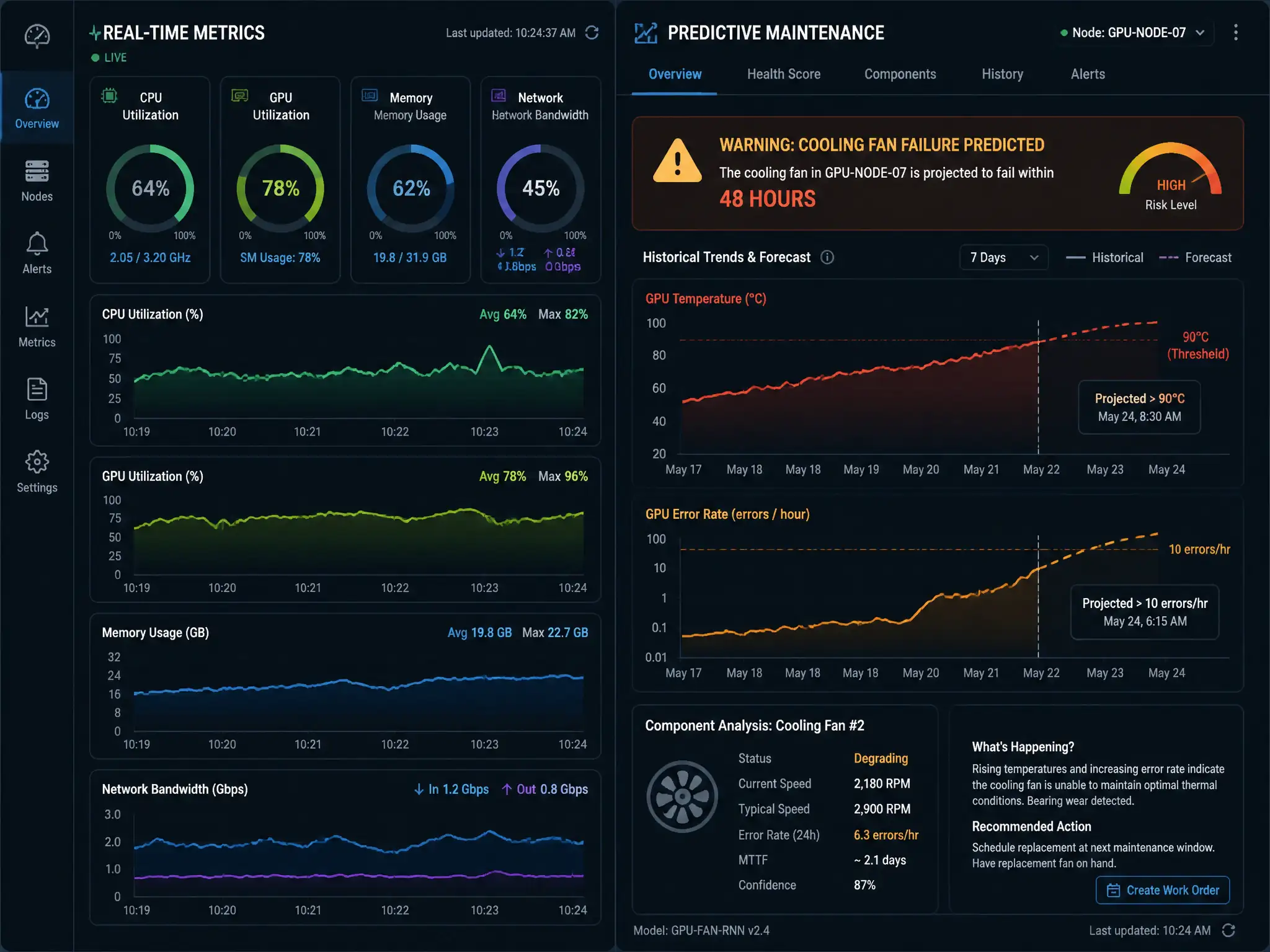
Here's the deal—you can't manage what you don't measure. If you're waiting for manual log checks or weekly reviews to catch a failing GPU, you're already too late—your cluster will be down and your users will be screaming. You need real-time metrics on CPU, GPU, memory, and network throughput, plus predictive maintenance on historical hardware telemetry to swap out failing parts before they take a node offline.
Full Explanation
Maintaining high reliability and continuous performance in a modern AI data center requires a combination of real-time telemetry and predictive analysis. Because deep learning workloads place intense and sustained stress on compute, memory, and network subsystems, failure to monitor these elements leads to operational instability and unplanned downtime.
Deploying a comprehensive monitoring system that captures real-time metrics on CPU, GPU, memory, and network bandwidth usage is essential. This system must gather telemetry across multiple vectors, including GPU utilization, temperature, power draw, CPU load, system memory usage, and network interface throughput. This allows administrators to immediately identify active bottlenecks, resource contention, or software anomalies.
Implementing predictive maintenance algorithms that analyze historical hardware metrics to forecast potential failures leverages historical hardware performance data to predict failures before they happen. For example, tracking slight increases in GPU operating temperatures under identical workloads or monitoring an increase in correctable memory errors can indicate that a cooling fan is failing or a memory module is degrading. By scheduling maintenance based on these insights, operations teams can replace components during scheduled maintenance windows, avoiding catastrophic failures during live production runs.
The incorrect strategies fail for specific reasons. Relying on manual daily checks of system log files and weekly performance reviews is reactive and too slow to address rapid-onset hardware failures or real-time performance degradation, which require immediate automated alerts. Disabling non-essential telemetry logging to minimize host processor and GPU driver overhead is a false economy. The computational overhead of running monitoring agents is negligible, whereas the lack of visibility creates massive operational risks. Setting up daily reboots of all compute nodes during production runs to flush memory leak build-ups is a highly disruptive practice that interrupts running AI workloads and does not address the root causes of memory leaks or resource bottlenecks.
Combining real-time telemetry with predictive modeling creates a robust framework for high-availability AI operations.