
Imagine you are running a massive, production-grade AI inference service that must process real-time user requests 24/7. Your manager is demanding zero downtime, but the CFO just saw last month's power bill and is breathing down your neck to cut energy consumption. What is the best strategy to keep your service highly available while keeping your energy footprint as low as possible?
Select an answer to reveal the explanation.
Short Explanation
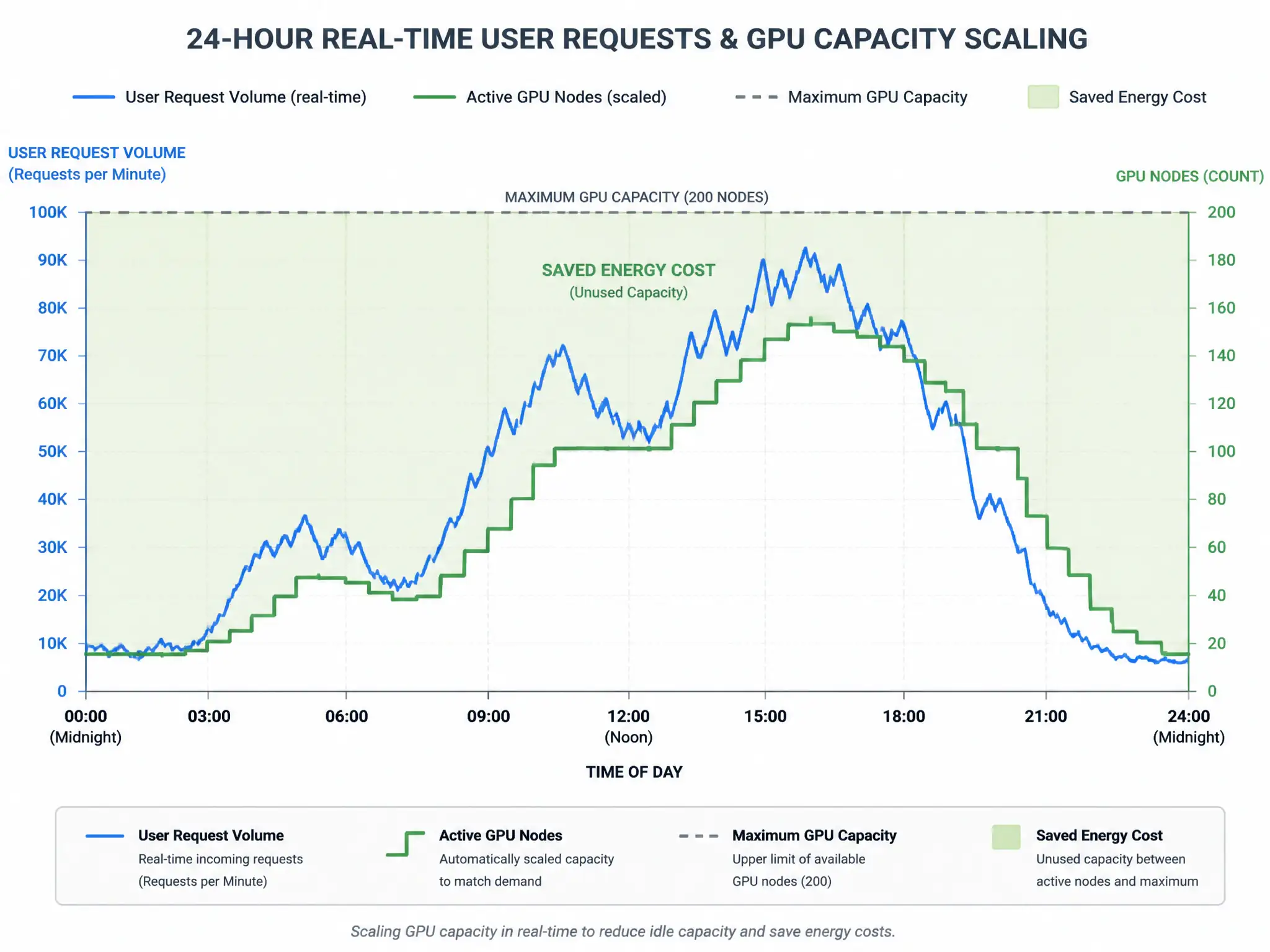
You need to match GPU capacity to real-time demand, so use an auto-scaling group that spins instances up when traffic rises and shuts them down when traffic falls. Static partial capacity wastes power, and off-peak batching breaks real-time response times. Auto-scaling keeps availability high while cutting idle energy use.
Full Explanation
In modern data center operations, maintaining high availability for 24/7 real-time inference while minimizing energy consumption requires dynamic infrastructure management. AI inference workloads are inherently variable, fluctuating based on user traffic patterns throughout the day. A static infrastructure approach fails to balance these opposing requirements.
Implementing an auto-scaling group of GPUs addresses both goals. By utilizing cloud-native orchestration, such as Kubernetes with custom metrics or cloud provider auto-scalers, the system monitors live traffic indicators such as request queue depth, latency, or GPU utilization. When load increases, the auto-scaler provisions additional GPU instances to handle the traffic, ensuring the service meets its latency SLAs and remains highly available. When traffic decreases, the auto-scaler automatically terminates idle instances, eliminating unnecessary idle power consumption.
The drawbacks of the other approaches are clear. A static GPU cluster running at a fixed partial capacity leads to massive energy waste during low-load periods, yet still risks performance degradation if a sudden traffic spike exceeds the cluster's static ceiling. Batching requests and processing them during cheap off-peak hours is highly energy-efficient and works well for offline processing, but it is completely incompatible with a real-time service where low latency is a key requirement. Running a single massive GPU continuously represents a single point of failure, failing the high availability requirement; if that GPU or its host server crashes, the entire service goes offline.
Therefore, dynamic auto-scaling is the industry-standard approach for matching compute resources directly to real-time workload demands.