An international bank is architecting a real-time, global credit card fraud detection pipeline. The pipeline must ingest billions of transaction records, execute deep learning-based tabular models with sub-millisecond response times, and scale dynamically without service interruption. Which combination of NVIDIA infrastructure and software frameworks is optimized to meet these high-throughput requirements?
Select an answer to reveal the explanation.
Short Explanation and Infographic
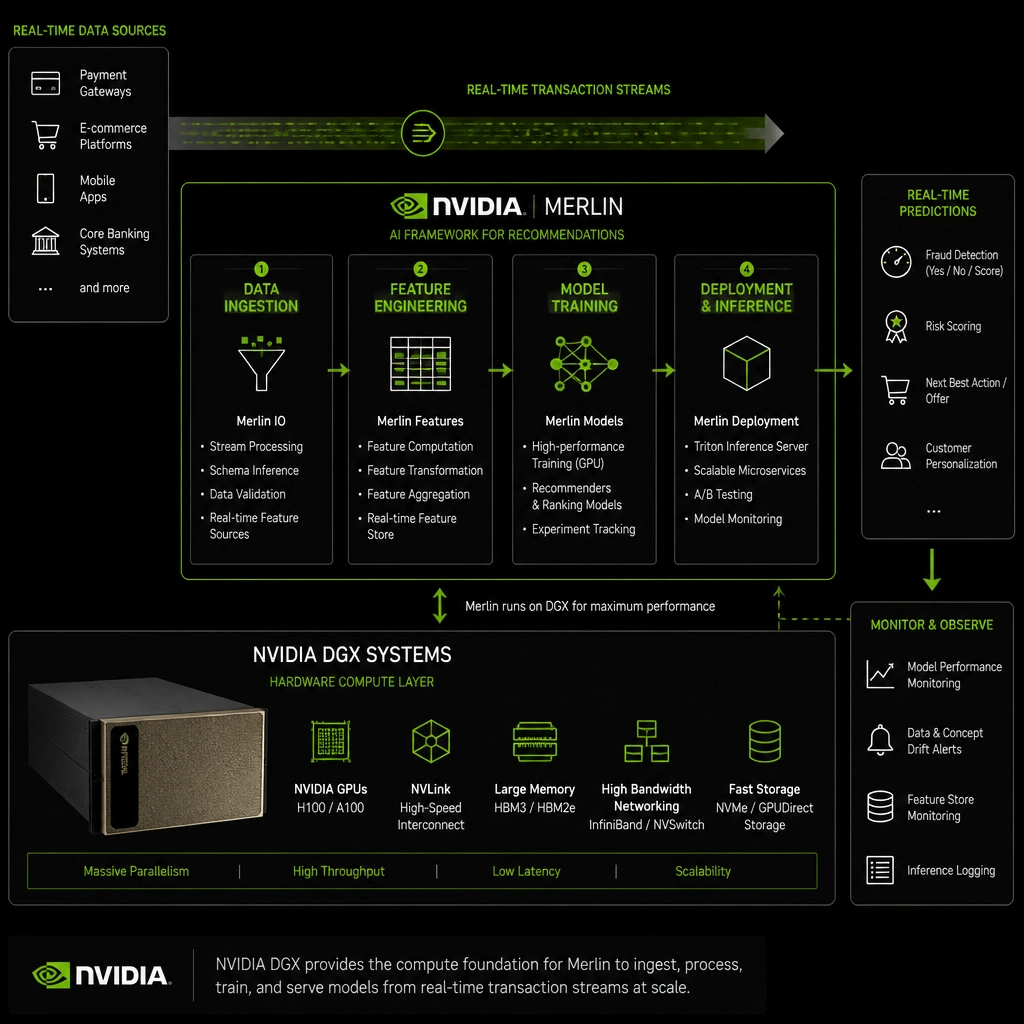
Okay, let's dive in. If you're building a global system to catch credit card fraud in real time, you are dealing with massive scale and zero room for delay. If the swipe takes more than a split second to analyze, the customer is standing there annoyed, or worse, the bad guys get away with the cash. You need serious horsepower and software built for speed. NVIDIA's DGX systems are the heavy lifters here — they are purpose-built AI supercomputers packed with high-speed interconnects. But the secret sauce is NVIDIA Merlin. Merlin is specifically optimized to handle huge recommender systems and tabular data pipelines. In fraud detection, you're constantly looking at tabular transaction logs and comparing them to user profiles. Merlin accelerates this data loading and model execution so you get decisions back in milliseconds. Running this on normal CPUs or desktop Quadro cards is going to bottleneck your throughput. And Jetson? That's an edge device for things like robotics or smart cameras, not a global bank's core transactional brain!
Full explanation below image
Full Explanation
Enterprise-grade, real-time fraud detection systems require high-performance computing platforms capable of scaling to handle massive volumes of transaction data with minimal latency. The database operations and deep learning models associated with fraud detection are typically based on tabular data and sequential patterns, similar to large-scale recommender systems. Deploying these workloads on NVIDIA DGX platforms provides the necessary hardware foundation. DGX systems integrate multiple high-performance enterprise GPUs (such as the A100 or H100) with high-bandwidth interconnects (NVLink and NVSwitch) and high-speed networking (InfiniBand/Ethernet). This architecture minimizes communication latency between GPUs, allowing for efficient distributed training and inference. On the software side, NVIDIA Merlin is an application framework optimized for deep learning recommender systems and large-scale tabular dataset processing. Merlin accelerates the entire pipeline—from data preprocessing and feature engineering (via NVTabular) to model training and deployment. This tight integration of hardware (DGX) and software (Merlin) enables the sub-millisecond response times required to assess fraud risk before transactions are approved. Reviewing the incorrect options: Generic CPU-based servers (Option A) lack the massive parallel processing capabilities of GPUs, and CUDA cannot run directly on CPU hardware without GPU acceleration. NVIDIA Quadro GPUs (Option C) are workstation-class GPUs designed primarily for professional visualization, computer-aided design (CAD), and rendering, rather than the high-density, multi-GPU scale required for global transaction processing. NVIDIA Jetson devices (Option D) are low-power, system-on-module (SoM) edge accelerators designed for embedded systems, robotics, and edge AI, not for central data center core pipelines processing global banking transactions.