A research hospital is deploying deep learning models to accelerate DNA sequencing and automate the segmentation of organs in MRI scans. Which domain-specific NVIDIA software platform is designed to provide pre-trained models and developer frameworks for healthcare applications?
Select an answer to reveal the explanation.
Short Explanation and Infographic
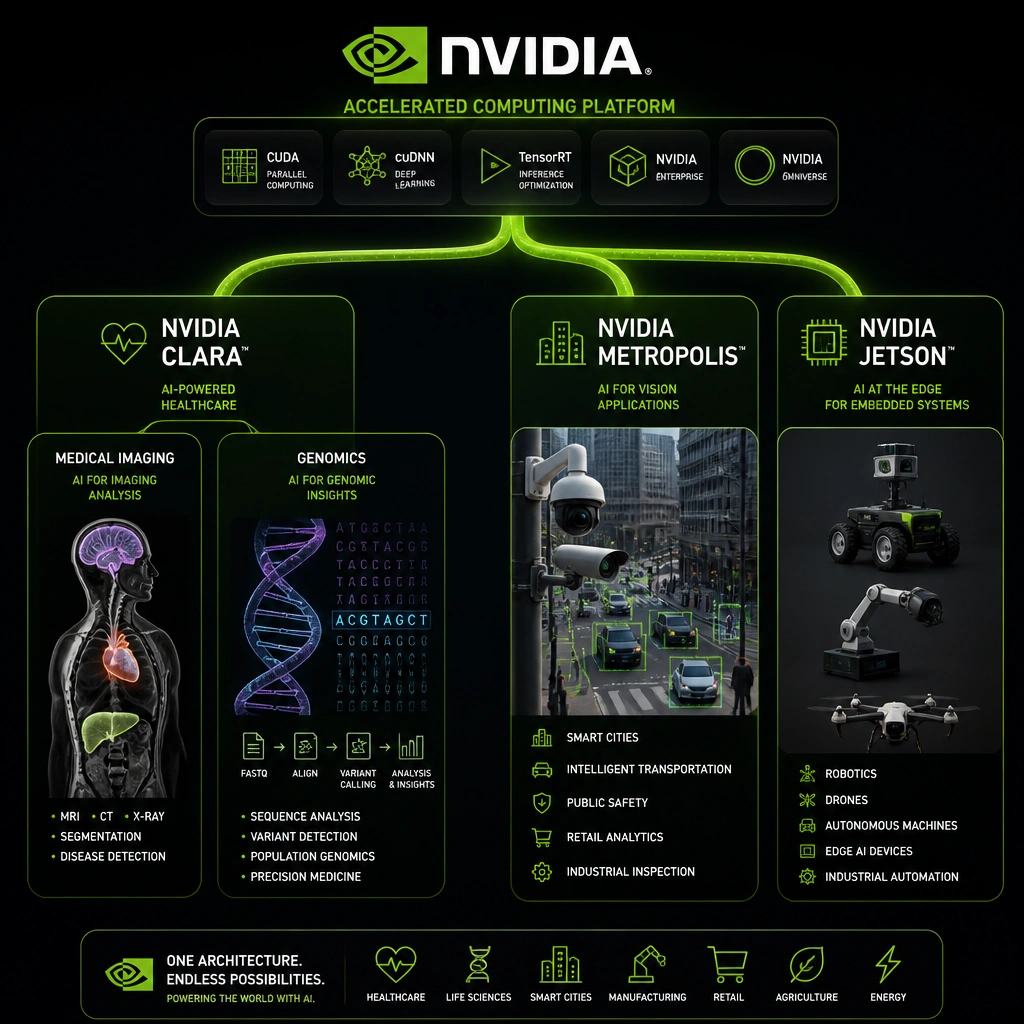
If you are working in healthcare, you need to know about Clara. NVIDIA developed Clara specifically to give medical researchers and developers a massive head start. Instead of writing imaging or genomics pipelines from scratch, Clara provides pre-trained models and software frameworks for things like MRI image reconstruction, organ segmentation, and genomic sequencing. Now, don't confuse this with Jetson, which is for low-power edge devices, or Metropolis, which is for smart cities and video analytics. And while TensorRT is great for optimizing models, it's a general tool, not healthcare-specific. For medical imaging and DNA analysis, Clara is the right answer.
Full explanation below image
Full Explanation
NVIDIA Clara is an application framework and suite of software developer kits (SDKs) tailored for the healthcare industry. It is divided into distinct application areas: Clara Imaging (for medical imaging, reconstruction, and segmentation using deep learning), Clara Parabricks (for high-throughput genomic analysis), and Clara Holoscan (for real-time medical device sensor processing). Clara provides developers with specialized pre-trained models, libraries, and reference pipelines that drastically reduce time-to-market and computational overhead. In contrast, NVIDIA Jetson is an embedded hardware-software platform for robotics, NVIDIA Metropolis is a framework for smart city and video analytics solutions, and NVIDIA TensorRT is a general-purpose model optimizer and runtime library used across all domains to accelerate deep learning inference.