You are setting up an MLOps pipeline for a data science team that is rapidly iterating on deep learning architectures. Which platform component acts as the definitive directory for cataloging model versions, storing associated metadata, and tracking lineage from training to production?
Select an answer to reveal the explanation.
Short Explanation and Infographic
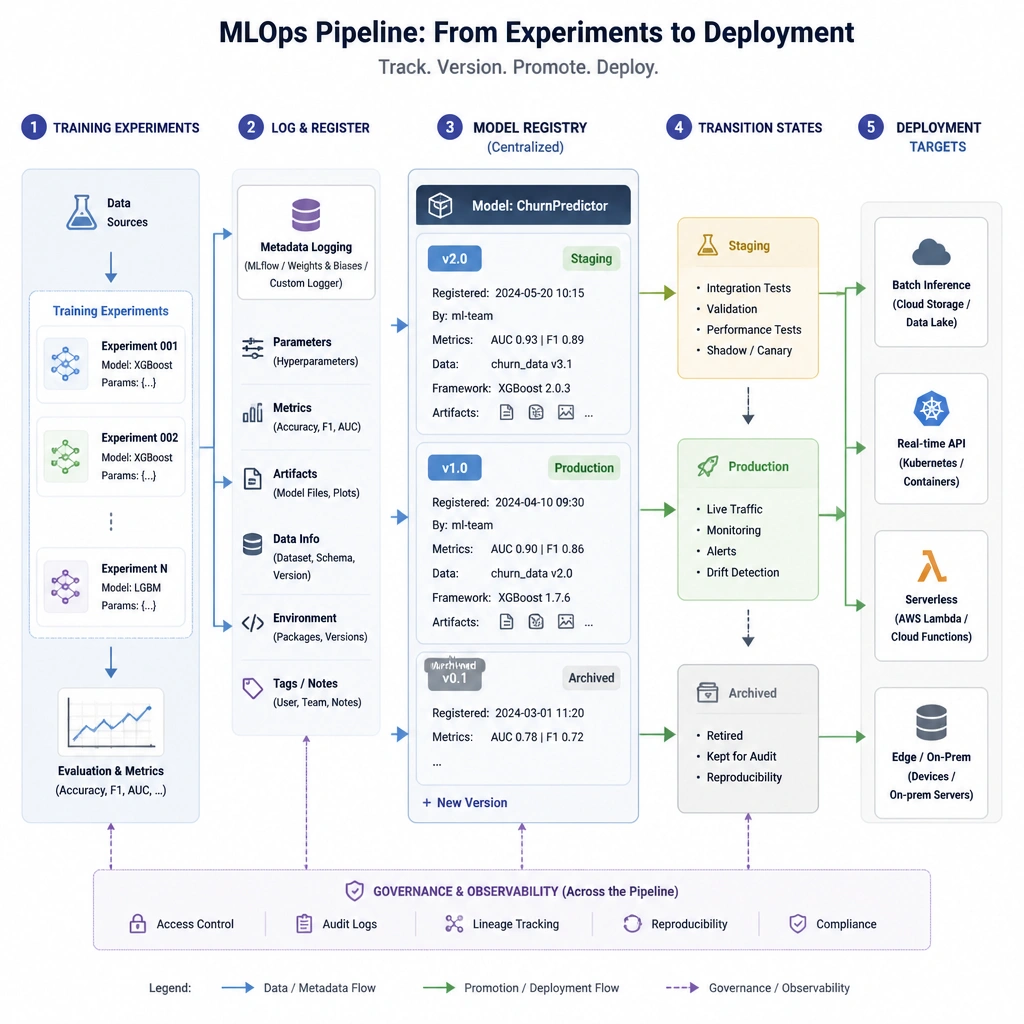
Imagine your team is training dozens of models a week, changing hyperparameters, tweaking architectures, and saving weights. If you don't have a single, organized place to keep track of all those versions, you're going to end up in absolute chaos. Someone will deploy 'model_v2_final_v3.bin' and nobody will know how it was trained! That's why you need a Model Registry. Think of it like a central library for your model assets. It doesn't just store the files; it tracks the lineage, version history, and performance metrics, and lets you manage the transition from staging to production. An artifact repository can hold raw files, but it doesn't understand the lifecycle of a machine learning model like a registry does.
Full explanation below image
Full Explanation
In an MLOps (Machine Learning Operations) architecture, managing the lifecycle of machine learning models requires specialized version control systems. While traditional software engineering relies on repositories for source code, machine learning requires tracking code, data, hyperparameters, and resulting model binaries. A Model Registry serves as the centralized repository designed specifically for this purpose. It manages model versions, stores metadata (such as training parameters and validation metrics), logs lineage, and orchestrates stage transitions (e.g., Development, Staging, Production). This differs from a general-purpose artifact repository, which merely stores raw binaries without model-centric metadata, or orchestration platforms that focus on task execution rather than state and version management.