An operations manager is tasked with maintaining maximum uptime and peak efficiency in a data center hosting dense GPU clusters for mission-critical AI workloads. Which two practices are essential for managing and monitoring this high-density environment? (Choose two)
Select all correct answers, then click Submit.
Short Explanation and Infographic
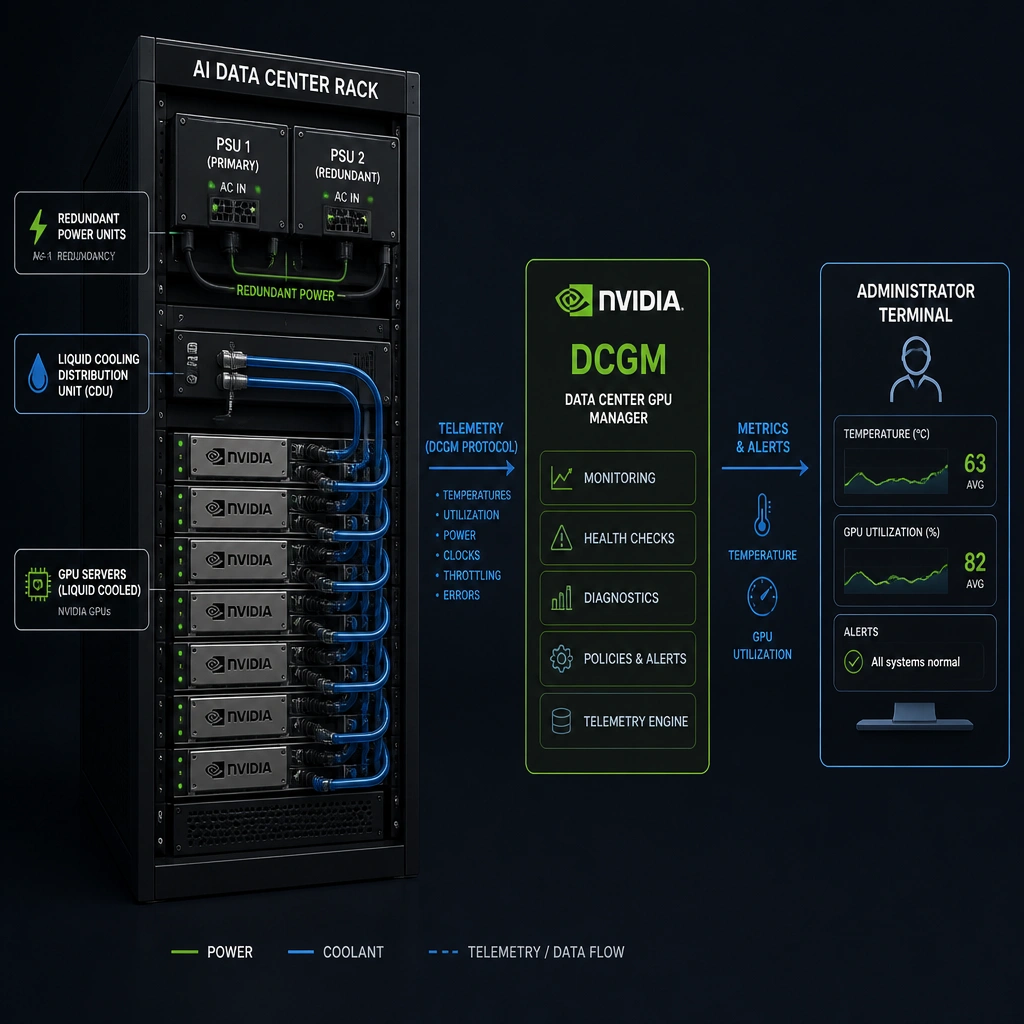
Pay close attention here, because high-density AI clusters will bite you in production if you don't monitor them properly. A rack full of modern GPU servers draws a massive amount of power and dumps out a crazy amount of heat. If your power grid blips or your AC units fail, your entire operation goes dark instantly. That's why you absolutely need redundant power (like N+1 setups) and backup cooling systems to keep the air flowing. Now, how do you know what's going on inside those servers? You don't guess! You use NVIDIA DCGM—Data Center GPU Manager. It'll watch your GPUs, track their health, keep track of their thermals, and catch hardware errors before they ruin a multi-day training job. Relying on basic CPU tools or cutting down on backups is a recipe for disaster. Keep your power redundant, keep your monitoring GPU-specific, and you'll sleep much better at night. Let's keep rolling.
Full explanation below image
Full Explanation
Managing a modern AI data center presents unique operational challenges due to the high power density and thermal output of GPU-accelerated servers. A single rack of high-performance GPU nodes (such as NVIDIA DGX systems) can draw tens of kilowatts, requiring specialized power and cooling infrastructures. To ensure reliability, operations teams must implement redundant hardware infrastructure (Option B), such as N+1 or 2N configurations for cooling and power distribution units (PDUs). This redundancy guarantees that the failure of a single cooling loop or electrical circuit does not cause cluster-wide thermal runaway or abrupt system shutdowns. On the software side, teams must utilize specialized monitoring tools like NVIDIA Data Center GPU Manager (DCGM) (Option A). DCGM is a suite of tools designed specifically for managing and monitoring NVIDIA GPUs in clustered environments. It provides low-overhead access to critical telemetry—such as GPU utilization, temperature, power consumption, memory health (including ECC errors), and hardware throttling events—and allows for group configuration and diagnostic testing. Standard CPU-focused monitoring tools (Option D) are insufficient because they lack visibility into GPU-specific registers and states. Restricting workloads to off-peak hours (Option C) is highly inefficient for expensive, enterprise-grade AI clusters that must run continuously to maximize ROI. Reducing backups (Option E) risks data loss and does not contribute to data center uptime or operational reliability.