Your organization is dealing with massive, multi-terabyte datasets containing complex relationship graphs and 3D geospatial telemetry. The lead data scientist needs to render high-fidelity, interactive visualizations of this data to trace model performance trends without hitting CPU bottlenecks. Which two GPU-accelerated solutions from the NVIDIA ecosystem should you implement? (Choose two)
Select all correct answers, then click Submit.
Short Explanation and Infographic
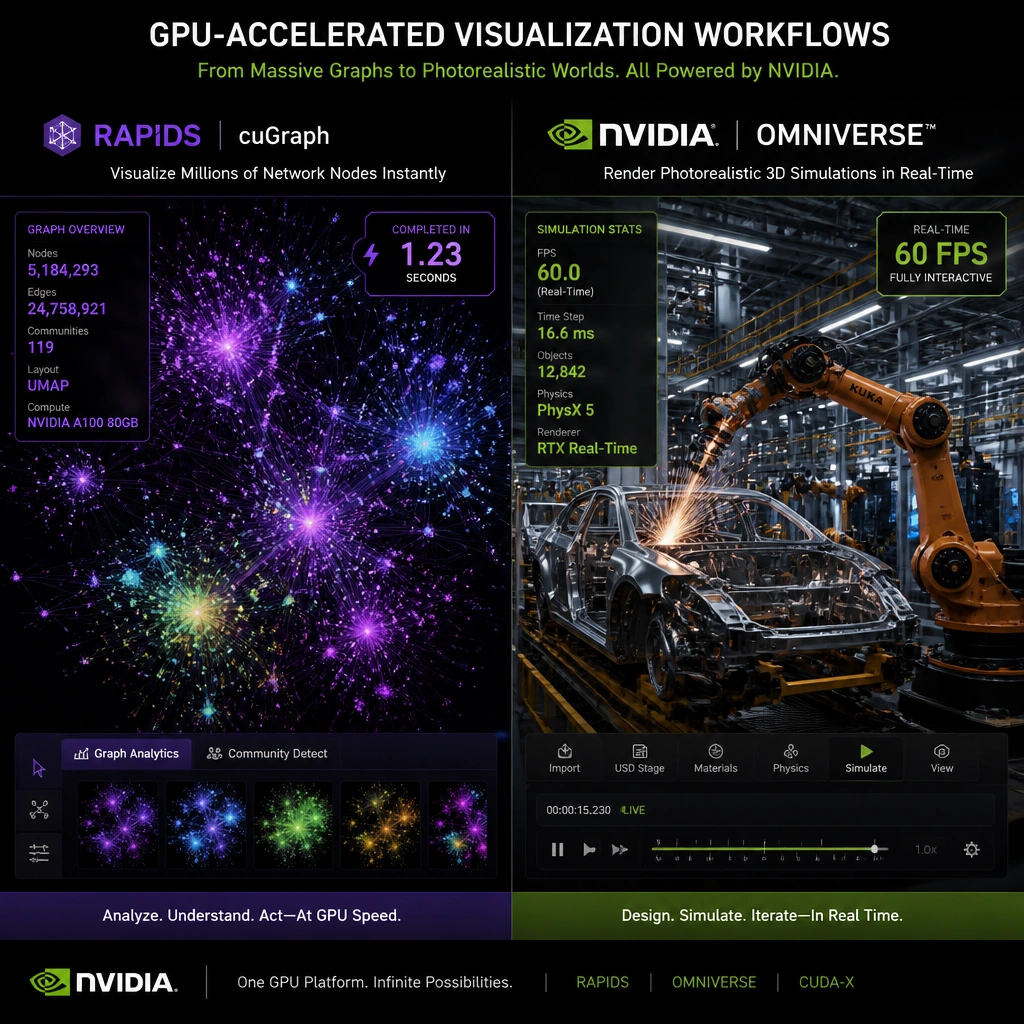
Here's the deal: when you are dealing with millions of nodes in a network graph or trying to render photorealistic 3D simulations, your CPU-based visualization tools are going to choke. Think of it like trying to paint a giant mural with a single toothpick—not going to happen! In the real world, we need the massive parallel horsepower of GPUs to draw these complex visuals in real time. That's where NVIDIA Omniverse and RAPIDS cuGraph come in. Omniverse is this incredible platform for real-time 3D design and simulation, using RTX ray tracing to make things look beautiful and render instantly. And if you've got massive web-like relationship graphs, RAPIDS cuGraph runs those network analytics directly on GPU memory, turning what used to take hours on a CPU into a task that takes seconds. Standard tools like ggplot2 or Tableau are great for basic charts, but for heavy-duty AI data, they just can't keep up. Trust me on this one! Got it? Sweet. Let's keep rolling.
Full explanation below image
Full Explanation
Large-scale data visualization, particularly in fields involving high-dimensional deep learning inputs, 3D environments, and large-scale graph networks, presents significant computational bottlenecks for traditional CPU-bound tools. To handle these demands efficiently, organizations leverage GPU-accelerated software. NVIDIA Omniverse (Option B) is an extensible platform built on Universal Scene Description (USD) and NVIDIA RTX technology. It enables real-time 3D simulation and photorealistic rendering by harnessing GPU parallel processing, allowing engineers and data scientists to visualize complex physical models and datasets. RAPIDS cuGraph (Option D) is part of the RAPIDS suite of open-source software libraries. It provides a collection of GPU-accelerated graph algorithms that integrate seamlessly with the PyData ecosystem. By keeping graph data in GPU memory (VRAM) and executing algorithms in parallel, cuGraph allows users to analyze and visualize massive network topologies and relationship data in a fraction of the time required by CPU-based packages. In contrast, ggplot2 in R (Option A), standard Tableau (Option C), and traditional Power BI (Option E) rely on CPU processing for rendering and data manipulation, which limits their scalability and performance when working with large-scale or real-time AI datasets.