When designing an enterprise infrastructure platform to support multiple data science teams, what is the primary benefit of deploying AI workloads within virtualized environments (such as VM-based or containerized orchestrations with vGPU support)?
Select an answer to reveal the explanation.
Short Explanation and Infographic
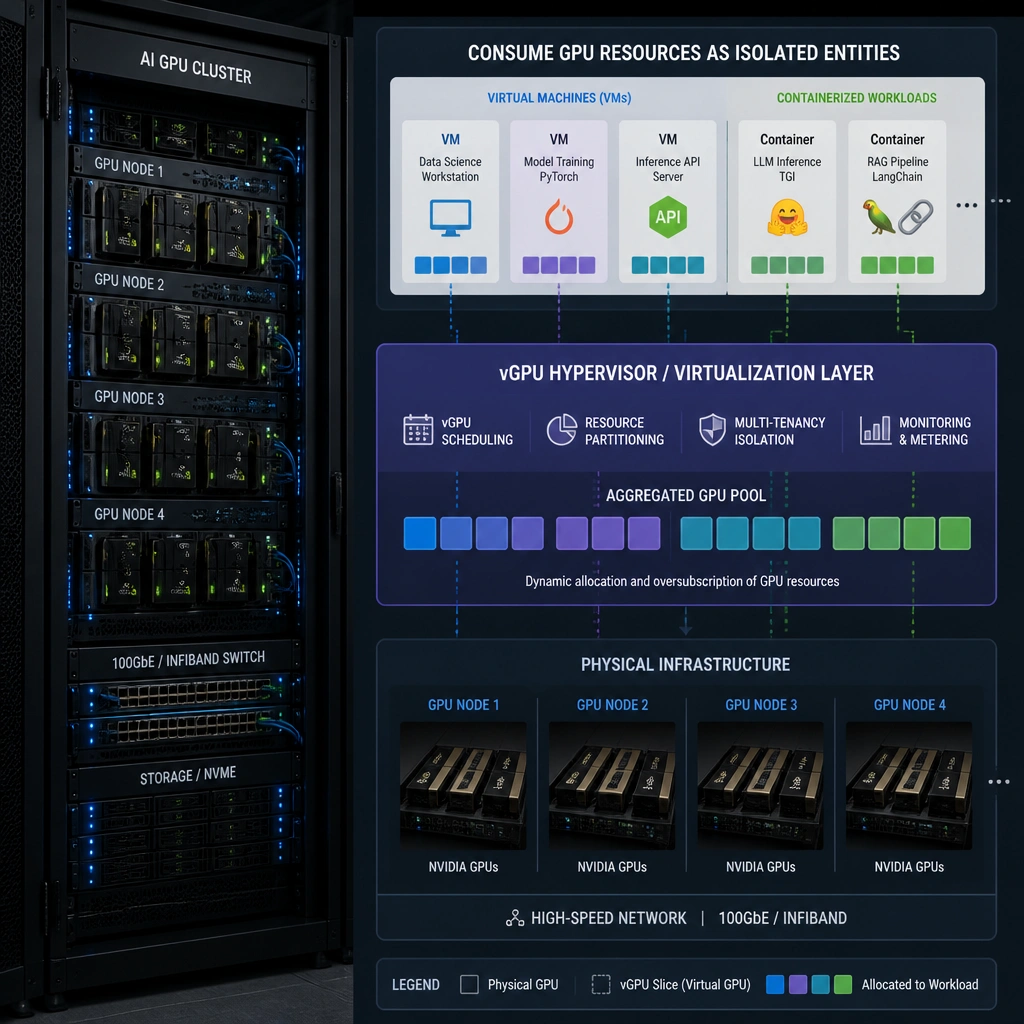
Think of it like this: in the old days, if a data scientist needed a GPU, you had to physically wheel a server into their office. Not very scalable! Today, we use virtualized environments and technology like NVIDIA vGPU to chop up physical GPU resources and serve them up dynamically. By running your AI workloads inside virtual machines or containers, you gain massive flexibility. Need to scale a training job across ten physical servers? Easy. Need to isolate a development environment so a rogue script doesn't crash your production inference server? Done. Virtualization abstracts the hardware, making it simple to manage, scale, and share expensive resources across the whole enterprise. Trust me, in a large company, you cannot survive without virtualization!
Full explanation below image
Full Explanation
In enterprise environments, deploying AI workloads directly on bare-metal servers can lead to resource fragmentation, poor utilization, and administrative bottlenecks. Virtualization—achieved through Virtual Machines (VMs) or containerized orchestration platforms (like Kubernetes) combined with technologies like NVIDIA vGPU—addresses these issues by abstracting the physical hardware.
The primary advantage of virtualization for AI workloads is the ability to easily provision, isolate, and scale resources across multiple physical machines. Virtualization allows administrators to slice a single physical GPU into multiple virtual GPUs (vGPUs) with dedicated frame buffer memory and compute power. This enables multiple smaller workloads (such as exploratory data analysis or inference) to run securely on the same physical card. Conversely, virtualization platforms can aggregate and orchestrate multi-node clusters, making it seamless to scale out massive training jobs across several physical GPU servers. Features like VM migration, automated scaling, and environment templating (e.g., Docker containers) streamline operations, ensure environment consistency, and maximize hardware ROI.
Let's analyze why other options are incorrect: Eliminating physical GPU hardware: Virtualization does not replace the need for physical GPUs. Emulating complex parallel CUDA workloads on host CPUs is extremely slow and impractical for modern deep learning. Locking to a single physical machine: Virtualization's strength is flexibility and migration, not pinning workloads to a single machine. While pins (affinity rules) can be set, they are not the primary benefit of virtualization itself. * Automatically compiling python code: Virtualization deals with infrastructure abstraction and isolation at the OS/hardware layer, not code compilation or software optimization, which are handled by compilers (like XLA) and deep learning frameworks.