Imagine you are managing a shared AI cluster where the computer vision team is doing heavy training, the NLP team is running real-time chatbots, and the data science team is spinning up hyperparameter sweeps. You notice some GPUs are sitting completely idle while others are pinned at 100%, causing massive job queues. What is the most efficient strategy to maximize cluster-wide GPU utilization and ensure fair access?
Select an answer to reveal the explanation.
Short Explanation and Infographic
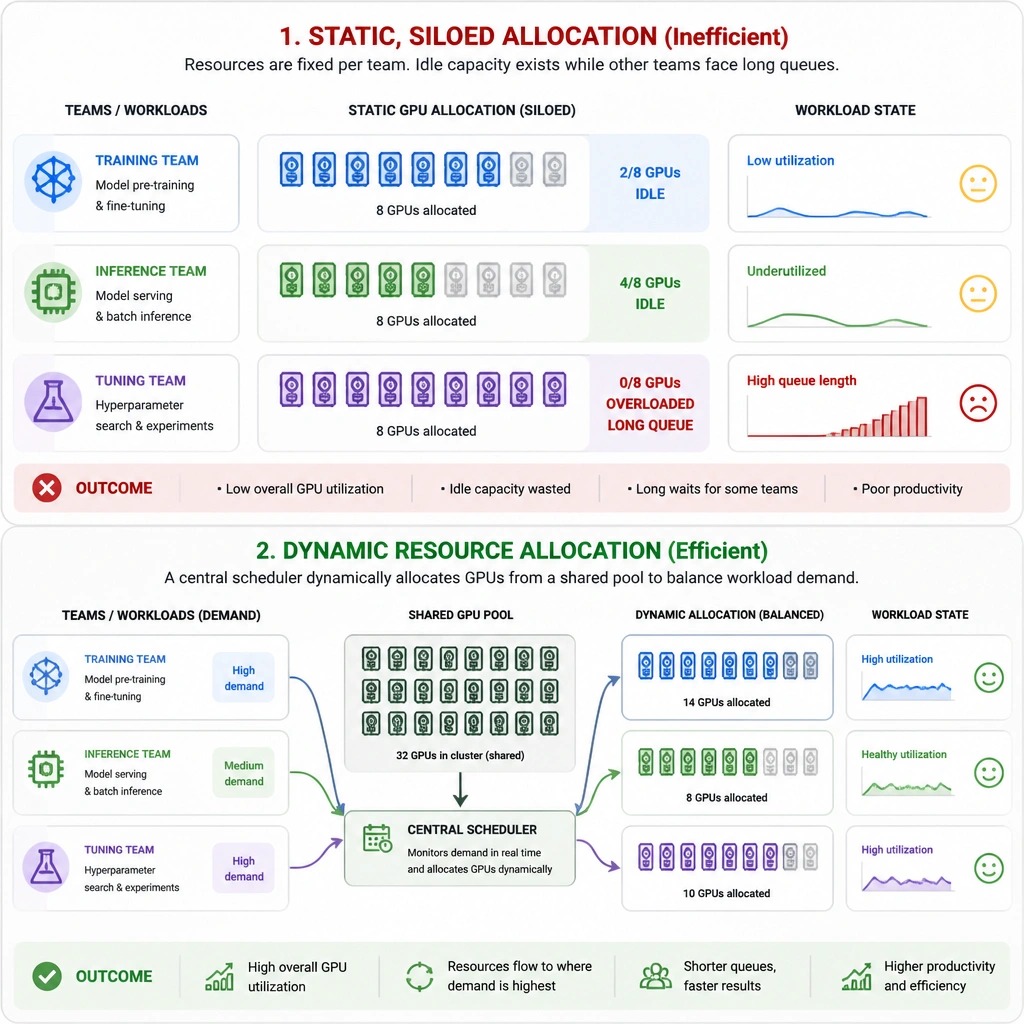
Here's the deal: if you carve up your expensive GPU cluster into fixed static pools for each team, you are going to have a bad time. One day the NLP guys are on vacation and their GPUs sit idle, while the computer vision team is screaming because their training jobs are stuck in a queue. That's why we use dynamic resource allocation. Think of it like a smart highway system that opens and closes lanes based on traffic flow. In the real world, tools like Kubernetes schedulers or NVIDIA's cluster management software can slide resources where they're needed most right now, ensuring you get the absolute most out of your hardware investment. Trust me, your boss will thank you when the GPU utility bill matches actual output! Got it? Sweet. Let's keep rolling.
Full explanation below image
Full Explanation
In a multi-tenant AI infrastructure, workload requirements are highly variable. Training deep learning models is compute-intensive and can run for days, while inference tasks require low-latency, intermittent compute, and hyperparameter tuning involves running many small, parallel trials. Using a static allocation approach (Option A) leads to resource silos, where some GPUs are over-committed and others sit idle, failing to maximize return on investment. Limiting concurrent tasks (Option D) artificially throttles developer productivity instead of optimizing infrastructure. While training is resource-intensive, prioritizing it over inference (Option C) is impractical because inference directly serves end-users and requires strict SLA compliance. Implementing dynamic GPU resource allocation (Option B) is the industry best practice. Schedulers (such as Kubernetes with specialized GPU plugins) monitor real-time resource demands and queue lengths, shifting available GPU capacity to where it is needed most. When a training run finishes or inference traffic drops, those resources are instantly reclaimed and given to waiting jobs. This ensures maximum cluster utilization, minimizes idle power waste, and prevents performance bottlenecks across all teams.