A research institution is training a massive deep convolutional neural network for automated medical scan analysis. Because of the size of the dataset, single-GPU training is taking weeks. The infrastructure engineer needs to scale the workload across a distributed cluster consisting of multiple nodes, each equipped with eight GPUs. Which combination of NVIDIA software solutions will help them resolve both inter-node communication latency and CPU-bound data loading bottlenecks?
Select an answer to reveal the explanation.
Short Explanation and Infographic
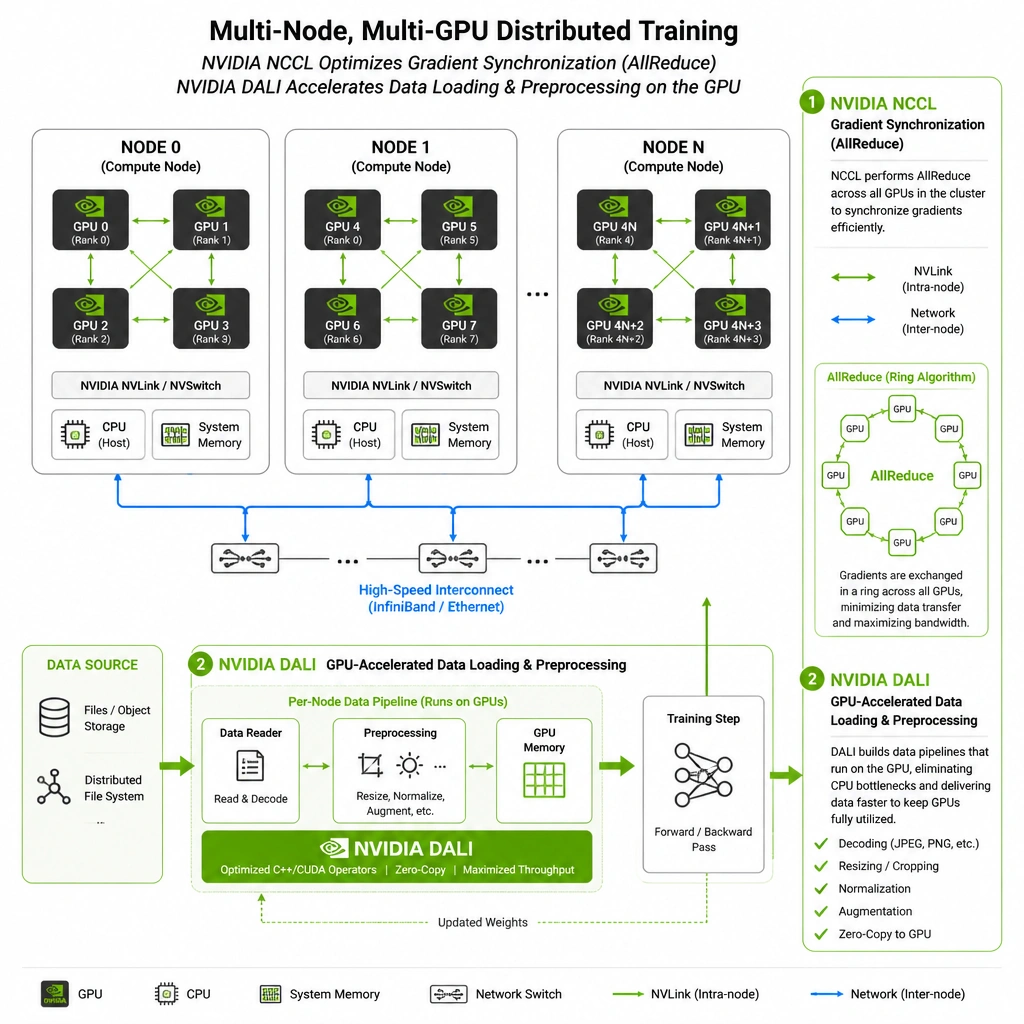
Check this out: when you're training a huge model across a cluster of nodes, you have two major speed bumps. First, the GPUs have to talk to each other to share gradient updates—if they use slow standard network protocols, they stall. Second, you have to feed those GPUs with preprocessed images fast enough. To solve the communication problem, you need NCCL (NVIDIA Collective Communications Library). It provides highly optimized inter-GPU communication routines. To solve the data feeding problem, you use DALI to offload image decoding and data prep to the GPU. Combining NCCL and DALI is the secret sauce for scaling up distributed training. Trust me on this!
Full explanation below image
Full Explanation
Distributed deep learning across multiple GPUs and nodes requires specialized software to handle communication and data preparation efficiently: 1. NVIDIA NCCL (Collective Communications Library) provides multi-GPU and multi-node collective communication primitives (such as AllReduce, AllGather, and Broadcast) that are optimized for high-bandwidth interconnects like NVLink and InfiniBand. This ensures that gradient synchronization during training occurs with minimal latency. 2. NVIDIA DALI (Data Loading Library) offloads data pipeline tasks—such as JPEG decoding, cropping, and resizing—from CPU threads to the GPU. This prevents CPU-bound data preparation from bottlenecking the distributed training loop. Together, NCCL and DALI address the primary networking and data-loading bottlenecks of distributed training. - A is incorrect because cuDNN is a GPU-accelerated library for deep neural network primitives (like convolutions) on a single GPU, and TensorRT is an optimization tool specifically for inference, not distributed training. - B is incorrect because DeepStream is a streaming analytics SDK for video ingestion/inference, and Clara is a healthcare application framework; neither is a general tool for distributed communication or data pipeline acceleration. - D is incorrect because NVLink is a physical hardware interconnect technology, not a software library, and Triton is an inference server designed for model deployment, not training.