An enterprise AI team is looking to scale their operations from deploying a single model to managing dozens of machine learning models across production environments. They want to establish a workflow that automatically handles retraining, validation checks, and rolling updates to production while minimizing manual intervention and human error. Which MLOps strategy is best suited to achieve this goal?
Select an answer to reveal the explanation.
Short Explanation and Infographic
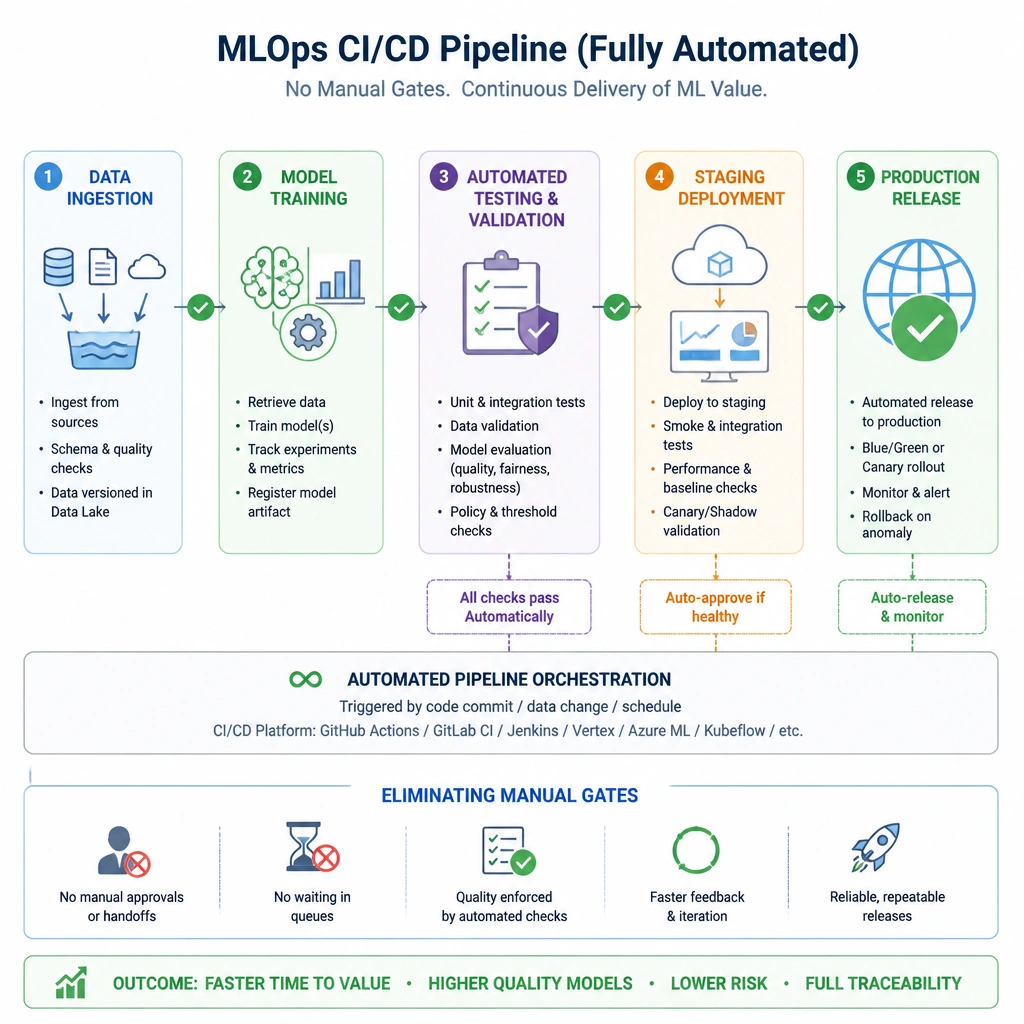
Check this out: when you're managing a handful of AI models, manual updates might seem fine. But when your boss walks in and demands that you scale that to fifty models across multiple production clusters, those manual steps are going to bite you. Big time. If you're manually running validation scripts or launching things with custom scripts, human error is going to slip in and cause havoc. The cool thing is that a solid CI/CD pipeline does the heavy lifting for you. It automatically triggers training on new data, runs rigorous validation checks, and safely rolls the model out to production. No drama, no manual mistakes, just a smooth, repeatable process. Trust me, automation is your best friend here!
Full explanation below image
Full Explanation
Implementing automated Continuous Integration and Continuous Deployment (CI/CD) pipelines is a core best practice in MLOps (Machine Learning Operations). A model lifecycle involves multiple complex stages, including data ingestion, training, validation (testing for performance, safety, and bias), and deployment. Manual execution of these steps is error-prone and scales poorly. An automated CI/CD pipeline ensures that every time data changes or a model is updated, the system runs through a standardized, repeatable suite of tests and validations before pushing the model to production, ensuring reliability and operational consistency. - A is incorrect because running all resource-heavy training and validation jobs concurrently during peak hours can lead to severe resource contention, out-of-memory errors, and network degradation, rather than improving efficiency. - B is incorrect because relying on manual deployments introduces significant human error, lack of auditability, and bottlenecks as the number of models scales. - D is incorrect because deploying directly to production without testing in staging or canary environments risks introducing buggy or biased models into customer-facing systems, potentially causing service outages or incorrect predictions.