An enterprise AI data center requires maximum uptime for its large-scale inference and training services. To ensure high availability and minimal disruption during a hardware failure or maintenance window, which architectural design combines GPU clustering with Data Processing Units (DPUs)?
Select an answer to reveal the explanation.
Short Explanation and Infographic
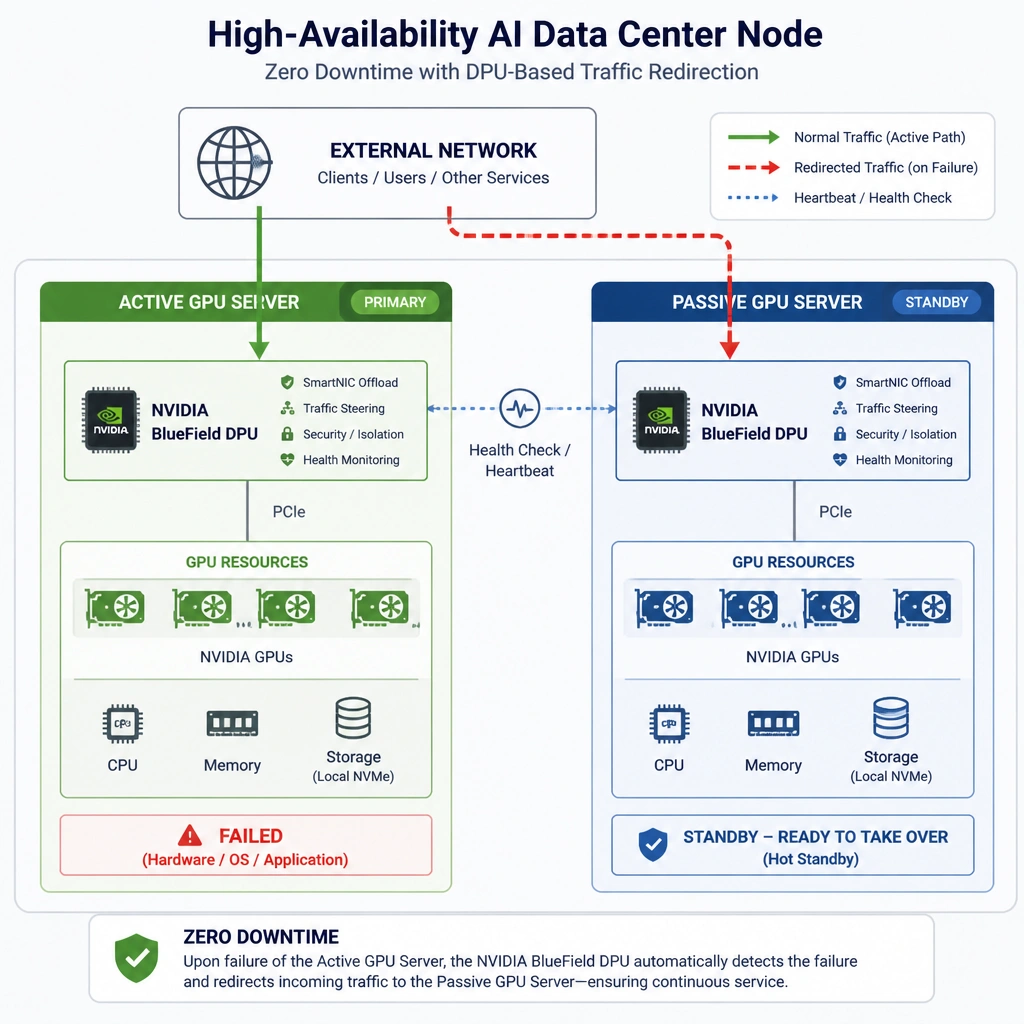
Think of it like this: in a high-availability network, you never want a single point of failure. If a GPU node crashes in the middle of a critical customer-facing AI inference session, you can't just wait around for someone to reboot it. You need a system that immediately switches over to a backup. By pairing active-passive GPU clustering with NVIDIA BlueField DPUs (Data Processing Units), you build an absolute tank of a system. The active GPU nodes handle the heavy lifting, while the passive nodes sit ready to take over. Meanwhile, the DPUs handle the networking, security, and traffic routing. If an active node goes dark, the DPU detects the failure and instantly routes the data traffic to the passive node. The transition is seamless, and your users never even notice. That's how we keep data centers running 24/7!
Full explanation below image
Full Explanation
High availability (HA) in modern AI data centers is critical for maintaining SLA-backed services like real-time LLM inference, autonomous driving processing, and financial forecasting. Achieving HA requires redundancy at both the compute (GPU) and network layers.
The optimal strategy involves deploying GPUs in an active-passive clustering configuration, coordinated by Data Processing Units (DPUs) such as NVIDIA BlueField. In this design: 1. Active-Passive Clustering: Active GPU nodes handle the primary computation. Standby (passive) GPU nodes are kept synchronized and ready to take over workloads if an active node fails or undergoes scheduled maintenance. 2. DPU-Offloaded Failover: DPUs act as smart network interfaces that sit in front of the servers. They run their own lightweight operating systems and handle tasks like virtual routing, encryption, firewalling, and telemetry. Because the DPU manages the network interface independent of the host CPU and GPU, it can detect host failures immediately. Upon detecting a failure, the DPU updates routing tables and redirects incoming network traffic to the passive standby node with sub-millisecond latency. This architecture keeps the data plane separate from the control plane, ensuring continuous operations without interrupting the client.
Let's check why the other options are incorrect: Option B is incorrect because a single GPU node lacks hardware redundancy. If the node fails, the service goes down. CPU-emulated failover over standard gigabit copper Ethernet is far too slow and lacks the necessary bandwidth for AI data streams. Option C is incorrect because disabling DPUs would force the host CPU and GPU to handle network routing, packet parsing, and security tasks. This introduces latency, reduces the GPU compute capacity available for AI tasks, and removes the offloaded failover capabilities. Option D is incorrect because CPUs are not suitable for running heavy deep learning workloads at scale. Using GPUs only for background diagnostics is a massive waste of accelerated hardware resources.