A data science team wants to accelerate their entire machine learning workflow—including data ingestion, preprocessing (dataframes), and model training (e.g., XGBoost, K-means)—directly on GPUs without abandoning their existing Python-based APIs. Which open-source NVIDIA suite of libraries should they adopt?
Select an answer to reveal the explanation.
Short Explanation and Infographic
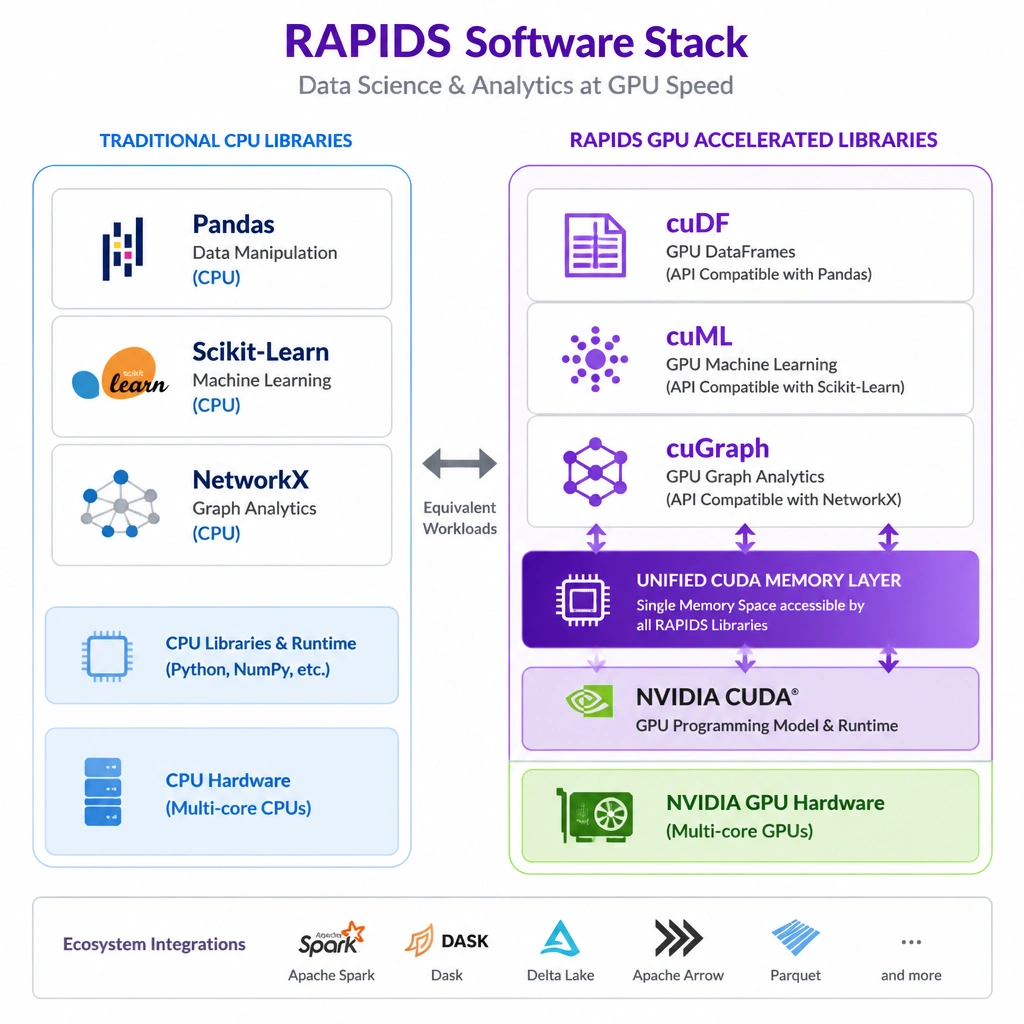
Alright, let's get real about Python data science. Python is great because it has amazing libraries like Pandas, Scikit-Learn, and NetworkX. The problem? They are built for CPUs, meaning they aren't designed to handle massive datasets at scale. NVIDIA RAPIDS is the solution. It's a suite of open-source libraries that replaces those CPU-bound tools with GPU-accelerated versions. Instead of Pandas, you use cuDF. Instead of Scikit-Learn, you use cuML. Instead of NetworkX, you use cuGraph. The beauty of RAPIDS is that it keeps the same APIs you already know, so you don't have to relearn how to code. It just swaps out the slow engine for a GPU rocket booster. Trust me, once you go RAPIDS, you'll never want to wait on a CPU again.
Full explanation below image
Full Explanation
Data science workflows typically involve several stages: data loading, cleaning, feature engineering, model training, and visualization. Traditionally, these stages are executed on CPUs using libraries such as Pandas (for data manipulation), Scikit-Learn (for machine learning algorithms), and NetworkX (for graph analytics). As datasets grow into gigabytes or terabytes, these CPU-bound libraries become major bottlenecks.
NVIDIA RAPIDS is an open-source suite of software libraries and APIs designed to execute end-to-end data science pipelines entirely on GPUs. It achieves this by providing GPU-accelerated drop-in replacements for standard Python data science libraries: - cuDF: Replaces Pandas for DataFrame operations, providing up to 10x-100x speedups. - cuML: Replaces Scikit-Learn for machine learning algorithms (such as Random Forests, K-means, and XGBoost). - cuGraph: Replaces NetworkX for parallel graph analysis.
By leveraging GPU parallelism and high-speed HBM (High Bandwidth Memory), RAPIDS minimizes the overhead of moving data between CPU host memory and GPU device memory. This allows data scientists to build, train, and deploy machine learning models at scale with drastically reduced execution times.
Let's examine the incorrect choices: Option A, NVIDIA CUDA-X, is a broader collection of libraries, tools, and technologies built on top of CUDA (such as cuBLAS, cuDNN, and TensorRT). It is not a dedicated data science and machine learning library suite like RAPIDS. Option C, NVIDIA TensorRT, is an SDK for high-performance deep learning inference. It optimizes trained deep learning models for deployment on GPUs but does not handle data preprocessing, tabular manipulations, or traditional machine learning algorithms like RAPIDS does. Option D, NVIDIA Riva, is a GPU-accelerated SDK for building conversational AI applications, such as automatic speech recognition (ASR) and text-to-speech (TTS), which is unrelated to general data analytics and machine learning pipeline acceleration.