You are overseeing an accelerated computing environment where some worker nodes are heavily congested with deep learning jobs while other nodes have idle GPUs. What strategy should you implement to dynamically manage the GPU software stack lifecycle and automate scheduling to optimize hardware utilization across the entire cluster?
Select an answer to reveal the explanation.
Short Explanation and Infographic
Here's the deal: if you have some GPUs sweating bullets at 100% load while others are sitting around drinking coffee, you've got a resource management nightmare. You could try to manually shuffle workloads, but trust me, that will bite you in production the second your traffic spikes. The cool thing is that NVIDIA and Kubernetes have teamed up to solve this. By running the NVIDIA GPU Operator, you're automating the provisioning, configuration, and monitoring of all your GPU resources. It handles everything from loading the NVIDIA drivers to configuring container runtimes. This lets Kubernetes do what it does best: dynamically schedule containerized jobs based on actual, real-time GPU availability. No more idle silicon, and no more angry users!
Full explanation below image
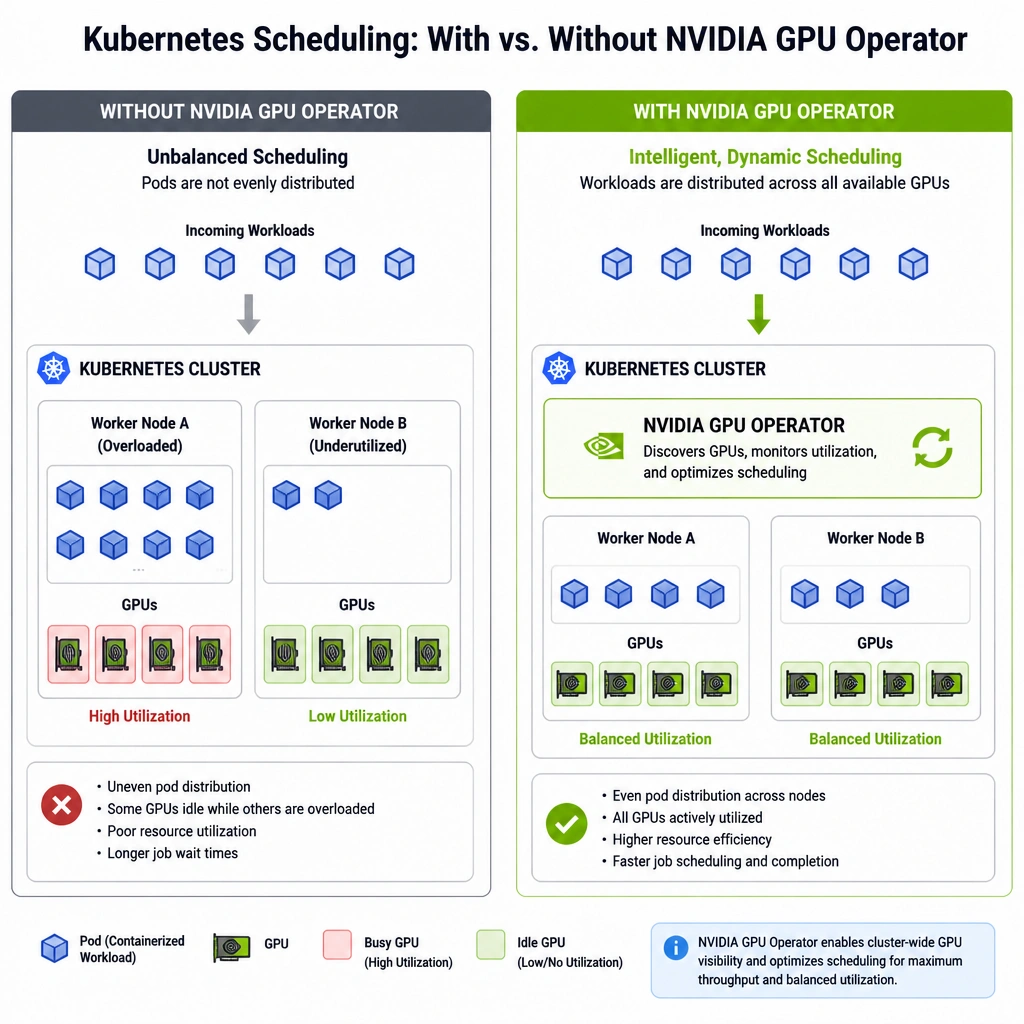
Full Explanation
In a heterogeneous accelerated computing cluster, workload imbalance is a frequent bottleneck that decreases return on investment (ROI) and increases overall job completion times. Static partitioning or manual scheduling of resources is highly inefficient and error-prone at scale. The correct approach is to implement the NVIDIA GPU Operator within a Kubernetes orchestration environment. The NVIDIA GPU Operator is a Kubernetes-native agent that containerizes and automates the deployment of all necessary software components for NVIDIA GPUs, including the host driver, container runtime, device plug-in, and telemetry tools (such as DCGM). By utilizing Kubernetes as the orchestrator, the GPU Operator enables dynamic, resource-aware container scheduling. Kubernetes monitors the GPU capacity and utilization of each node, allowing it to schedule containerized workloads to nodes with available resources.
Let's look at why the other options are incorrect: Option A is incorrect because manual bare-metal scripts cannot dynamically adapt to real-time workload fluctuations. It also creates a massive operational burden. Option C is incorrect because a FIFO queue on standalone servers lacks the orchestration layer necessary to distribute tasks across multiple nodes dynamically. Option D is incorrect because adding more physical servers (horizontal scaling) fails to address the root cause of the scheduling imbalance. It increases capital expenditure and data center power usage without solving the scheduling inefficiencies that leave existing GPUs underutilized.