During peak model training runs, your GPU cluster experiences severe performance bottlenecks. System telemetry shows that the host CPUs are constantly saturated at 100% utilization handling network packet encapsulation, storage virtualization (NVMe-oF), and cryptographic operations, which delays data transfer to the GPUs. How should you integrate Data Processing Units (DPUs) to resolve this bottleneck?
Select an answer to reveal the explanation.
Short Explanation and Infographic
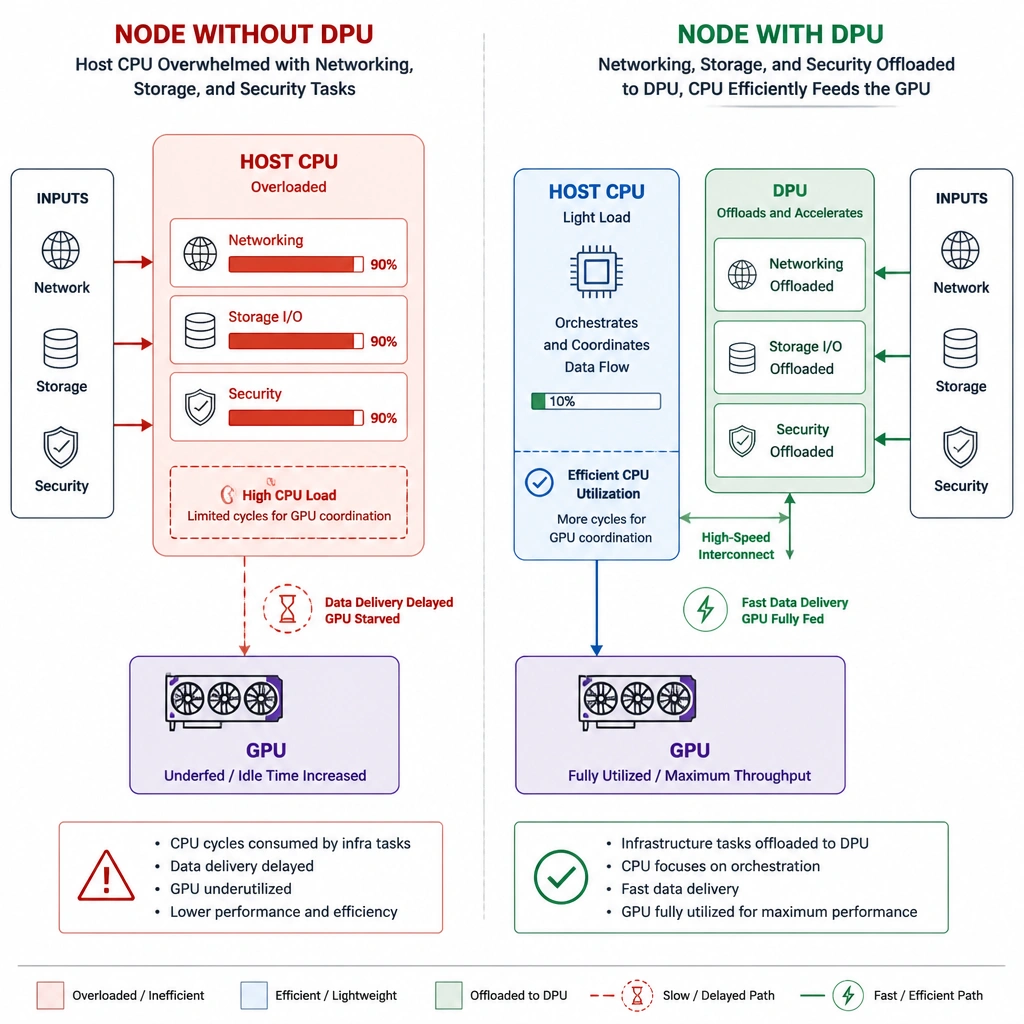
Check this out: in a high-performance AI cluster, the CPU is like the manager of the project. Its job is to coordinate everything and keep the GPUs (the specialized workers) fed with data. But if the manager is buried under a mountain of paperwork—like processing network packets, managing storage drives, and handling encryption—they can't do their actual job. The GPUs end up sitting idle. Enter the DPU (Data Processing Unit). Think of the DPU as a personal assistant that takes all that administrative junk (networking, storage, security) off the CPU's plate. Once the CPU is freed up, it can focus 100% on managing the AI workload and keeping the GPUs busy. And let's make sure we're clear for the exam: DPUs are not built to run AI models or manage GPU memory. They are there to accelerate the infrastructure data plane!
Full explanation below image
Full Explanation
In modern high-performance AI training and inference environments, the extreme bandwidth requirements of GPU-to-GPU and GPU-to-storage communications can overwhelm the host CPU. The CPU must handle complex infrastructure tasks such as network protocol processing (e.g., routing, packet encapsulation, and RDMA over Converged Ethernet (RoCE)), storage virtualization (e.g., NVMe over Fabrics (NVMe-oF)), encryption/decryption, and security firewalls. When the CPU becomes saturated with these infrastructure management tasks, it cannot feed data to the GPUs quickly enough, creating a host bottleneck. A Data Processing Unit (DPU) is a specialized class of programmable processor designed specifically to offload these network, storage, and security services from the host CPU. By handling these data-plane operations in dedicated hardware pipelines on the DPU, host CPU cycles are reclaimed. The CPU can then dedicate its computational capacity to hosting the operating system, orchestrating containerized workloads, and managing the high-speed data path to the GPUs, thereby maximizing GPU utilization and overall system throughput. Let's analyze the incorrect options: - DPUs are not designed for deep learning matrix math (Option B); migrating AI compute tasks to a DPU would result in terrible performance, as they lack the tensor/parallel execution units found in GPUs. - DPUs cannot serve general AI inference models (Option C); they do not possess the hardware architecture or libraries required to execute neural network layers at scale. - GPU VRAM memory management (Option D) is handled by the GPU's onboard memory controller and runtime drivers, which cannot be offloaded to an external network card processor like a DPU. By implementing DPUs (like NVIDIA BlueField), data centers achieve a 'zero-copy' architecture where data moves directly between storage and GPU memory via GPUDirect RDMA. The CPU is completely bypassed for the actual data movement, allowing it to remain responsive for scheduling, monitoring, and administrative tasks, ensuring the GPU cluster runs at peak efficiency. Therefore, using DPUs to offload network, storage, and security operations is the correct approach to resolving host CPU bottlenecks.