
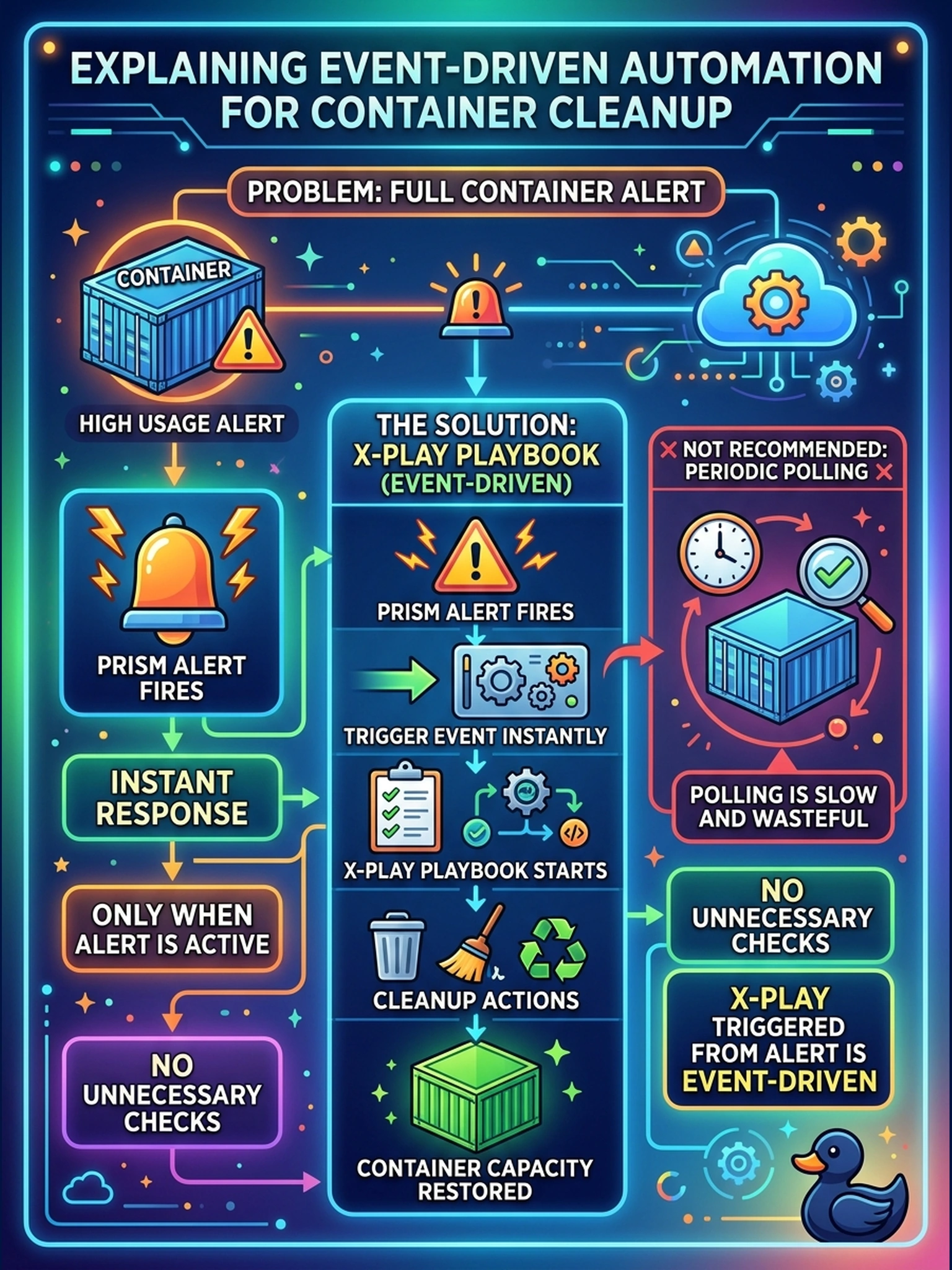
In a Prism Central estate, a Prism alert repeatedly warns that a container is approaching capacity. You want the platform to start a cleanup playbook only when the alert fires, without polling. Which approach uses event-driven automation?
Select an answer to reveal the explanation.
Short Explanation
Think of it like a smoke alarm wired to a sprinkler, not a calendar. If the alert fires, your X-Play playbook should wake up and clean up; if you schedule it nightly, you're just guessing when the trouble happens.
Full Explanation
Event-driven automation in Nutanix uses an alert condition as the trigger for a defined playbook. X-Play is the Prism Central automation construct for packaging operational tasks, and when a playbook is bound to an alert, the cleanup runs only when that alert fires, preserving the platform's existing alert evaluation and avoiding duplicate capacity logic. A nightly scheduled playbook is wrong because time-based automation does not respond to the actual threshold crossing; it may run too early, too late, or when no cleanup is needed. API polling is wrong because it recreates the alert condition outside the alert pipeline, increasing load, latency, and the chance of mismatched thresholds. Alert-policy email notification is wrong because it informs a person instead of executing a workflow, so the capacity warning remains a manual task. This keeps remediation tied to the condition that actually matters. Exam caveat: focus on the trigger type required by the requirement—alert-triggered versus scheduled or polled. Operational check: confirm the alert policy produces a test alert and that the bound X-Play playbook records a run with the expected inputs.