
An X-Play playbook in Prism Central produces automation results that a third-party ticketing system must receive immediately. Which integration should you implement so the ticketing system can create tickets from the playbook output?
Select an answer to reveal the explanation.
Short Explanation
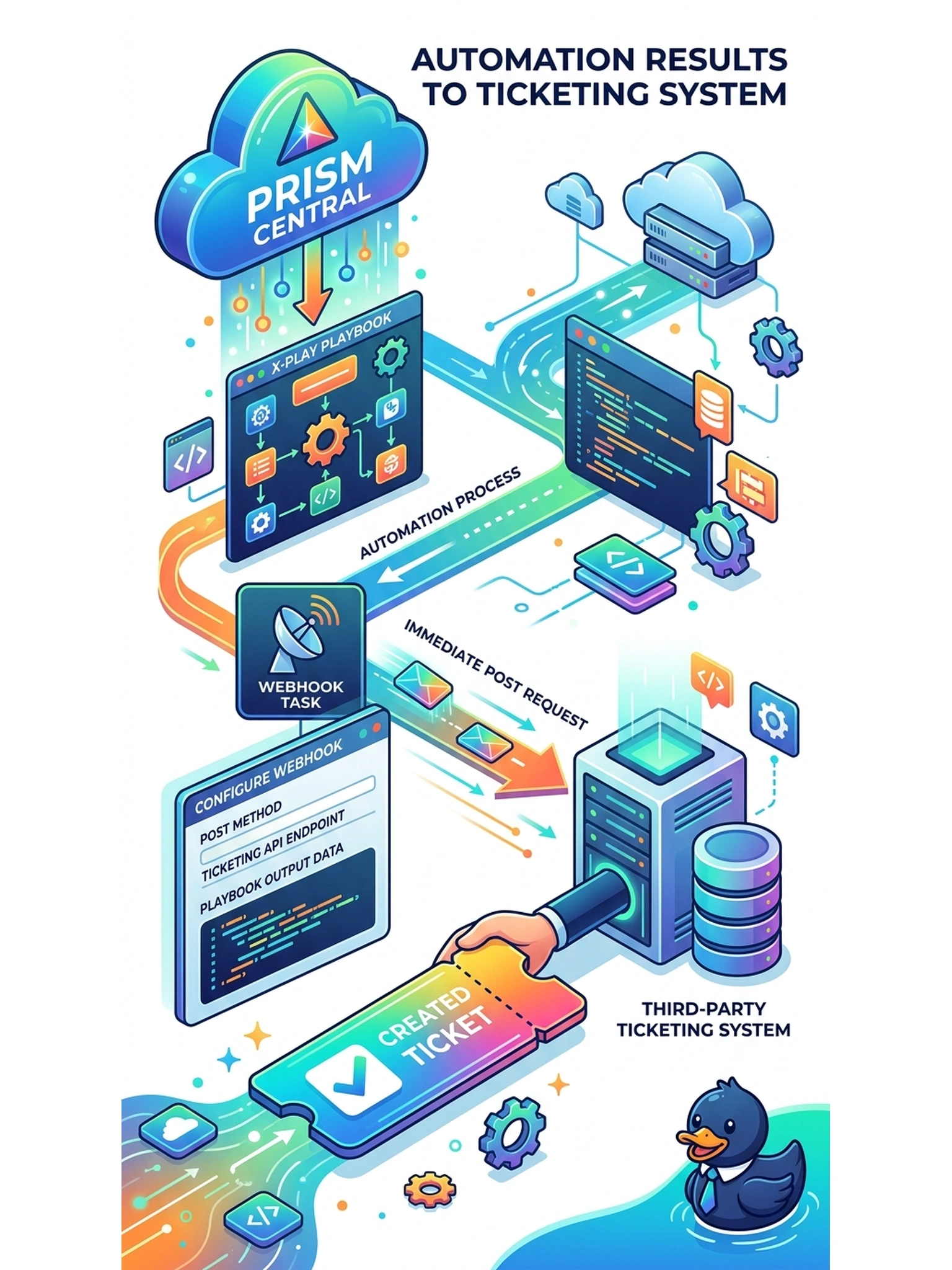
Think of a webhook like handing the ticketing system a stamped envelope with the result inside. If the playbook needs to tell another system, you push that result to its API instead of waiting for someone to read an email or log file. That's the direct integration you want.
Full Explanation
A webhook integration is the mechanism that lets an automation workflow actively deliver its outcome to an external system. In this scenario, the playbook produces an automation result, and the ticketing platform must receive that result as it happens. A webhook or API call sends a structured payload to a defined endpoint, so the ticketing system can create or update a ticket without polling or manual interpretation. Email alerting can notify administrators, but it is not an application integration; ticketing systems may parse mail only if that feature exists, and the alert body is not the authoritative automation result. Scheduled NCC log exports are for health diagnostics and batch reporting, not for delivering the outcome of a playbook run, and they add latency and storage coupling. SNMP traps are network and system event notifications, not automation result payloads, and a ticketing system would not normally ingest playbook outputs through trap parsing. Exam caveat: choose the integration that sends the result to the target system's API, not a notification channel that only informs humans. Operational check: confirm the playbook's webhook URL, authentication token, and JSON payload format by running a test playbook and verifying the resulting ticket in the external system.