
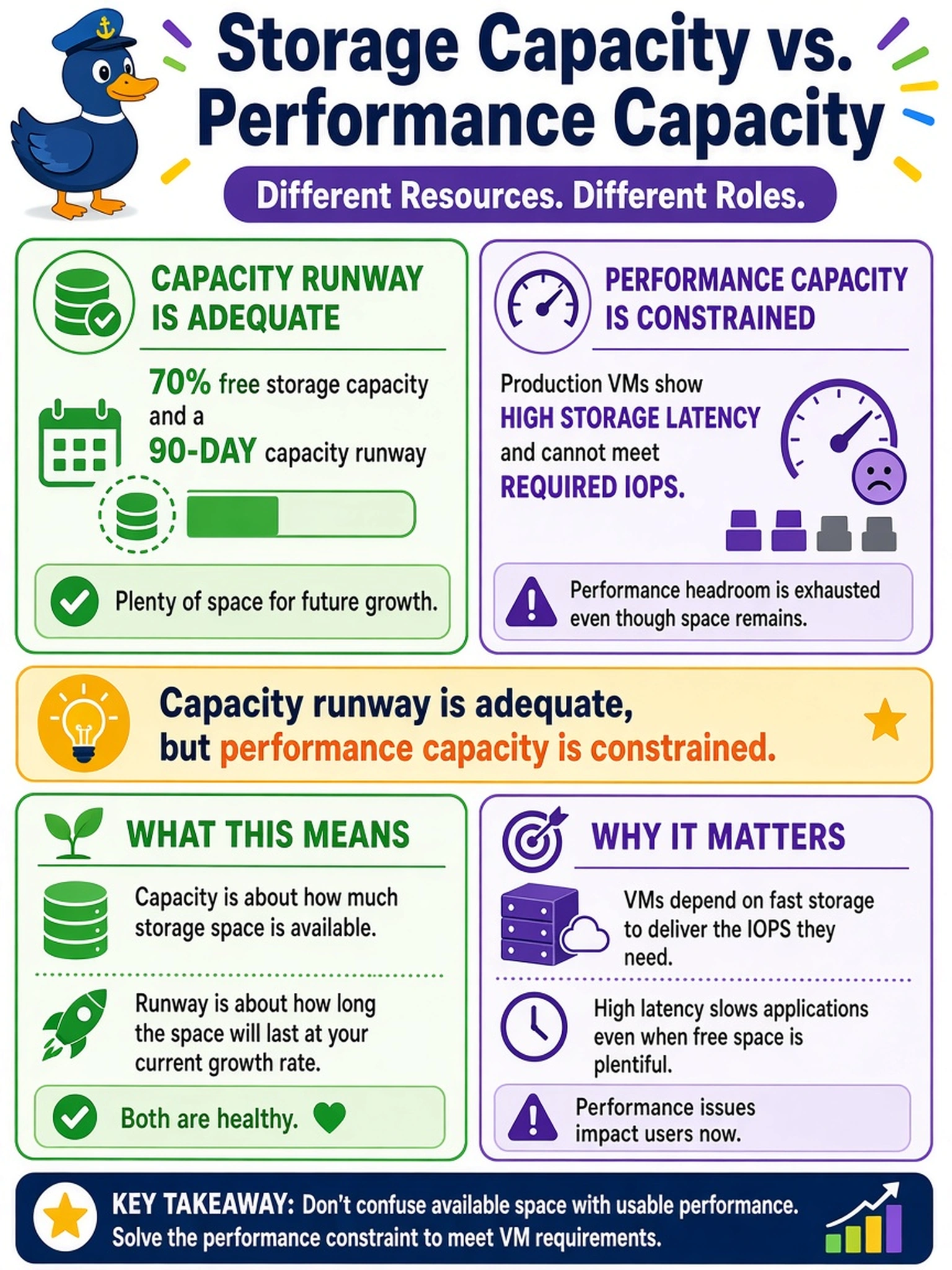
A four-node AHV cluster reports 70% free storage capacity and a 90-day capacity runway, but production VMs show high storage latency and cannot meet required IOPS. An administrator is asked whether the cluster has a capacity problem. Which conclusion should be reported?
Select an answer to reveal the explanation.
Short Explanation
Think of capacity runway like the fuel gauge and IOPS headroom like the engine: plenty of gas doesn't help if the engine can't pull. You can have months of storage left and still be performance-starved. Don't call raw free space 'capacity solved' when your workloads are queueing.
Full Explanation
Nutanix capacity planning separates capacity runway from performance capacity. Capacity runway estimates how long usable storage space will last based on free space, metadata, snapshots, and growth. Performance capacity estimates whether the cluster can meet IOPS, throughput, and latency targets without queueing. A cluster can have ample raw free space yet fail performance goals when hot data, small random I/O, or contention exceeds available IOPS, so the correct conclusion is that capacity runway is adequate but performance capacity is constrained. A conclusion that raw free space alone proves there is no capacity problem is wrong because capacity planning is not limited to bytes. A conclusion that capacity runway already accounts for all storage performance is wrong because runway forecasts storage space, not guaranteed latency or IOPS headroom. A conclusion that more raw capacity must be added because IOPS demand consumes free space faster is wrong because IOPS demand does not necessarily consume storage capacity, and extra raw space may not relieve queueing. Exam caveat: distinguish capacity forecasting from performance sizing. Operational check: review cluster performance metrics for IOPS, throughput, latency, and queue depth, then compare them with workload SLAs before recommending expansion.