
A Nutanix administrator is planning capacity for a mixed-size AHV cluster. The cluster must keep normal capacity headroom and still absorb the data from one failed node without exceeding storage capacity limits. Which capacity-planning action directly provides the failure-domain reserve?
Select an answer to reveal the explanation.
Short Explanation
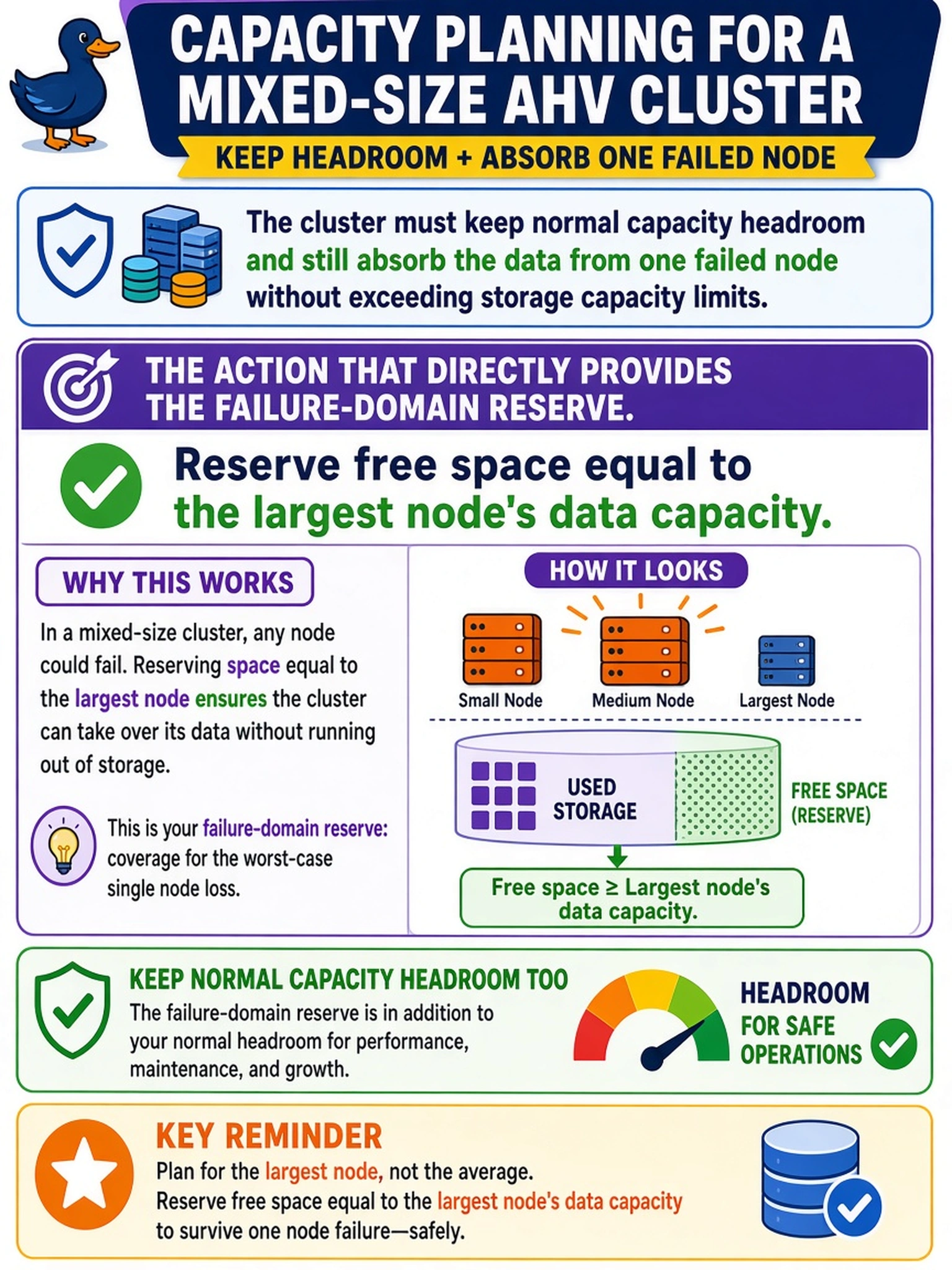
Think of spare capacity like an airbag: you need it sized for the biggest impact, not just the average node. If one node dies, its data has to land somewhere, so reserve enough free space to absorb the largest node's data. Compression or snapshots don't replace that hard failure-domain reserve.
Full Explanation
Capacity headroom for a node failure is a failure-domain reserve, not a data-reduction feature. In a Nutanix cluster, storage data is distributed across CVMs and nodes, so when one node becomes unavailable, its share of data must be accommodated by the remaining nodes. The planning action that directly creates that reserve is to keep enough free data capacity on the cluster—sized to the largest node in a mixed cluster—so the failed node's data can be absorbed without crossing capacity thresholds or forcing expansion. Raising replication factor adds more copies of data and consumes capacity rather than reserving it; it may improve durability but does not guarantee spare space for a failed node's working set. Compression and deduplication can increase effective usable space, but they are opportunistic and workload-dependent, so they cannot be treated as a deterministic node-failure reserve. Remote snapshots preserve recovery points and help DR, but they do not add local free capacity for rebuild or placement on the remaining nodes. Exam caveat: when the requirement is to tolerate a specific failure domain, reserve capacity by the largest failure domain, not by average utilization. Operational check: review current and forecast cluster capacity, subtract the largest node's expected data footprint, and confirm the remaining cluster stays within the approved capacity threshold.