
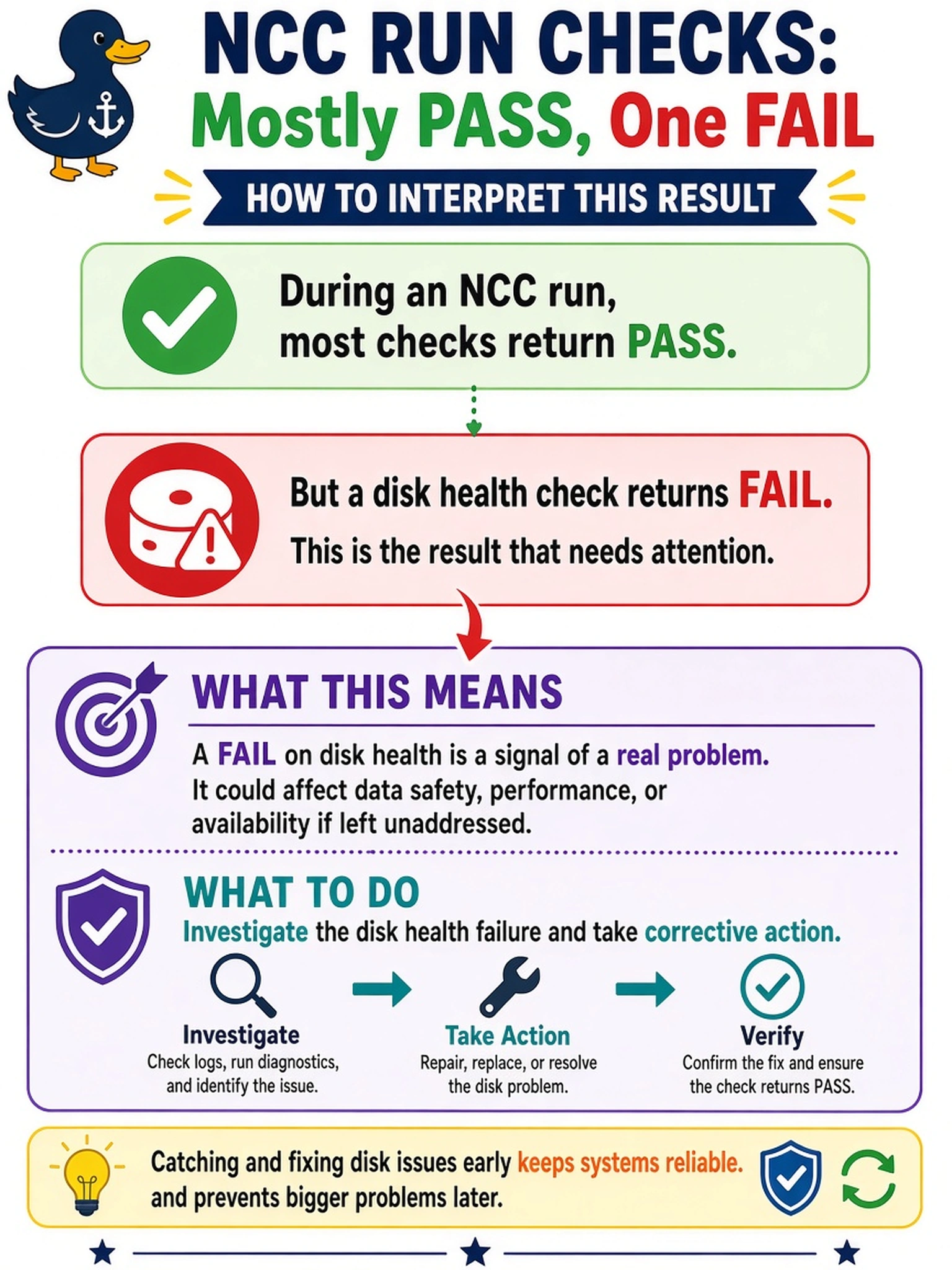
During an NCC run, most checks return PASS, but a disk health check returns FAIL. How should the administrator interpret this result?
Select an answer to reveal the explanation.
Short Explanation
Think of NCC like a car dashboard: PASS is green, WARN is amber, and FAIL is a red light you can't ignore. A disk health FAIL means you need to find and fix the underlying condition, not just note it. If you treat it like a warning, a small disk problem can become a big outage.
Full Explanation
NCC evaluates many cluster components and reports each check as PASS, FAIL, or WARN. A FAIL means the check found a condition that violates Nutanix health expectations and should be investigated before it affects operations. Disk health checks are especially concrete: they can expose degraded drives, SMART errors, or disk-level problems that may lead to data-service impact if left unaddressed. Treating the result as warning-only is wrong because warning status is a distinct NCC outcome used for non-blocking observations, while FAIL signals an actionable defect. Assuming other PASS results prove the cluster healthy is also wrong; NCC checks are independent, and unrelated passes do not cancel a specific disk failure. Re-running after maintenance is not a remedy unless the maintenance actually repairs the disk condition; a later pass may simply be temporary or caused by a changed check scope. Exam caveat: on the exam, FAIL is not a cosmetic status and should not be mapped to acknowledgement or normal operations. Operational check: after remediating the disk, rerun NCC and verify the disk health check returns PASS while monitoring Prism alerts for related storage or CVM events.