
After completing an LCM upgrade on an AHV cluster, an administrator needs to confirm the cluster is healthy before returning workloads to normal operations. Which action should be taken first?
Select an answer to reveal the explanation.
Short Explanation
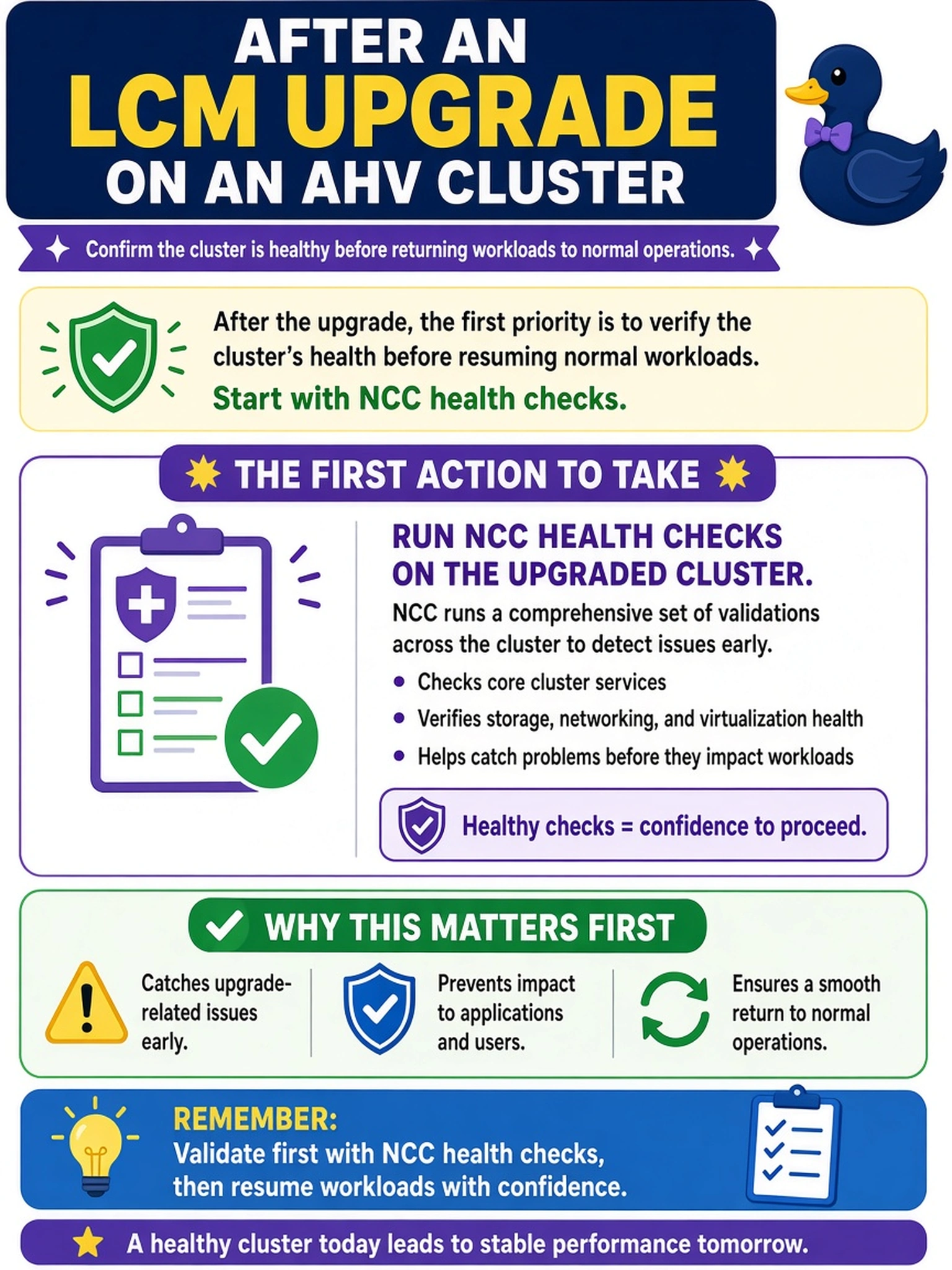
Think of an upgrade like a car service: you don't trust the receipt alone, you pop the hood. Run NCC health checks to see whether CVMs, storage, networking, and cluster services actually came back healthy. If you only read the LCM completion message, you'll miss the warnings hiding under the bonnet.
Full Explanation
NCC health checks are the designed post-change validation tool for Nutanix clusters because they exercise the same health framework used for routine cluster diagnostics. After LCM finishes, the upgrade workflow may report task success, but that only confirms the orchestrated steps completed; it does not prove every distributed component is healthy. NCC evaluates CVM services, storage layer components, networking, time synchronization, and cluster consistency, so it surfaces issues that may persist after a rolling upgrade. Reviewing only the LCM completion summary is insufficient because task completion and component health are different states: a task can finish while a CVM service, disk, or network path remains unhealthy. Checking Prism Central alerts is useful but reactive and incomplete; alerts may be delayed, suppressed, or not generated for conditions that NCC detects proactively. Validating protection domains is relevant only to DR replication health and does not confirm local cluster services, storage, or hypervisor connectivity. Exam caveat: do not confuse LCM pre-upgrade checks with post-upgrade validation; post-upgrade confirmation should still use a comprehensive health check. Operational check: after the LCM job completes, run the NCC health check on the upgraded cluster and review any failing checks before resuming workload operations.