
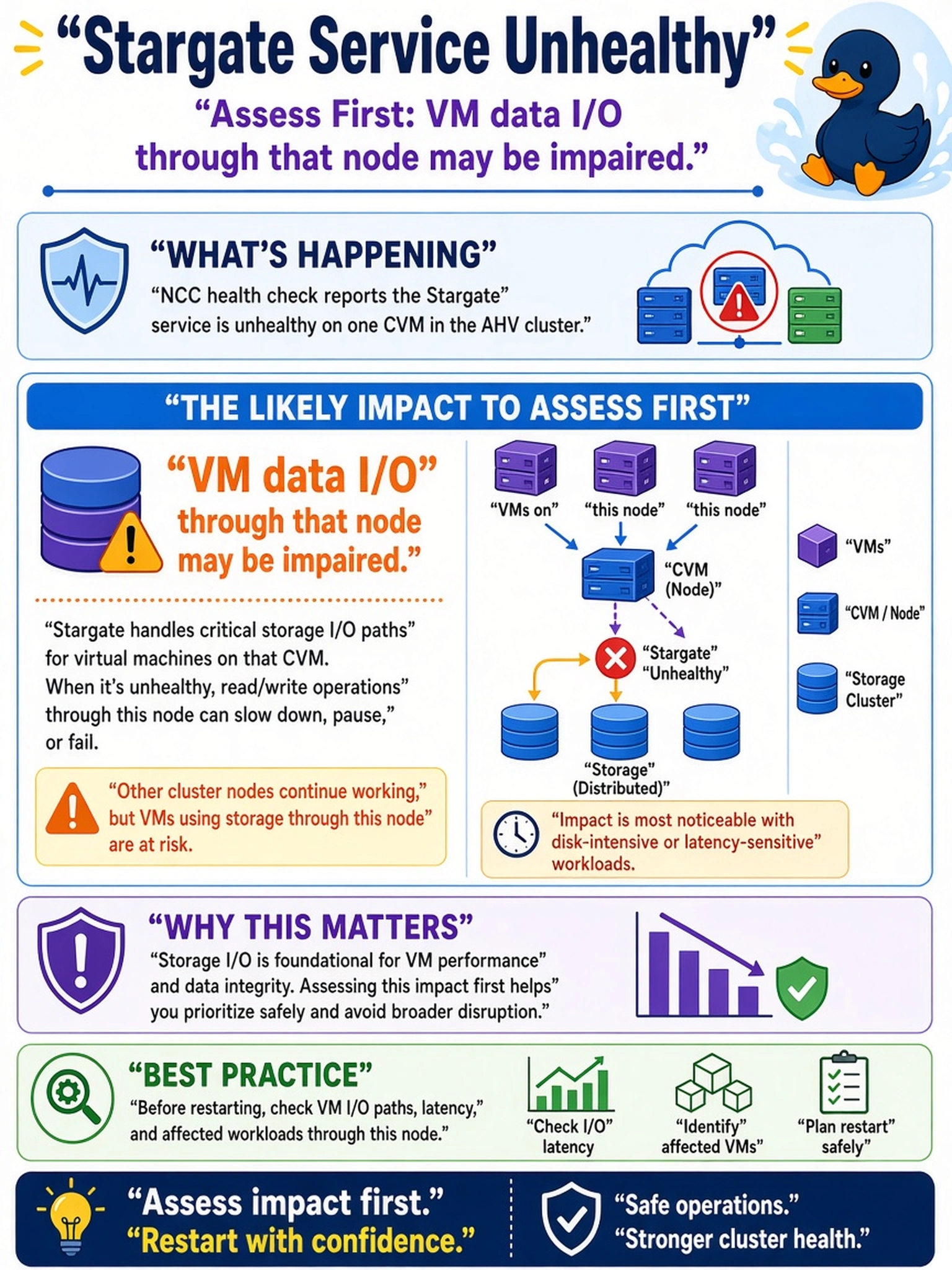
During routine monitoring, an NCC health check reports that the Stargate service is unhealthy on one CVM in an AHV cluster. The administrator needs to determine the likely operational impact before restarting the service. Which impact should be assessed first?
Select an answer to reveal the explanation.
Short Explanation
Think of Stargate as the CVM’s I/O busboy: it carries storage reads and writes, not alert emails. If NCC says Stargate is unhealthy, you don't chase the alert path first; you check whether VMs on that node can still get data. The trap is blaming the notification pipeline just because the health check fired.
Full Explanation
Stargate is a data-path service that runs inside each CVM on an AHV node. VM storage requests are handled by Stargate before they reach storage containers and data services, so an unhealthy Stargate instance points to impaired local data I/O rather than a management-plane failure. The notification-delivery concept is wrong because Stargate does not send or forward alerts; alert generation and delivery are handled by Prism/Prism Central monitoring and notification components. The management REST API concept is also wrong because Prism Element or Prism Central API availability is tied to management services, not to the Stargate data-path process on one CVM. The NTP and Zookeeper time-sync concept is wrong as well because time synchronization and cluster quorum services are separate from Stargate; a Stargate health check does not indicate that clocks have drifted or that Zookeeper has lost quorum. Exam caveat: NCC health checks tell you which component is unhealthy, so you must map each CVM service to its function before choosing the operational impact. Operational check: Review VM disk latency and I/O errors on the affected node, confirm the Stargate process state in the CVM, and migrate or restart only after confirming the data-path impact.