
A Nutanix administrator must migrate protected VMs from the production AHV cluster to the DR site during a scheduled maintenance window. The source cluster, CVMs, and replication link are healthy, and the operator wants a controlled switchover with final sync. Which recovery-plan action should be used?
Select an answer to reveal the explanation.
Short Explanation
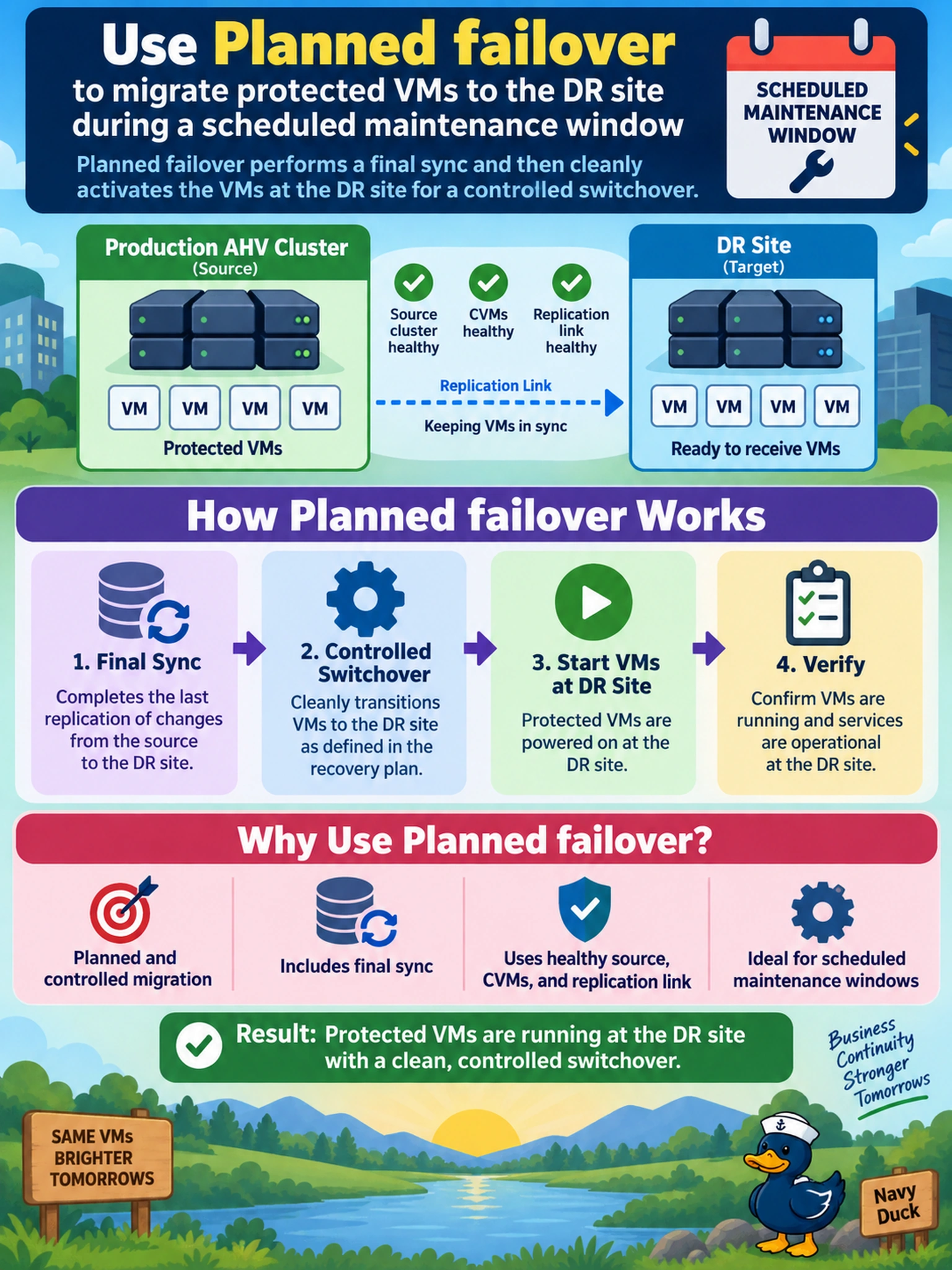
Think of planned failover like a supervised handoff: the source site is still online, so you can do a final sync before flipping the switch. If the source is reachable and healthy, you don't need to gamble with a crash-style failover or a test that never moves production.
Full Explanation
Planned failover is the correct action when the protected site is available and healthy because it performs a controlled transition: it can finalize replication state, ensure the latest data is synchronized, and then promote the DR copy with minimal service interruption. This is the workflow used for scheduled maintenance, site migration, or any scenario where administrators intentionally move workloads while the original site can participate. A standard failover is intended for unplanned outages where the source site is unreachable or unhealthy; it must prioritize availability over a clean handoff and cannot rely on source-side confirmation. Failback is the inverse movement, used after a failover to return workloads to the original site once it is restored, not to initiate a planned migration from a healthy source to the DR site. Running a recovery plan test validates configuration, connectivity, and runbook logic without changing production ownership, so it is useful before a planned event but does not itself migrate workloads. Exam caveat: choose the action that matches the operational intent and source-site state, not just the existence of a recovery plan. Operational check: confirm the protection domain is healthy, replication lag is acceptable, and the recovery plan is set to planned failover before executing the maintenance window.