
A DR administrator must protect production VMs between two Nutanix clusters. The business can tolerate losing up to 15 minutes of writes, and replication must send only periodic recovery points across a constrained WAN. Which replication mode should be selected?
Select an answer to reveal the explanation.
Short Explanation
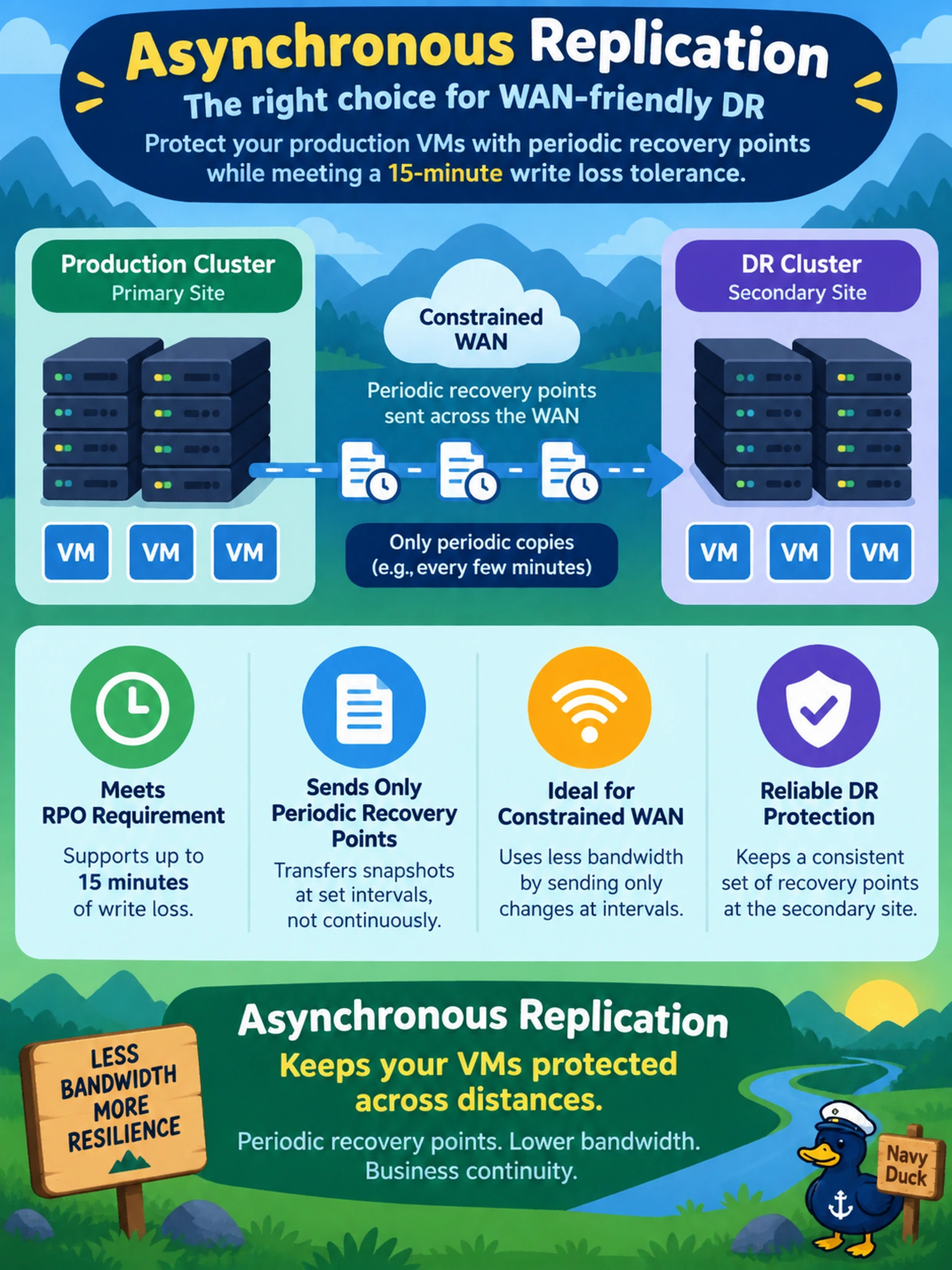
Think of async like a courier who picks up packages on a schedule instead of standing at your desk. If the business says a 15-minute gap is acceptable, you don't pay for the tightest possible copy. NearSync and Metro chase smaller gaps, so they're overkill when scheduled snapshots meet the RPO.
Full Explanation
Asynchronous replication creates remote recovery points from snapshots taken at configured intervals, so the distance between the last accepted write and the last replicated snapshot defines the practical recovery point objective. It is appropriate when the business accepts a bounded amount of lost data and the link or storage cost makes continuous copying unnecessary. NearSync replication is intended for much lower recovery point objectives by maintaining a continuously available remote copy, which adds bandwidth and storage overhead and is not chosen when scheduled snapshot intervals already satisfy the requirement. Metro availability provides synchronous, tightly coupled protection across sites and is reserved for near-zero data loss with strict latency and distance constraints, making it inappropriate when a fifteen-minute write loss is acceptable. A local snapshot policy alone does not provide site-to-site recovery because it keeps recovery points on the protected cluster and does not transfer them to a remote cluster. Exam caveat: choose the replication mode by the required recovery point objective and WAN constraints, not by the name of the feature or the number of snapshots. Operational check: confirm the snapshot schedule, remote cluster health, replication queue, and last successful recovery point before declaring the asynchronous policy compliant with the agreed RPO.