
An application requires shared raw block devices that can be attached to multiple AHV VMs. Which provisioning method should an administrator use?
Select an answer to reveal the explanation.
Short Explanation
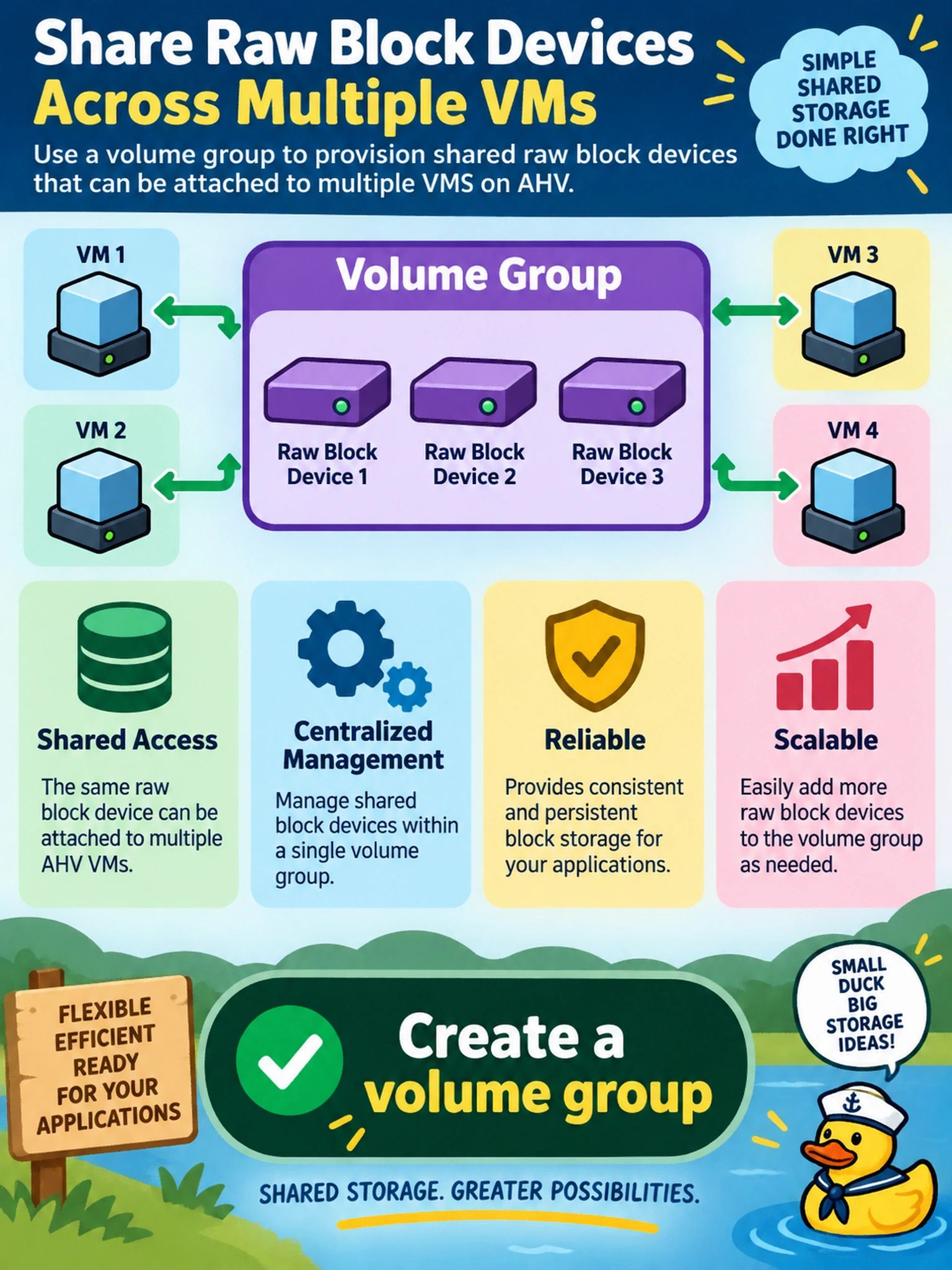
Think of it like handing out raw hard drives to a cluster of servers: you want one shared block device, not a bunch of separate disks. Create a volume group so the application sees raw LUN-style storage it can format and coordinate itself. The trap is thinking a regular vDisk can be shared like that — it usually can't.
Full Explanation
A volume group is Nutanix’s construct for exposing block storage as raw disks to guest operating systems, typically by creating one or more disks inside the volume group and attaching the group to one or more VMs. It is used when an application needs direct disk access, such as clustering software, database engines, or tools that expect to manage block devices themselves. A regular virtual disk is intended as a boot or data disk for a single VM, so using it as a shared raw device does not provide the required multi-VM block semantics. A storage policy describes requirements such as redundancy, compression, or QoS, but it does not create the block device the application consumes. Deduplication is an efficiency optimization on stored data; it changes capacity behavior, not how raw block devices are presented. Exam caveat: do not confuse volume groups with Shadow Clones or snapshot-backed shared reads, because those serve different access models. Operational check: after attaching the volume group, confirm each application node sees the same block device name, size, and multipath or cluster state before formatting it.