
An administrator manages a cluster with many identical Windows Server VMs and wants to reclaim space from common OS and application blocks without changing the guest VMs. Which storage optimization feature should be enabled?
Select an answer to reveal the explanation.
Short Explanation
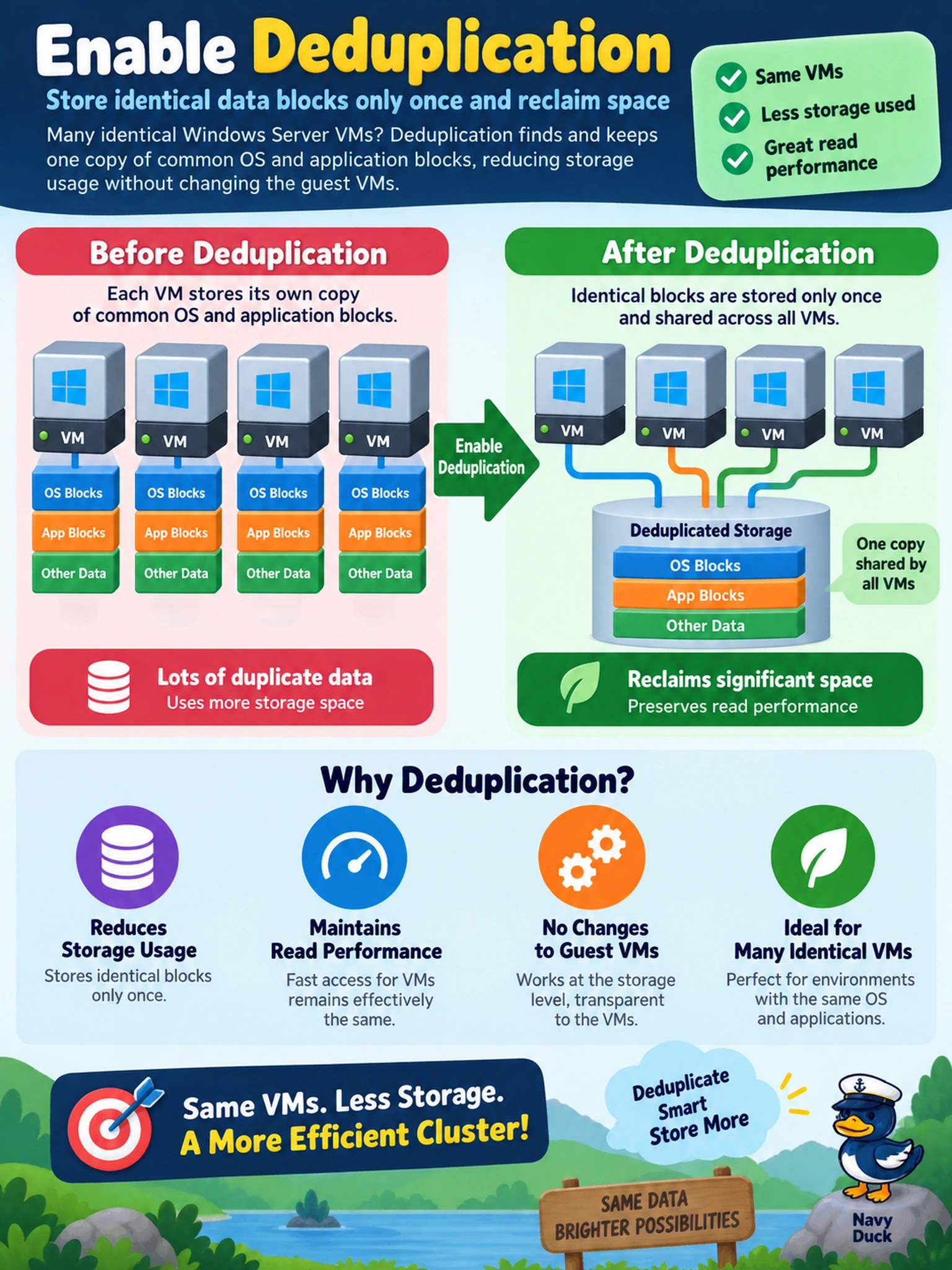
Think of deduplication like a filing cabinet that keeps one copy of a memo instead of one for every department. When your VMs all carry the same OS and app blocks, dedupe stores those repeated blocks once and saves space. The trap is thinking compression or thin provisioning fixes identical blocks - they don't.
Full Explanation
Deduplication is the correct storage feature because repeated OS and application blocks across multiple VMs can be stored once. Nutanix AOS deduplication identifies identical data blocks and stores a single copy, while mapping the original block locations to that shared copy. This is most effective when many VMs share a common base image or application binaries, and it operates at the storage layer so the guest operating systems do not need modification. Compression is a poor fit for this objective because it reduces size by encoding patterns within a block or across data, not by removing exact duplicate blocks across VMs. Thin provisioning is also incorrect because it avoids allocating unused virtual disk space to the guest, but it does not reclaim capacity from already-written duplicate blocks. Erasure coding addresses protection and capacity efficiency by storing data with parity instead of full mirrors, and it does not target duplicate OS or application blocks. Exam caveat: do not confuse space-saving features that operate on written duplicate data with features that affect allocation or redundancy. Operational check: review the storage policy or container settings to confirm deduplication is enabled, then compare logical and physical capacity before and after applying it.