
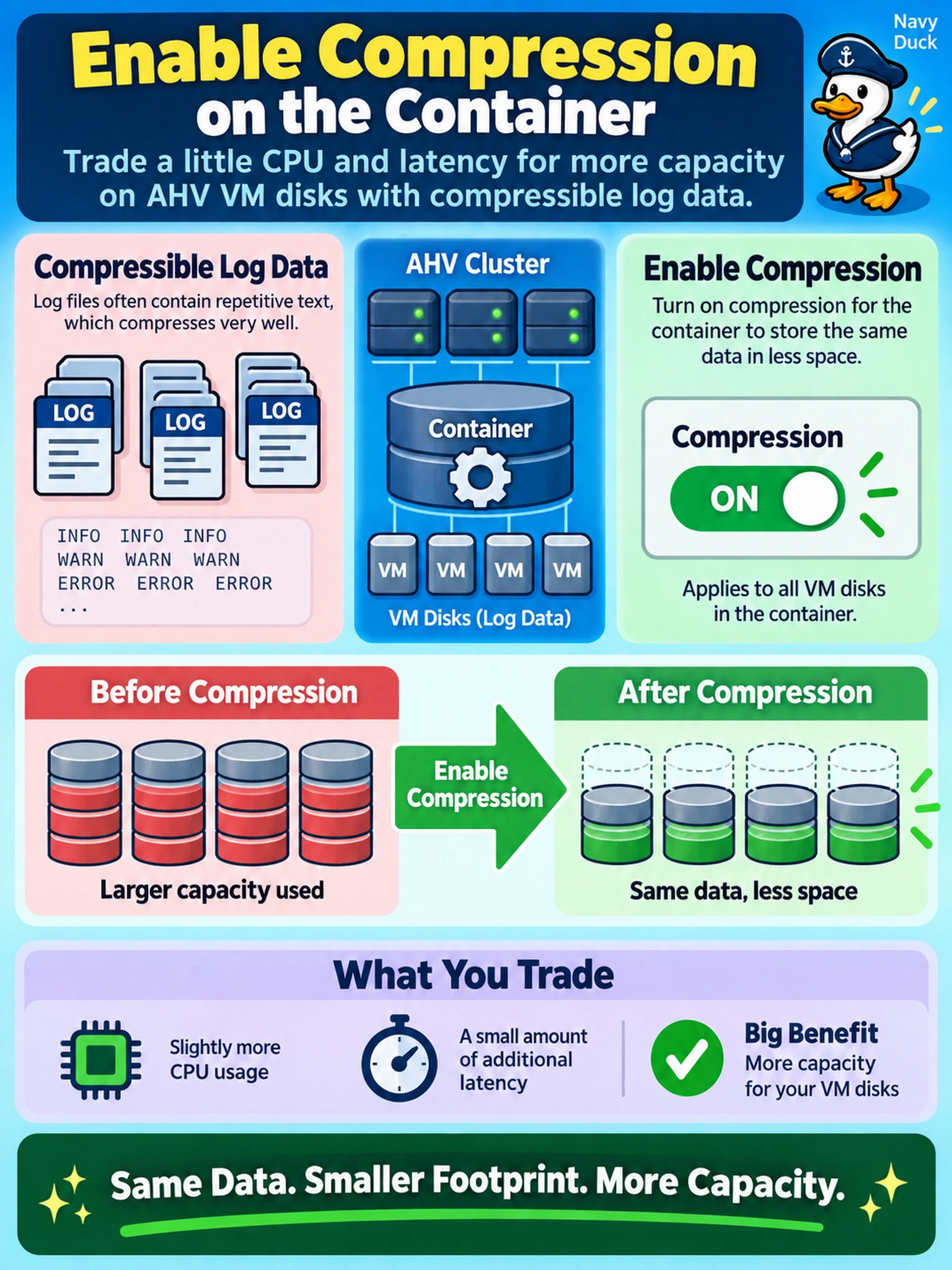
A team needs more capacity on AHV VM disks storing compressible log data. The cluster has enough CPU headroom to trade a small amount of CPU and latency for capacity savings. Which storage action best meets this goal?
Select an answer to reveal the explanation.
Short Explanation
Think of compression like squashing packing peanuts: you save shelf space, but it takes a bit of effort each time. You pick it when the data is compressible and capacity matters more than a little CPU or latency overhead. That is the tradeoff you are buying here.
Full Explanation
Container compression reduces the physical space consumed by VM disks by encoding compressible block data before persistence. It is selected when the workload's data has high entropy reduction potential and the cluster has enough CPU headroom to absorb compression overhead, so the capacity benefit outweighs added CPU or latency. Erasure coding spreads data across nodes to reduce replica capacity and survive node failures, but its capacity savings come from redundancy layout rather than data compressibility and can add CPU and latency for small random I/O. Deduplication removes duplicate blocks, so it helps when many VMs share identical data, but it does not primarily exploit compressible patterns and can introduce additional processing. Thin provisioning lets you allocate more virtual capacity than physical capacity, but it does not shrink the data actually written and can obscure real capacity consumption. Exam caveat: choose compression only when the data is compressible and the capacity benefit justifies the CPU or latency cost. Operational check: review container capacity, compression savings, and CPU headroom before enabling it on the container serving those VM disks.