
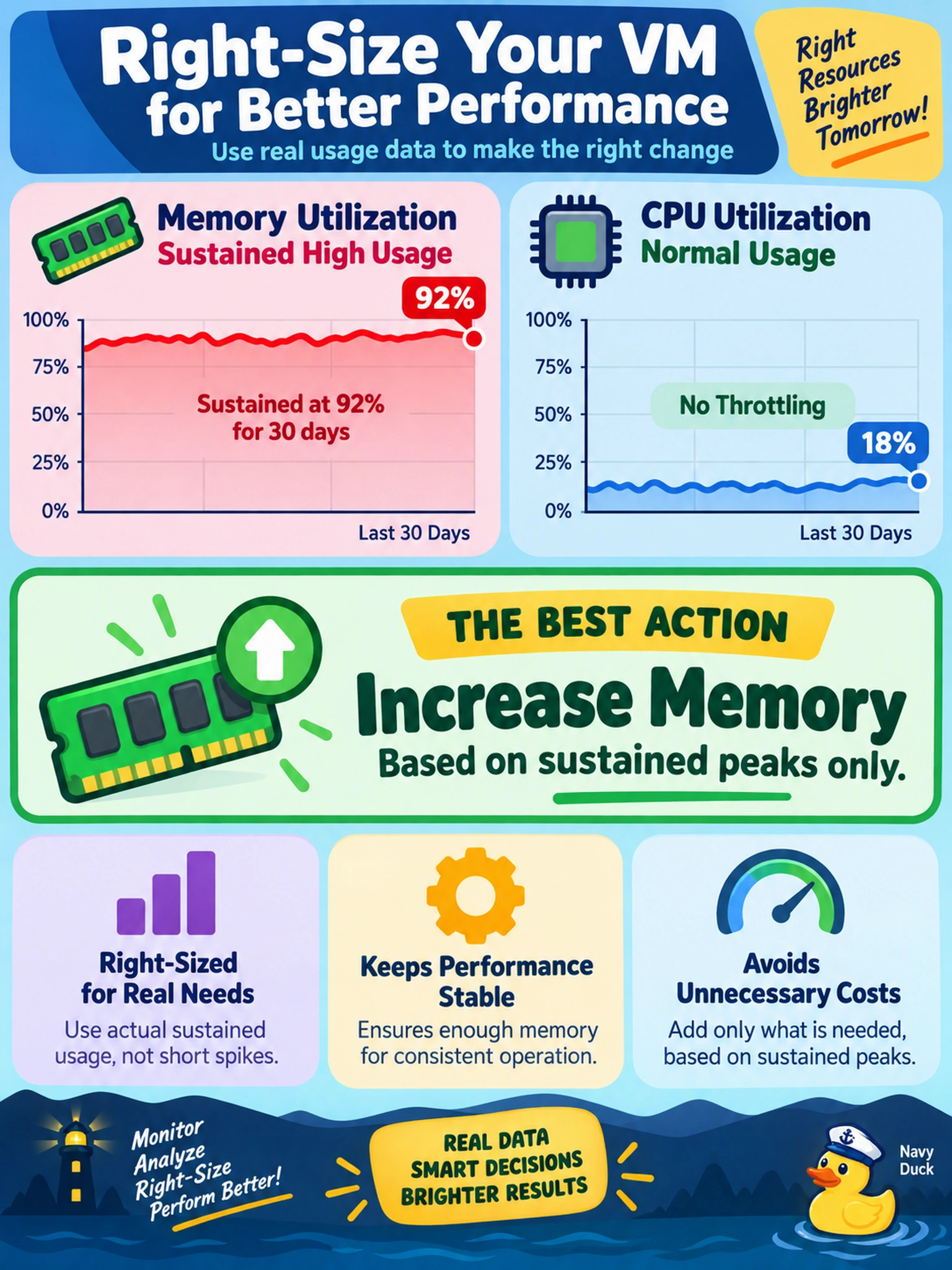
A Prism Central VM report shows sustained memory utilization at 92% for 30 days, while CPU averages 18% with no throttling. The administrator must right-size the VM for the next quarter. Which action is best?
Select an answer to reveal the explanation.
Short Explanation
Think of sizing like fueling a truck: you watch the tank that keeps running dry, not the one with room to spare. If memory is pegged and CPU is idle, you add memory and leave CPU alone. That avoids wasting capacity on a problem you don't have.
Full Explanation
Metric-driven right-sizing uses sustained utilization trends to identify the actual bottleneck, then changes only the constrained resource. When a VM shows prolonged high memory utilization while CPU remains low and not throttled, the correct adjustment is to increase memory to cover the observed sustained peak plus a defined headroom, while leaving vCPU unchanged. This aligns allocation with demand and avoids consuming scarce CPU capacity that the workload does not need. Doubling both vCPU and memory is arbitrary overprovisioning because it treats every metric as insufficient and ignores evidence that CPU is underused. Reducing vCPU to save capacity is wrong because CPU is not the bottleneck; shrinking it may introduce contention if the workload changes. Setting a CPU reservation equal to memory utilization is conceptually invalid because CPU reservations reserve CPU shares or MHz, not a percentage of memory, and reservations do not solve a memory shortage. Exam caveat: select the action supported by trended utilization and throttling evidence, not by owner preference or uniform growth assumptions. Operational check: review 30-day CPU and memory charts, calculate target memory from sustained peak plus headroom, apply the memory resize, then verify alerts and utilization after the workload runs.