
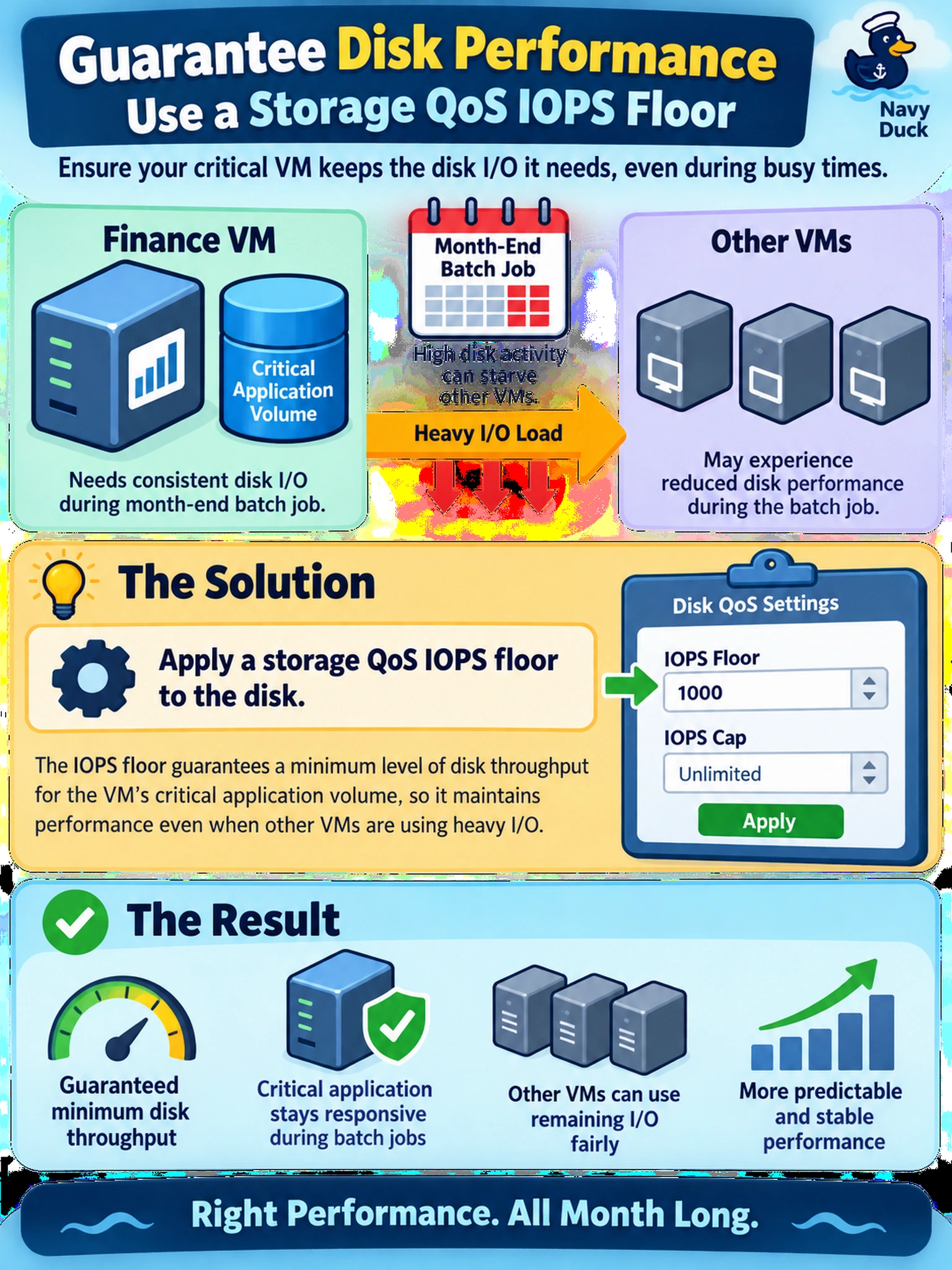
A finance VM on AHV must maintain disk I/O during a month-end batch job that can starve other VMs. The administrator needs to guarantee a minimum disk throughput for the VM’s critical application volume. Which setting should be applied?
Select an answer to reveal the explanation.
Short Explanation
Think of it like reserving a lane on a busy highway. You want the finance VM to keep its minimum IOPS even when everyone else is hammering the array, so you set a storage QoS IOPS floor on the disk. Don’t confuse that with HA or CPU reservations; those protect or schedule something else, not disk throughput.
Full Explanation
Nutanix Storage QoS controls virtual disk performance by applying IOPS floors and caps at the storage layer. An IOPS floor acts as a reservation for a VM disk, telling the system to preserve a minimum number of IOPS for that disk when other workloads compete for resources. This is the correct choice because the requirement is to guarantee disk I/O for a critical application volume, not merely to improve availability or allocate processor time. A CPU reservation changes hypervisor scheduling for vCPU resources; it does not influence storage scheduler decisions or disk IOPS availability. Enabling VM high availability protects against host failure by restarting or migrating a VM, but it does not shape or reserve storage performance while the VM is running. Increasing a container replication factor adds redundancy and changes durability and capacity use, but it does not set a minimum IOPS guarantee for a specific workload. Exam caveat: do not confuse availability features or redundancy settings with performance guarantees; QoS is the storage performance control. Operational check: review the VM disk QoS configuration in Prism and generate a sustained I/O load to confirm the configured floor is honored.