
A production web tier uses two identical AHV VMs for redundancy. You must prevent both from being placed on the same host during power-on and live migration. Which control should you apply?
Select an answer to reveal the explanation.
Short Explanation
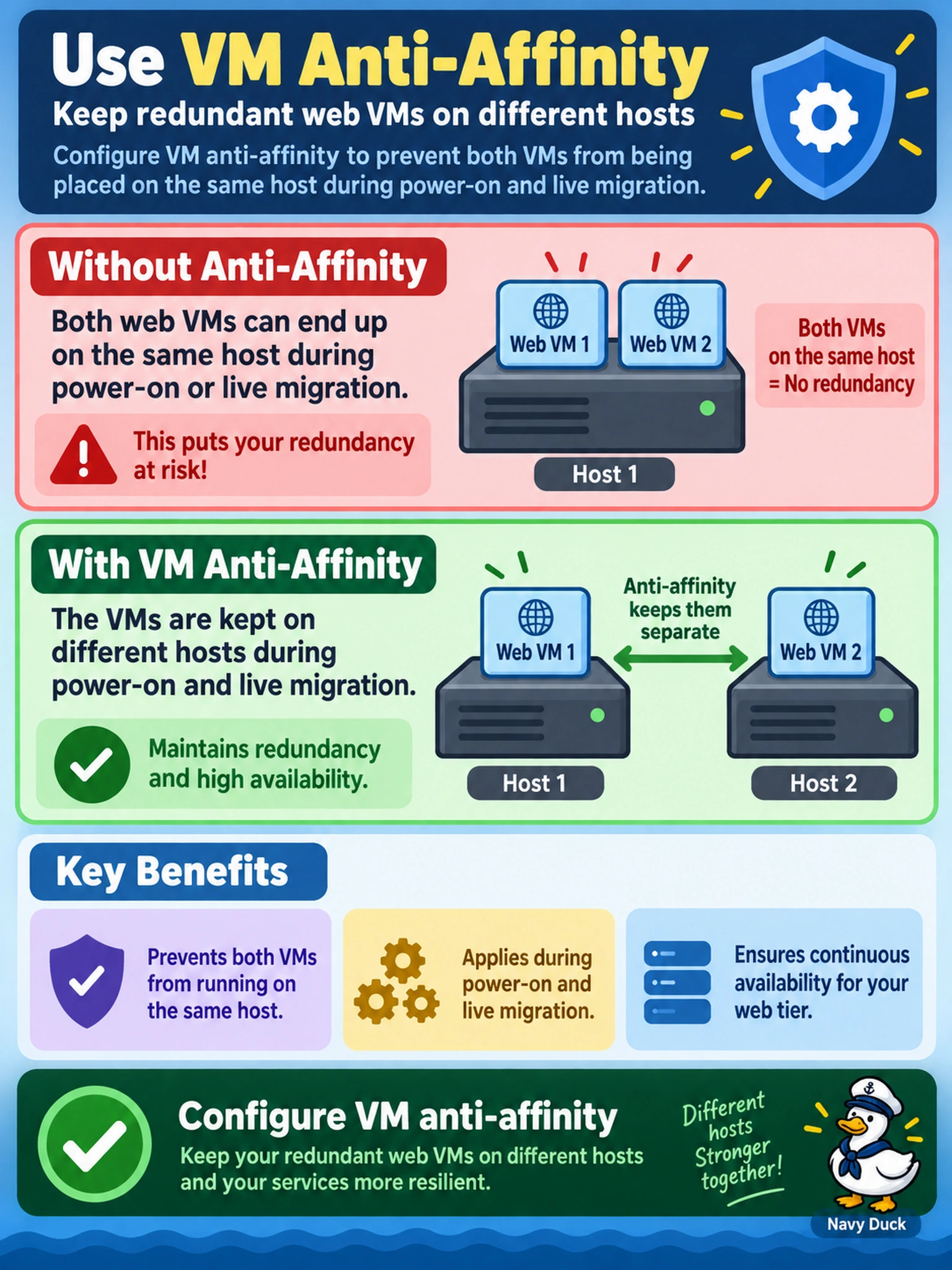
Think of placement rules like seating two backup singers: if you want them apart, you set an anti-affinity rule, not a reservation. You're tempted to raise CPU reservation, but that only guarantees resources, not where the VM lands. For redundant web VMs, anti-affinity keeps them off the same host, while a reservation doesn't.
Full Explanation
VM anti-affinity is a placement control that tells the hypervisor to keep the members of a defined group on separate hosts whenever possible. For a redundant pair, host separation matters because a single host failure or maintenance event should not remove both copies. The rule is evaluated during placement and migration, so it is the direct way to prevent both members from landing on the same host. VM affinity is the opposite concept because it tells placement to keep workloads together, which would increase risk for a redundant pair. A CPU reservation is a resource guarantee; it reserves compute capacity for a VM but does not specify host separation, so both workloads could still run on one host with adequate CPU. Storage oversubscription is a storage efficiency setting that allows more provisioned capacity than physically available and has no bearing on VM host placement. Exam caveat: anti-affinity depends on sufficient eligible hosts and supported placement paths; it is not a guarantee if capacity or maintenance constraints force placement elsewhere. Operational check: after powering on or migrating the workloads, confirm their host placement differs, then simulate or schedule a host maintenance event and verify both copies remain available.