
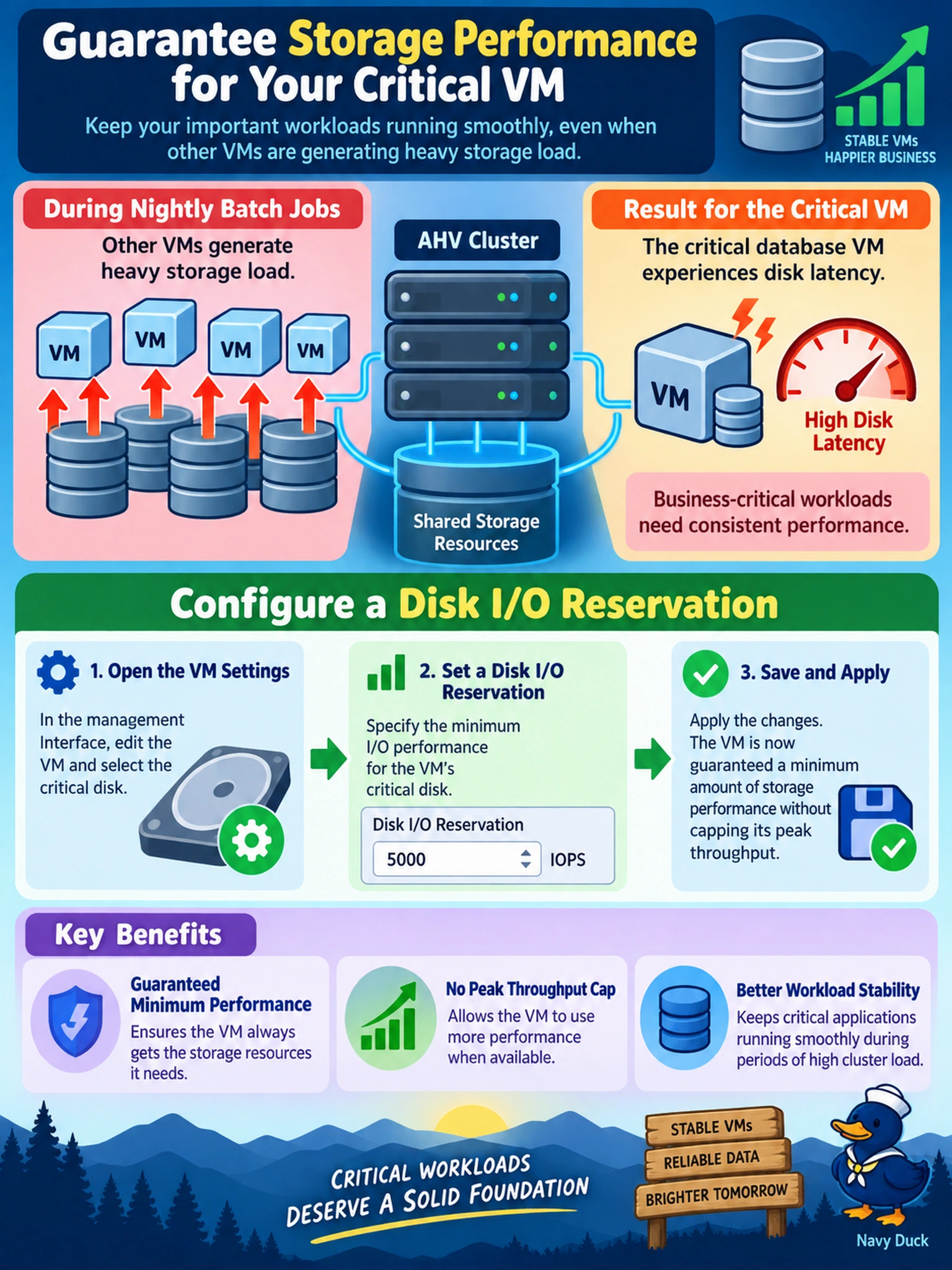
A business-critical database VM on AHV starts showing disk latency during nightly batch jobs, while other VMs on the same Nutanix cluster are generating heavy storage load. You need to guarantee this VM a minimum amount of storage performance without capping its peak throughput. Which control should you configure in Prism?
Select an answer to reveal the explanation.
Short Explanation
Think of storage contention like a busy highway: if your critical VM has no reserved lane, it gets stuck behind everyone else. A disk I/O reservation gives that VM a guaranteed lane, while a QoS cap just puts a speed limit on it. Don't confuse limiting a noisy neighbor with protecting the workload you care about.
Full Explanation
A disk I/O reservation is the control that protects a workload when multiple virtual machines compete for the same storage resources. It asks the storage layer to keep a baseline amount of storage performance available to the protected VM, so latency spikes caused by neighboring workloads do not consume all available I/O capacity. In a Nutanix AHV environment, this is applied at the VM disk level and is useful for latency-sensitive databases or transactional systems that need predictable performance during peak contention. A QoS IOPS cap is not the same mechanism. A cap sets an upper bound on the IOPS a VM or disk may generate, which is helpful for limiting a noisy neighbor, but it does not guarantee that the protected VM will receive enough performance when the cluster is busy. A VM affinity rule controls placement relationships between VMs or hosts, such as keeping VMs together or separating them, but it does not reserve storage performance. Increasing the memory reservation helps ensure RAM availability and can reduce ballooning or swapping, but it does not address disk latency or I/O contention on the storage pool. Exam caveat: exact menu labels and supported settings can vary across Prism and AOS versions, so focus on the function of each control rather than the path. Operational check: after setting the reservation, monitor VM disk latency and IOPS during the contention window to confirm the protected workload maintains its baseline performance.