
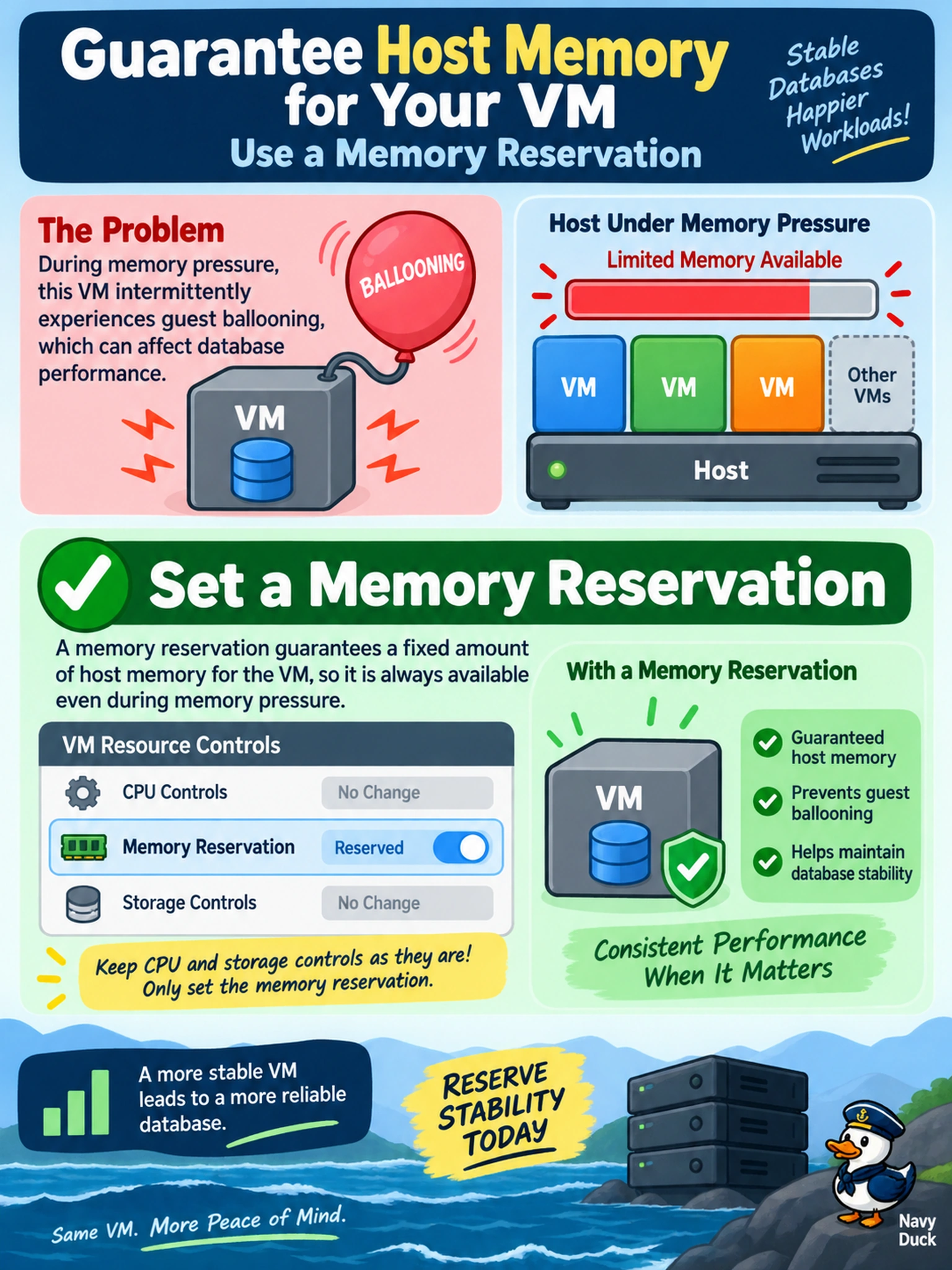
You manage an AHV VM running a database that intermittently suffers guest ballooning during memory pressure, and you must guarantee a fixed amount of host memory for it without changing CPU or storage controls. Which resource control should you apply?
Select an answer to reveal the explanation.
Short Explanation
Think of memory like a reserved parking space: if you don't reserve it, someone else can park there and your VM gets squeezed. Set a memory reservation when you need guaranteed host memory and want to keep ballooning from stealing it. The trap is picking CPU or QoS controls — they don't guarantee guest RAM.
Full Explanation
A memory reservation is the host-level guarantee that a defined amount of physical RAM is set aside for a virtual machine, so the hypervisor does not reclaim that memory through ballooning or other oversubscription techniques when other workloads demand it. In Nutanix AHV environments, this control is applied per VM to protect latency-sensitive or memory-bound applications, while the remainder of cluster memory can still be shared according to normal scheduling and memory-management behavior. A CPU reservation is incorrect because it protects processor scheduling priority or capacity, not the amount of RAM available to the guest; it cannot stop memory reclamation from causing ballooning. A memory limit is incorrect because it places a ceiling on the memory the VM may consume, which can reduce peak usage but does not reserve any minimum amount of physical memory. A storage QoS limit is incorrect because it controls disk bandwidth or IOPS behavior for storage performance, not host memory allocation or guest memory pressure. Exam caveat: on the exam, match the symptom to the resource dimension, because ballooning is always a memory oversubscription signal rather than a CPU or disk contention signal. Operational check: review the VM's configured memory reservation, guest ballooning counters, and host memory pressure before changing any non-memory resource control.