
An administrator configures an AHV host bond for active-active link aggregation across two 10 Gb NICs, but the upstream switch ports remain separate access ports. What must be configured on the switches so the aggregated link behaves as one logical connection?
Select an answer to reveal the explanation.
Short Explanation
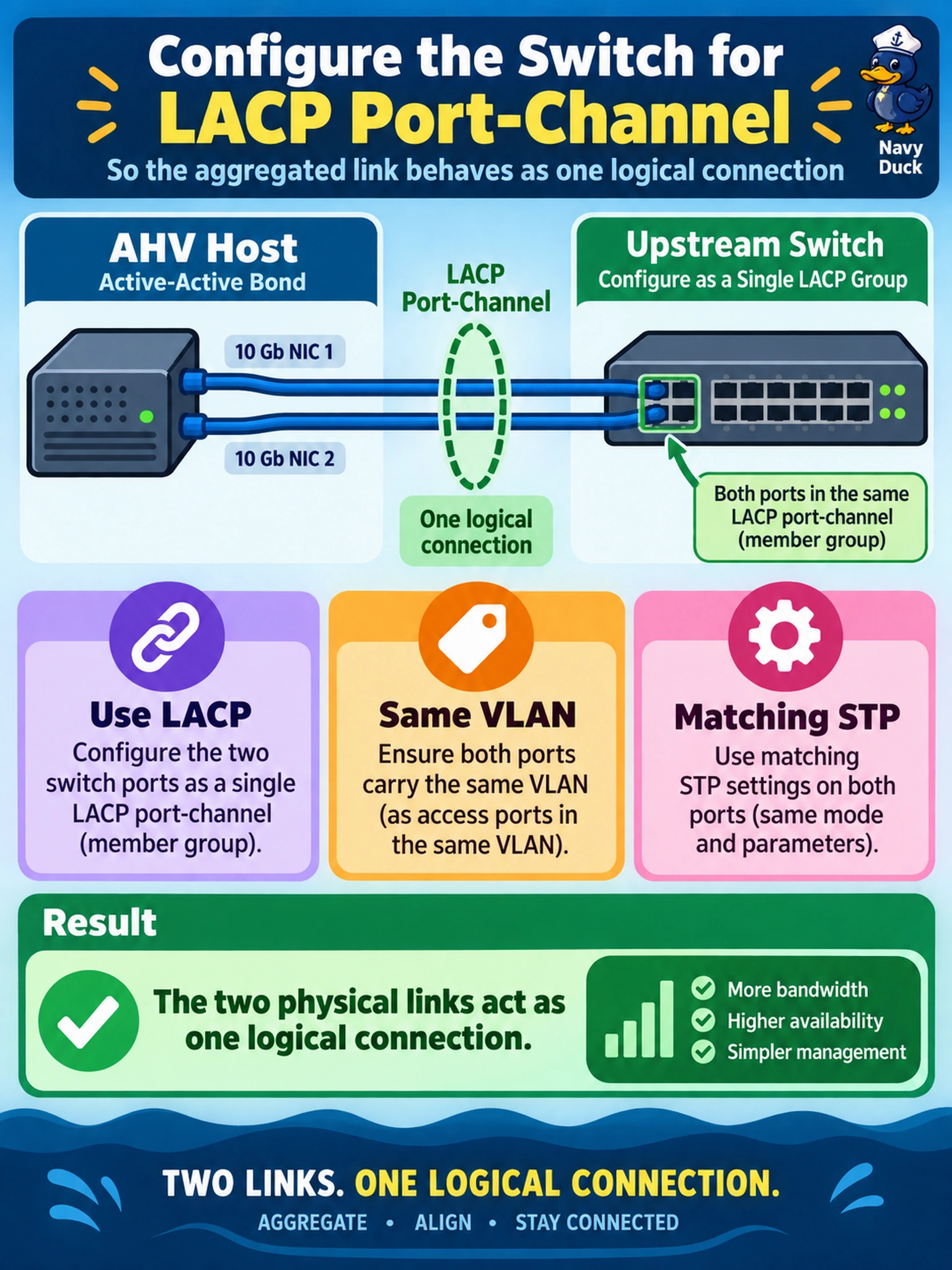
Think of an active-active bond like two lanes that must be merged by the switch, not just two random doors. If the switch doesn’t bundle the ports with LACP, the host sees a bond but the network sees two disconnected links. You need the switch side to agree before the aggregate can work.
Full Explanation
Active-active link aggregation on AHV relies on the hypervisor and upstream switch presenting the member links as one logical interface. The host may form a bond, but traffic distribution, loop avoidance, and failover behavior depend on the switch bundling the physical ports into a common aggregate group, typically with LACP or an equivalent static channel. The member ports must also carry the same VLAN membership and have compatible spanning-tree settings so the aggregate is treated as a single forwarding path. A different VLAN on each member splits the bond into unrelated access paths, so the host cannot load-share or fail over across them. Leaving the ports unaggregated and switching the host bond to active-backup avoids the switch dependency but does not deliver the requested active-active aggregation. Applying Flow network security controls to the bond changes traffic policy inside the cluster, not the physical switch port channeling required for link aggregation. Exam caveat: the exam may test the requirement that switch-side aggregation and matching VLAN/STP settings precede host-side active-active bonding. Operational check: verify the switch reports the member ports in one LACP or port-channel group and that the AHV bond reports both NICs as active before moving production VMs.