
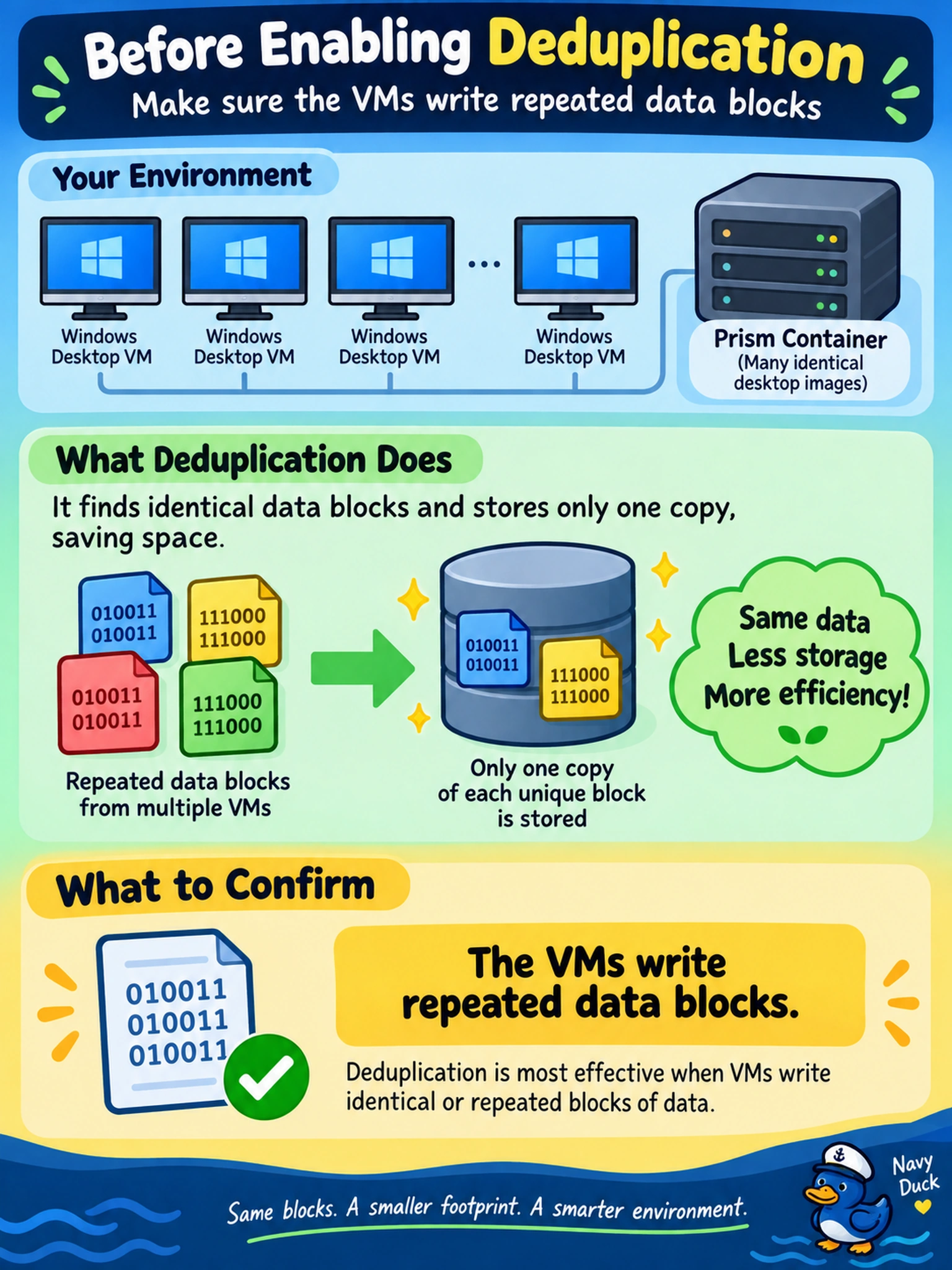
An administrator is evaluating deduplication for a Prism container that holds many identical Windows desktop images. What should be confirmed before enabling it?
Select an answer to reveal the explanation.
Short Explanation
Think of dedupe like a closet full of identical jackets: it only saves space if the jackets are really the same. If your VMs are writing repeated blocks, dedupe can shine; if not, you’re just adding overhead. Check the data pattern before flipping the switch.
Full Explanation
Deduplication in Nutanix AOS reduces capacity consumption by identifying and storing repeated data blocks once, so its benefit is determined by the actual data pattern written to the container. When a workload such as VDI, linked clones, or a database with repetitive pages writes many identical blocks, dedupe can materially lower logical footprint; when data is unique, encrypted, or already compressed, savings may be minimal while CPU and memory overhead remain. An engineer should therefore examine block-level similarity across VMs before enabling it. Compression is a different reduction technique that operates on entropy and repeated byte sequences within a block, so the presence of compression does not prove dedupe will be effective. EC-X erasure coding affects how data and parity are distributed for capacity efficiency and rebuild behavior, not whether data blocks are duplicates. High random IOPS describes performance behavior, not data similarity, and may increase dedupe overhead without improving space savings. Exam caveat: Nutanix dedupe effectiveness is workload-data dependent, not a guaranteed outcome of enabling a container setting. Operational check: sample representative VMs or use cluster reporting to estimate duplicate block percentage across the intended container before enabling dedupe.