
A calibrated check source has a certified activity of 0.50 microcuries. What is this source's disintegration rate expressed in disintegrations per minute (dpm)?
Select an answer to reveal the explanation.
Short Explanation
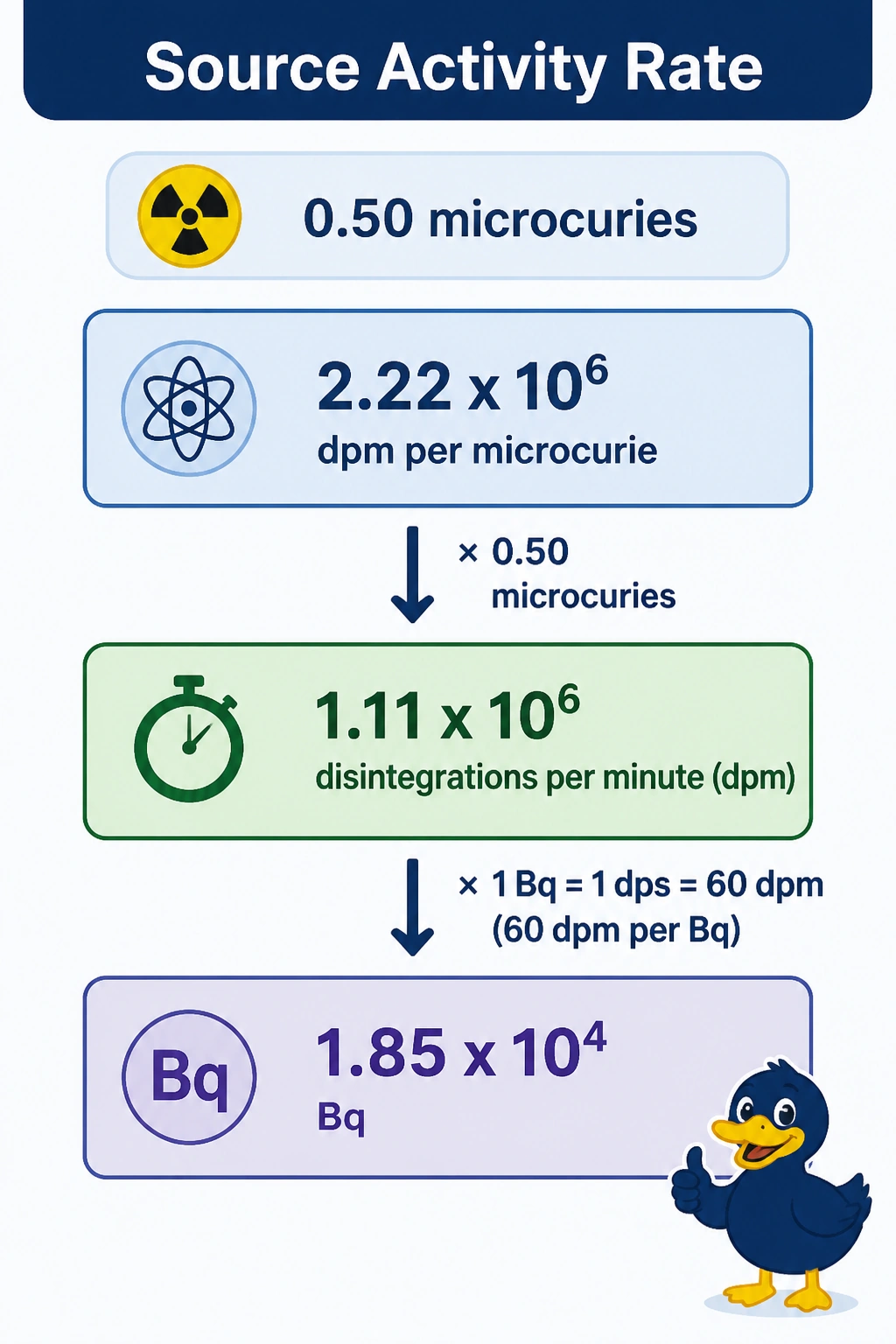
One microcurie packs 2.22 million nuclear decays every single minute, so half a microcurie lands right at 1.11 million. The trap is forgetting to convert seconds to minutes and stopping at becquerels, which leaves your answer sixty times too small.
Full Explanation
1.11 x 10^6 disintegrations per minute (1.85 x 10^4 Bq) is correct because 1 curie equals 3.7 x 10^10 disintegrations per second (2.22 x 10^12 dpm), making 1 microcurie equal to 2.22 x 10^6 dpm; multiplying 0.50 microcuries by 2.22 x 10^6 dpm per microcurie yields 1.11 x 10^6 dpm. 1.85 x 10^4 disintegrations per minute mistakes disintegrations per second (becquerels) for disintegrations per minute, omitting the factor of 60 seconds per minute. 1.11 x 10^4 disintegrations per minute reflects a two-order-of-magnitude power-of-ten error when scaling from curies to microcuries. 2.22 x 10^6 disintegrations per minute represents the activity of a full 1.0 microcurie source rather than 0.50 microcuries. A key caveat is that disintegration rate (dpm) describes true nuclear decay events in the source, not the counts per minute (cpm) observed on a detector, which also depends on counting efficiency and geometry. As an operational check, track units explicitly at every step—from microcuries to becquerels and then to dpm—and confirm the source certificate reference date for decay correction.
Prefer to study offline? Printable PDF study book + test engine ($7.50, unofficial). These questions stay free here.