
A nuclear reactor startup unit uses an Antimony-124 and Beryllium (Sb-Be) source to provide a steady neutron flux during initial criticality checks. By what nuclear reaction does this source generate neutrons?
Select an answer to reveal the explanation.
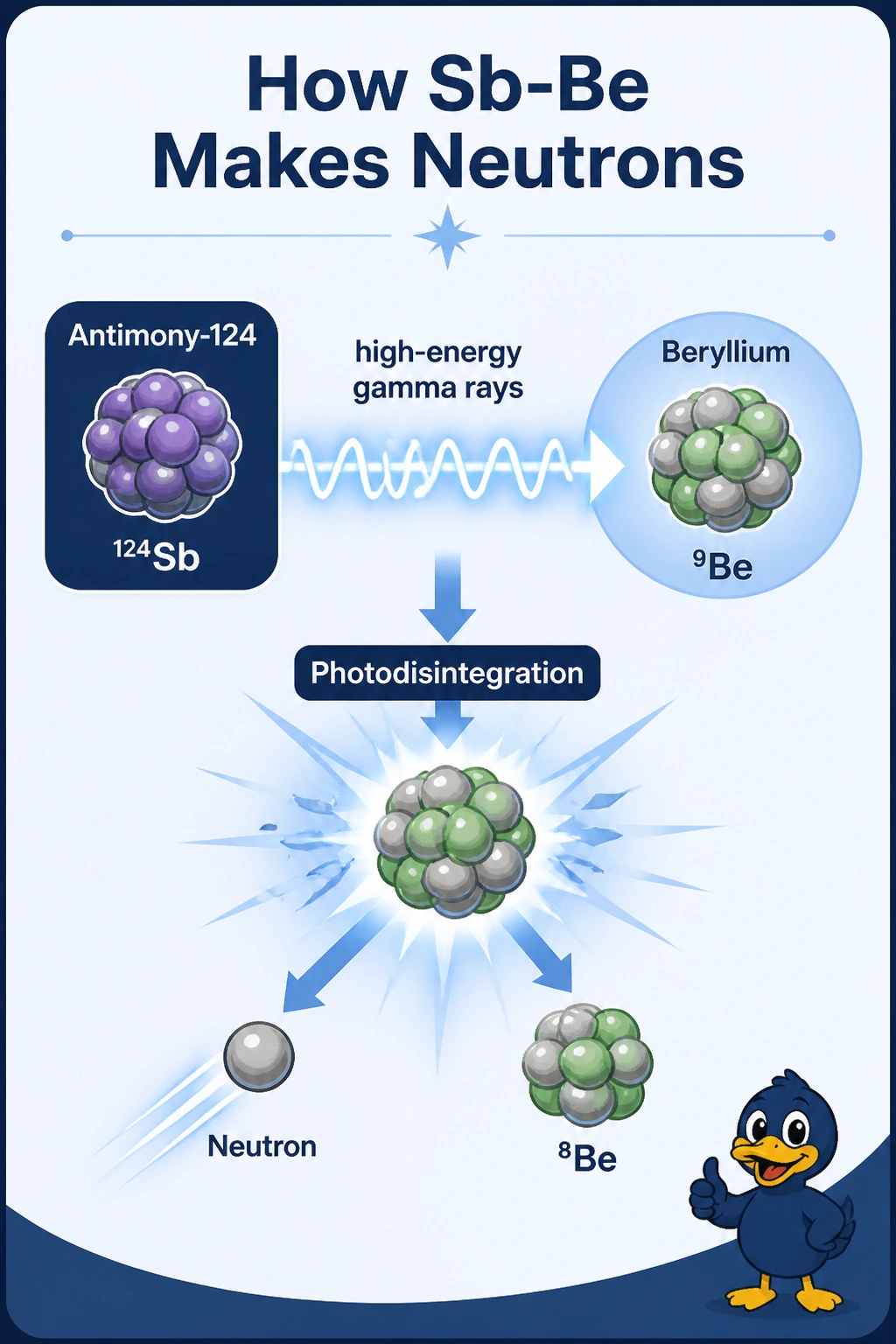
Short Explanation
Unlike alpha-neutron sources, an antimony-beryllium pair uses high-energy light rather than heavy particles to knock a neutron loose. Remember which target reacts to gamma rays so you do not confuse it with spontaneous fission or alpha bombardment.
Full Explanation
An Antimony-124 and Beryllium source is a classic photoneutron emitter that operates via Photodisintegration of beryllium induced by high-energy gamma rays. Antimony-124 emits high-energy gamma photons that exceed the binding energy threshold of the weakly bound ninth neutron in Beryllium-9, ejecting a neutron through a (gamma, n) reaction. Choosing Spontaneous nuclear fission of the antimony target is incorrect because Antimony-124 decays by beta-minus and gamma emission rather than undergoing spontaneous fission like Californium-252. Selecting Alpha-particle bombardment of the beryllium nucleus describes an (alpha, n) source such as Americium-Beryllium or Plutonium-Beryllium, whereas Antimony-124 is not an alpha emitter. Picking Deuterium-tritium fusion inside a sealed target tube refers to an accelerator-based neutron generator rather than a passive isotope-target assembly. As a caveat, because Antimony-124 has a relatively short half-life compared with actinide sources, reactor startup sources must be reactivated or replaced periodically and produce intense gamma fields alongside the neutrons. As an operational check, verify both gamma and neutron survey instruments before approaching an Sb-Be source, and confirm the antimony capsule is separated from the beryllium sleeve when neutron output must be halted.
Prefer to study offline? Printable PDF study book + test engine ($7.50, unofficial). These questions stay free here.