
Why do legacy radium-226 sealed sources pose a unique containment and leakage hazard compared with sealed cobalt-60 or cesium-137 sources?
Select an answer to reveal the explanation.
Short Explanation
Think of a pressurized soda can slowly building gas inside a vintage bottle: even a microscopic pinhole lets the gas escape. When you manage legacy radium-226 sources, the trap is treating them like solid metal emitters when they actually generate gaseous radon-222.
Full Explanation
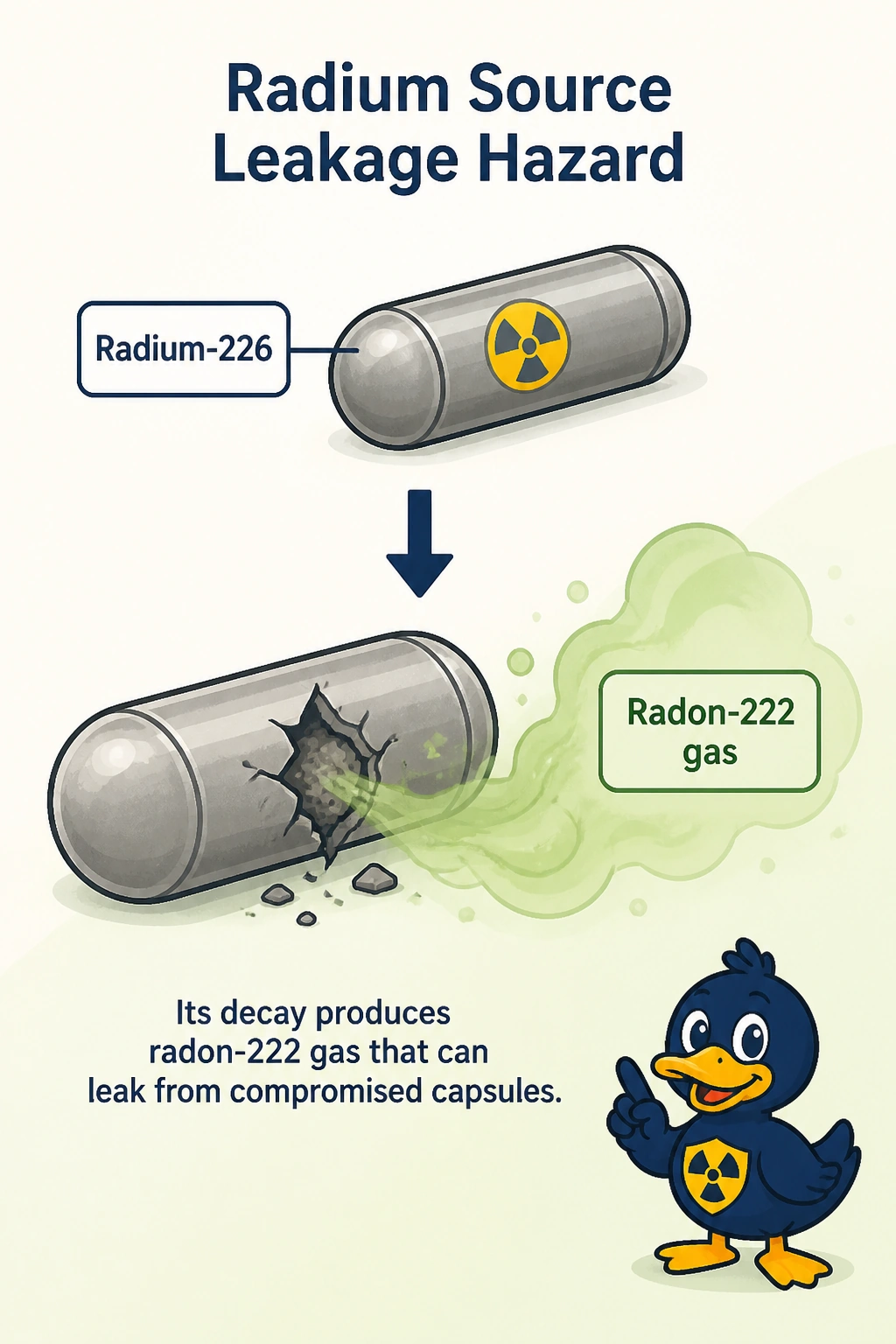
Radium-226 decays by alpha emission directly into radon-222, a radioactive noble gas with a 3.82-day half-life, which means Its decay produces radon-222 gas that can leak from compromised capsules. If the welded seal or capsule wall develops even a tiny crack, radon gas and its short-lived alpha-emitting progeny can escape into storage areas and create an airborne internal hazard. By contrast, cobalt-60 and cesium-137 decay into solid daughter nuclides that remain bound within the source matrix unless physically abraded. It emits high-energy neutrons that activate surrounding metal housing is incorrect because radium-226 does not emit neutrons on its own unless mixed with a light target such as beryllium. Its rapid radioactive decay requires weekly source replacement during calibration fails because radium-226 has a half-life of roughly 1,600 years, making its activity nearly constant over a human lifetime. It releases intense beta bremsstrahlung that saturates standard ion chambers is wrong because radium-226 is primarily an alpha emitter with progeny gammas rather than a pure high-energy beta source. As a caveat, intact modern double-encapsulated sources retain radon effectively, so risk centers on older corroded capsules. Always perform scheduled leak tests and inspect radium storage vaults for elevated airborne radon progeny.
Prefer to study offline? Printable PDF study book + test engine ($7.50, unofficial). These questions stay free here.