
An industrial radiography crew must inspect welds on medium-wall carbon steel piping rather than thick pressure-vessel castings. Why is Iridium-192 generally preferred over Cobalt-60 for this thinner steel application?
Select an answer to reveal the explanation.
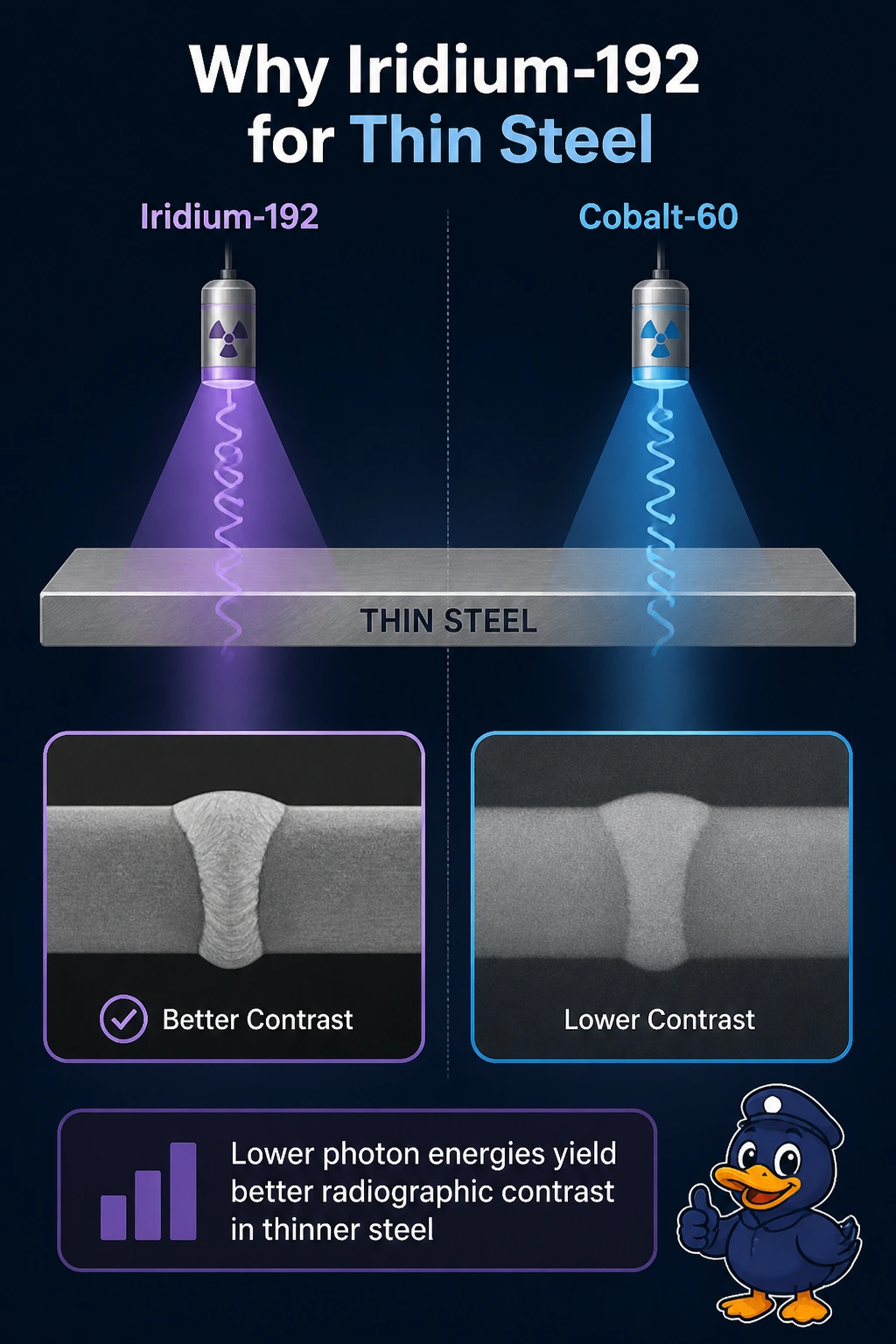
Short Explanation
Think of X-raying a thin sheet of paper with a floodlight versus a spotlight—if the beam blasts straight through without slowing down, you lose all the detail. Iridium-192 emits lower-energy gammas than Cobalt-60, giving you sharper contrast in thinner steel; the trap is thinking longer half-life always wins.
Full Explanation
Iridium-192 emits gamma photons predominantly in the 0.3 to 0.6 MeV range, which attenuate noticeably across thin-to-medium steel thicknesses and create clear density differences on film or digital plates, meaning Lower photon energies yield better radiographic contrast in thinner steel. Selecting Longer physical half-life eliminates frequent source replacements describes Cobalt-60 (about 5.27 years) rather than Iridium-192 (about 74 days), which actually requires more frequent source exchanges. Choosing Pure beta emission removes the need for heavy projector shielding is incorrect because Iridium-192 is a strong gamma emitter requiring depleted uranium or tungsten camera shielding. Picking Zero-neutron emission avoids activating the inspected steel pipe is irrelevant because neither Iridium-192 nor Cobalt-60 emits neutrons capable of activating carbon steel. As a caveat, Cobalt-60's higher 1.17 and 1.33 MeV gamma photons are still required when penetrating very thick steel sections where Iridium-192 would require impractical exposure times. Before dispatching a radiography camera, verify the source isotope, current decay-corrected activity, and steel thickness range against the exposure technique chart.
Prefer to study offline? Printable PDF study book + test engine ($7.50, unofficial). These questions stay free here.