
An industrial radiographer wears a calibrated electronic alarming ratemeter on the belt during field gamma radiography. Why can this device not replace a handheld radiation survey meter when confirming source retraction after an exposure?
Select an answer to reveal the explanation.
Short Explanation
Your belt-worn alarming ratemeter is like a smoke detector that shouts when danger reaches you, whereas a survey meter is a flashlight you sweep right along the pipe. Relying only on your belt alarm misses a source stuck partway down the guide tube until you walk too close.
Full Explanation
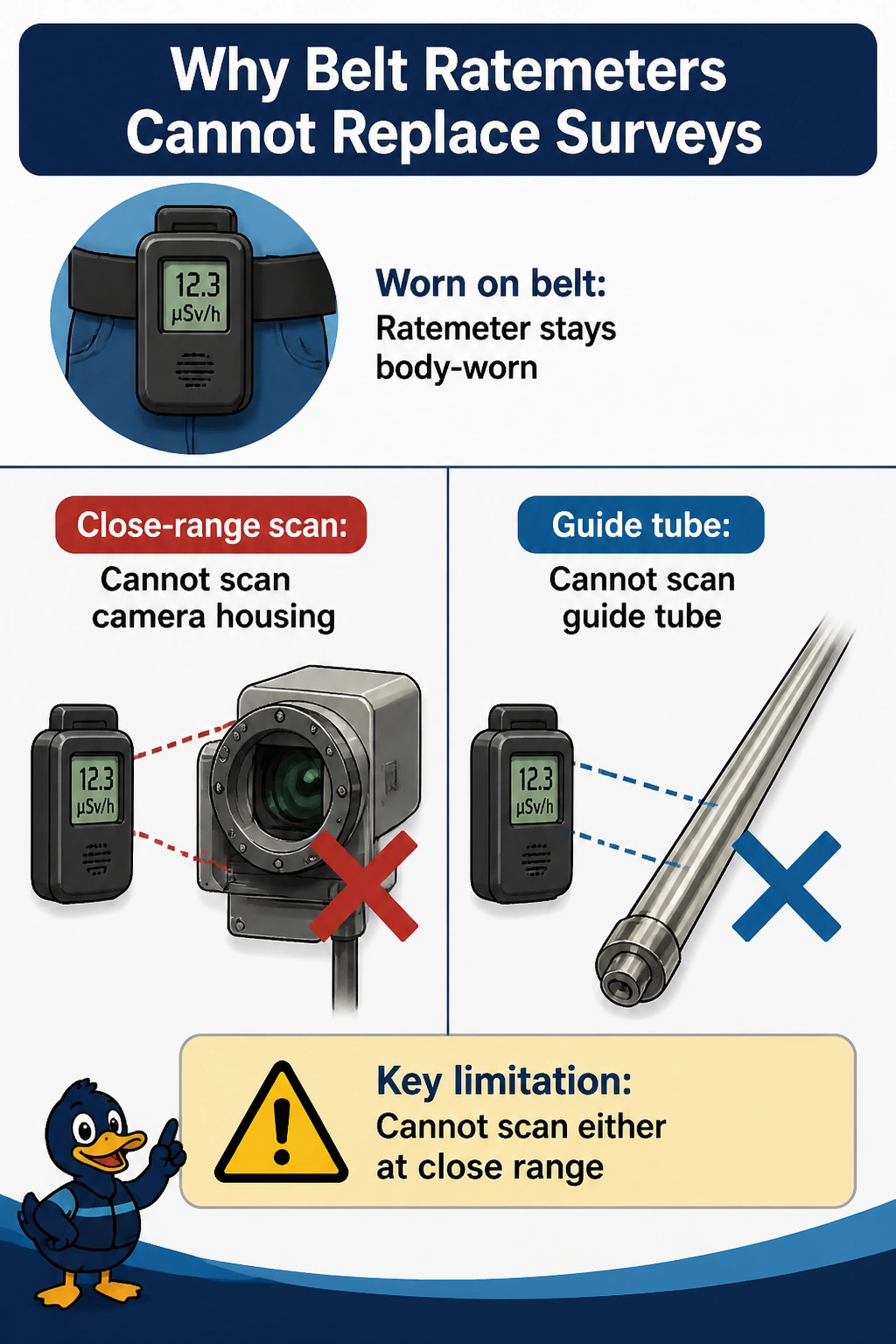
Under NRC 10 CFR 34.49, an industrial radiographer must perform a physical survey with a calibrated, operable radiation survey instrument after every exposure to verify that the sealed source has returned to its fully shielded position. A body-worn ratemeter cannot scan the camera housing and guide tube at close range, and an alarming ratemeter only triggers when the dose rate at the wearer's torso exceeds a preset alarm threshold. Without sweeping the entire circumference of the exposure device and the full length of the guide tube, a partially retracted source could remain undetected. An alarming ratemeter only responds to alpha and beta particles rather than gamma photons is false because radiography ratemeters are specifically designed for gamma and X-ray fields. An alarming ratemeter cannot detect radiation fields below the occupational annual dose limit confuses a dose-rate alarm setpoint with an annual cumulative dose limit. Electronic ratemeters must be zeroed after every exposure before they can measure dose rates describes integrating pocket dosimeters rather than continuous dose-rate meters. As a regulatory caveat, the alarming ratemeter is required in addition to, never instead of, the handheld survey meter. Operationally, approach the camera while watching the survey meter and sweep 360 degrees around the housing and along the guide tube.
Prefer to study offline? Printable PDF study book + test engine ($7.50, unofficial). These questions stay free here.