
Under NRC 10 CFR 34.49, what radiation survey must an industrial radiographer perform immediately after cranking a sealed gamma source back into its exposure device after each exposure?
Select an answer to reveal the explanation.
Short Explanation
Cranking the handle back is never proof that a radiography source actually made it home into the shield. The trap is assuming the mechanical lock tells the whole story instead of walking your survey meter right up to the camera and guide tube.
Full Explanation
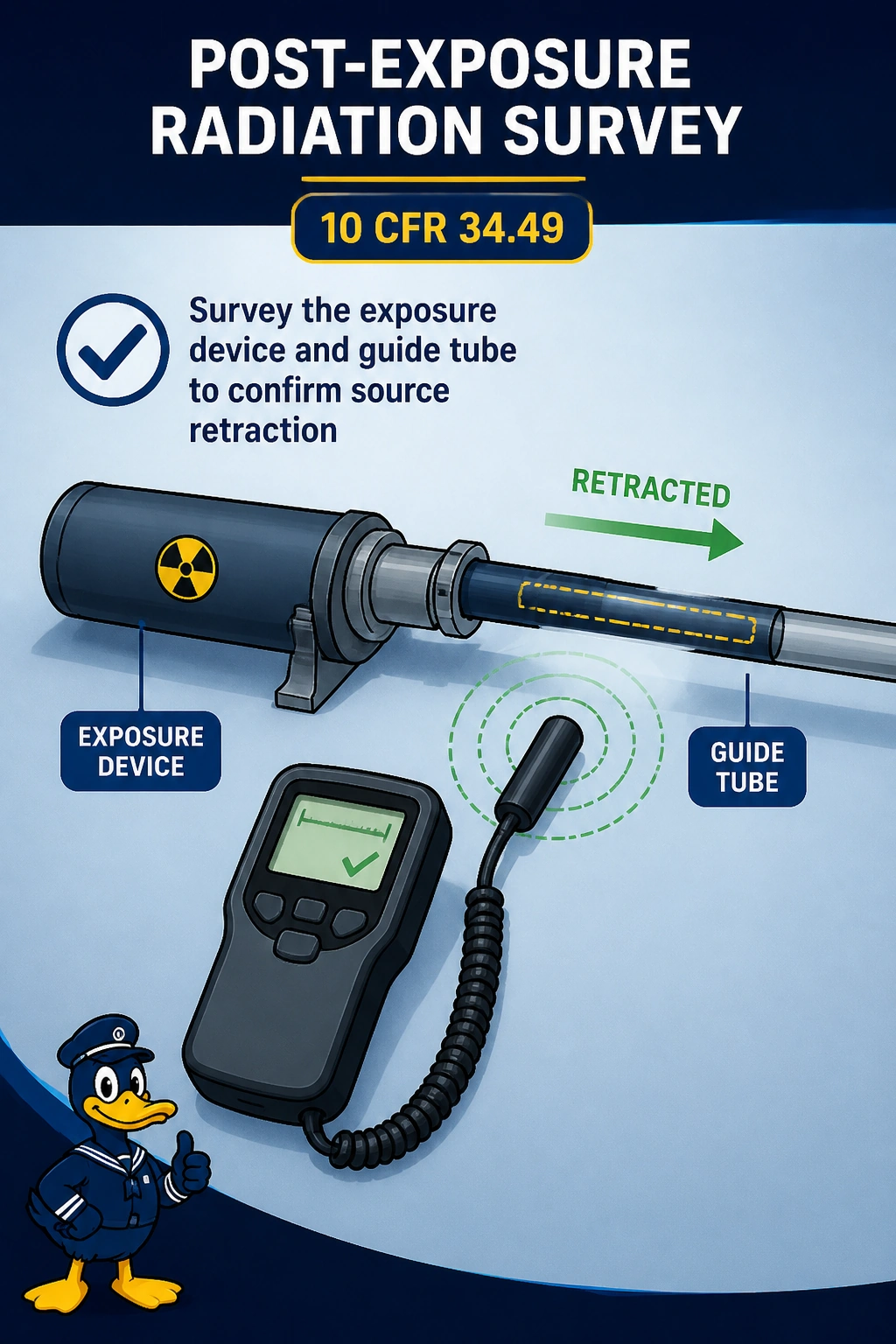
Under NRC 10 CFR 34.49, after each radiographic exposure the radiographer must Survey the exposure device and guide tube to confirm source retraction. Mechanical crank-out cables can bind, kink, or disconnect, leaving a high-activity Iridium-192 or Cobalt-60 source partially exposed in the guide tube while the operator assumes it is shielded; sweeping the entire camera and guide tube with an operating survey meter confirms radiation levels have returned to normal shielded values. Collect a 100 cm² smear wipe from the exposure device to check for leakage is a periodic six-month requirement under 10 CFR 34.27 rather than an immediate post-exposure check. Survey only the perimeter rope boundary to verify public dose compliance fails to confirm that the source itself is safely housed before approaching the camera. Measure the ambient dose rate inside the darkroom before developing film has nothing to do with verifying source retraction at the exposure site. As a caveat, approach the exposure device while watching the survey meter continuously so an unshielded source is detected from a safe distance. As an operational check, perform a full 360-degree survey of the camera and the entire length of the guide tube before locking the device or moving the tripod.
Prefer to study offline? Printable PDF study book + test engine ($7.50, unofficial). These questions stay free here.