
A radiation worker at an NRC-licensed facility performs maintenance near an unshielded beta-gamma source that delivers elevated dose rates at eye level. Under 10 CFR 20.1201, what is the annual occupational lens dose equivalent limit for an adult worker?
Select an answer to reveal the explanation.
Short Explanation
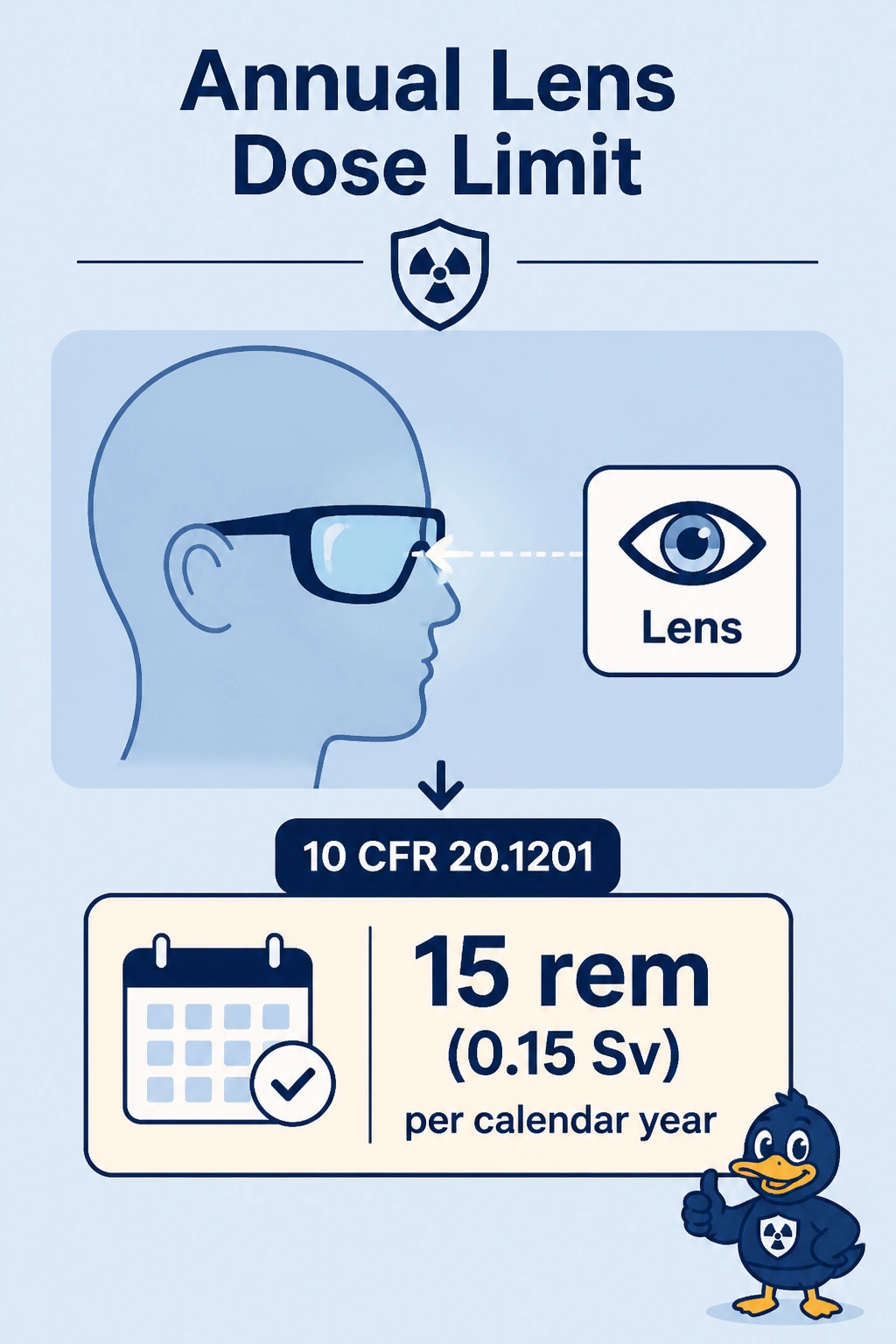
Your eyes are more sensitive to radiation-induced cataracts than your whole body is, yet they have a higher annual limit than TEDE. The trap here is mixing up the lens limit with either the whole-body TEDE cap or the much higher skin and extremity limit. Under 10 CFR 20.1201, an adult worker's annual lens dose equivalent limit is 15 rem (0.15 Sv).
Full Explanation
Under 10 CFR 20.1201, the NRC sets an annual occupational lens dose equivalent (LDE) limit of 15 rem (0.15 Sv) per calendar year for adult radiation workers. This limit specifically protects the crystalline lens of the eye from deterministic radiation-induced opacities and cataracts at a tissue depth of 0.3 centimeters. By contrast, 5 rem (0.05 Sv) per calendar year is the annual Total Effective Dose Equivalent (TEDE) limit for the whole body, which addresses overall stochastic risk rather than eye lens sensitivity. Choosing 50 rem (0.50 Sv) per calendar year confuses the lens limit with the annual shallow-dose equivalent limit for the skin or extremities and the organ committed dose equivalent cap. Meanwhile, 0.5 rem (0.005 Sv) per calendar year reflects the dose limit for the embryo or fetus of a declared pregnant woman over the entire pregnancy, or the ten-percent limit for occupationally exposed minors. As an important regulatory caveat, 10 CFR 20.1201(f) requires the licensee to reduce the dose allowed for the rest of the current year by occupational dose already received during that same year while employed by any other person, documented under 10 CFR 20.2104 (NRC Form 4); dose from earlier calendar years does not reduce this year's annual limit, and eye dose from weakly penetrating beta radiation can dominate if protective eyewear is omitted. Operationally, verify that your dosimetry program assigns a collar or head badge when eye-level beta-gamma fields exceed whole-body torso levels.
Prefer to study offline? Printable PDF study book + test engine ($7.50, unofficial). These questions stay free here.