
Under NRC 10 CFR 20.1208, what is the occupational dose equivalent limit for the embryo or fetus during the entire pregnancy of a declared pregnant woman?
Select an answer to reveal the explanation.
Short Explanation
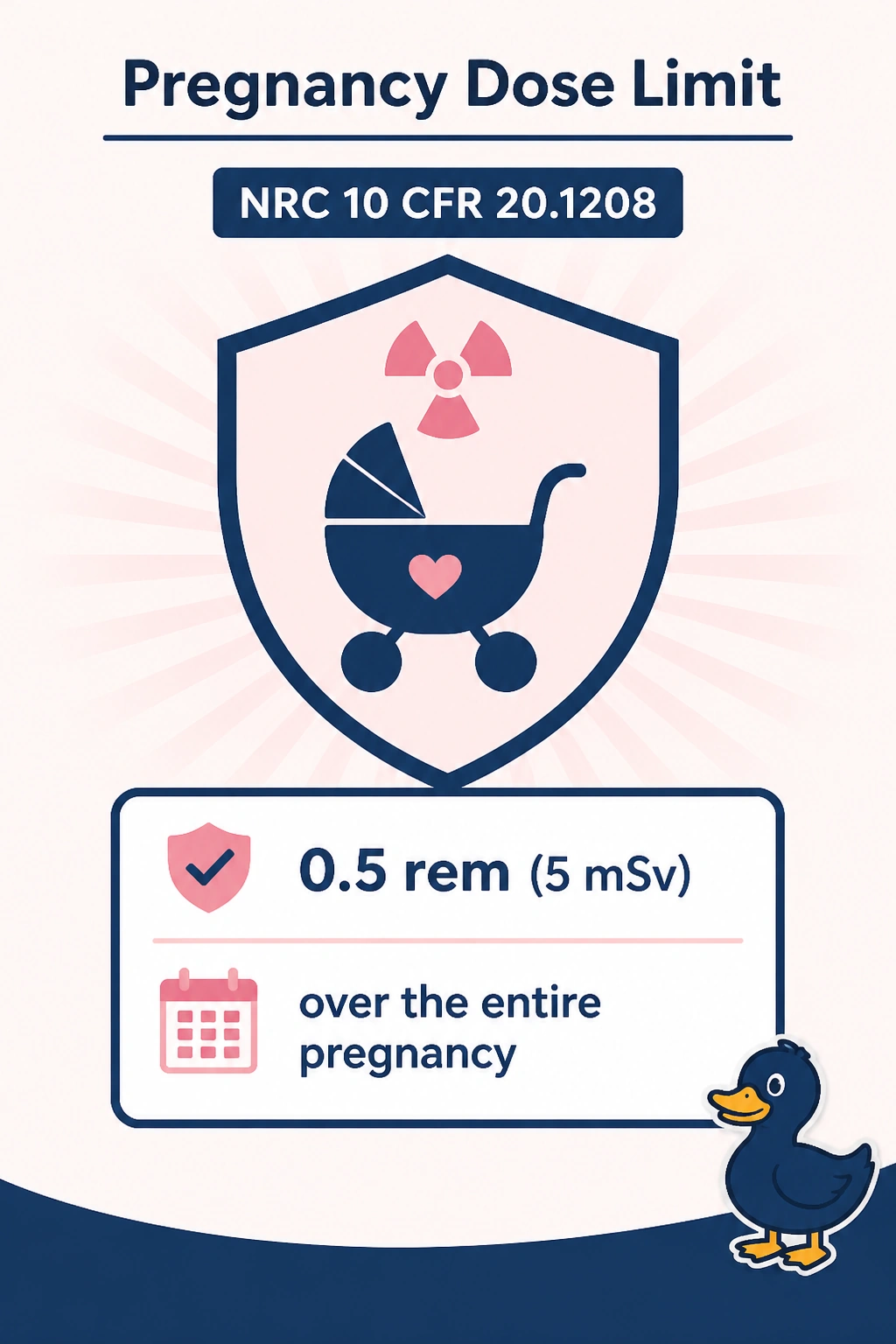
When a worker formally declares a pregnancy, the regulatory safety margin tightens to protect developing tissue. You must keep the dose to the embryo or fetus within 0.5 rem (5 mSv) over the entire pregnancy under 10 CFR 20.1208. A common trap is confusing that limit with the 0.1 rem public limit or the 5.0 rem standard adult occupational limit.
Full Explanation
0.5 rem (5 mSv) over the entire pregnancy is the binding occupational dose equivalent limit for the embryo or fetus under 10 CFR 20.1208 once a woman voluntarily declares her pregnancy in writing. This limit sums both external deep-dose equivalent to the woman and internal dose to the embryo or fetus from radionuclides in the mother and the embryo or fetus. 0.1 rem (1 mSv) total effective dose equivalent is the annual dose limit for individual members of the public under 10 CFR 20.1301, not the declared pregnant worker fetal limit. 1.0 rem (10 mSv) excluding internal intakes is incorrect because the regulatory limit is half that value and explicitly includes both external and internal contributions. 5.0 rem (50 mSv) matching the adult annual limit applies to an adult radiation worker under 10 CFR 20.1201 and does not provide the additional fetal protection required after declaration. As a caveat, if the embryo or fetus has already received 0.5 rem or more by the time pregnancy is declared, 10 CFR 20.1208 restricts additional dose for the remainder of the pregnancy to 0.05 rem (0.5 mSv). As an operational check, review the worker's prior dosimetry records upon written declaration and issue a supplemental fetal dosimeter worn at the abdomen along with monthly dose tracking.
Prefer to study offline? Printable PDF study book + test engine ($7.50, unofficial). These questions stay free here.