
When evaluating an airborne intake of Uranium-238 under NRC 10 CFR 20 Appendix B, why does insoluble uranium dioxide (Class Y) have a substantially more restrictive Annual Limit on Intake (ALI) than soluble uranium hexafluoride (Class D)?
Select an answer to reveal the explanation.
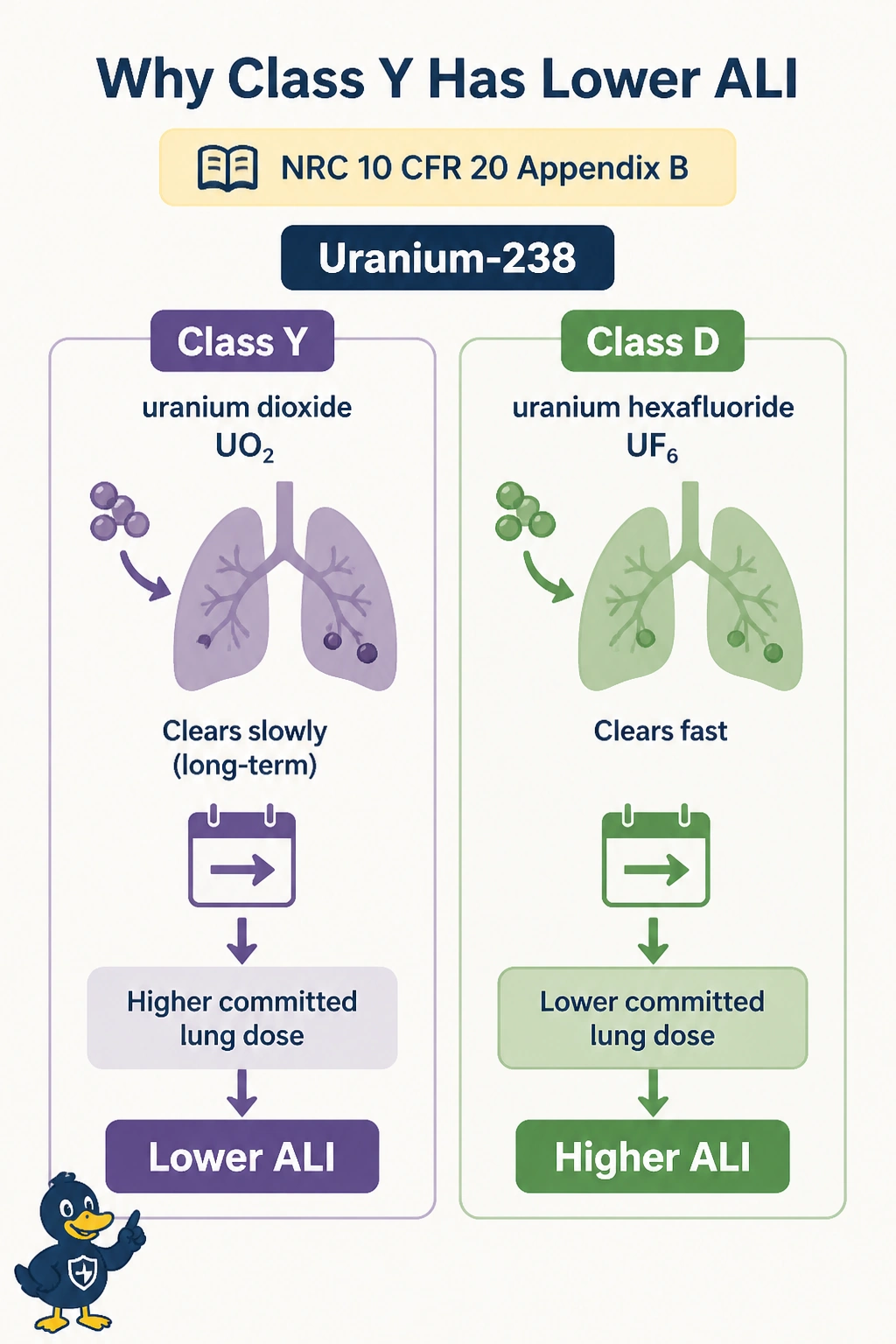
Short Explanation
Think of lung clearance classes like houseguests: Class D leaves in days, while Class Y refuses to leave for years. Because insoluble Uranium-238 stays parked in your pulmonary tissue, it delivers a much larger committed lung dose per microcurie inhaled, forcing a tighter ALI. The trap is thinking soluble forms are always worse or that chemical form changes decay energy.
Full Explanation
Under NRC 10 CFR 20 Appendix B, inhalation clearance classes D (days), W (weeks), and Y (years) describe how long a compound remains in the pulmonary region, so Class Y compounds clear slowly from the lungs, increasing committed lung dose is the correct reason for the tighter ALI. Because insoluble uranium dioxide persists in lung tissue for years, each inhaled microcurie delivers far more alpha energy to the lungs over the 50-year integration period, lowering the permitted intake. Class Y compounds emit higher-energy alpha particles than soluble Class D forms is wrong because chemical form does not alter nuclear decay energies. Class Y compounds bypass upper-airway filtration and deposit directly in bone fails because particle size governs airway deposition, and insoluble Class Y material remains in the lungs rather than translocating rapidly to bone. Class Y compounds dissolve rapidly into the bloodstream and concentrate in kidneys actually describes soluble Class D behavior, not insoluble Class Y retention. As a regulatory caveat, soluble uranium also poses chemical kidney toxicity alongside its radiological limits. Operationally, always verify the chemical form of airborne uranium on air-sample evaluations before selecting the Appendix B ALI and DAC.
Prefer to study offline? Printable PDF study book + test engine ($7.50, unofficial). These questions stay free here.