
A worker potentially inhales insoluble Plutonium-239 dioxide (PuO2) particles during a glovebox containment breach. Which bioassay method provides the most sensitive early assessment of cleared particles during the first few days post-intake?
Select an answer to reveal the explanation.
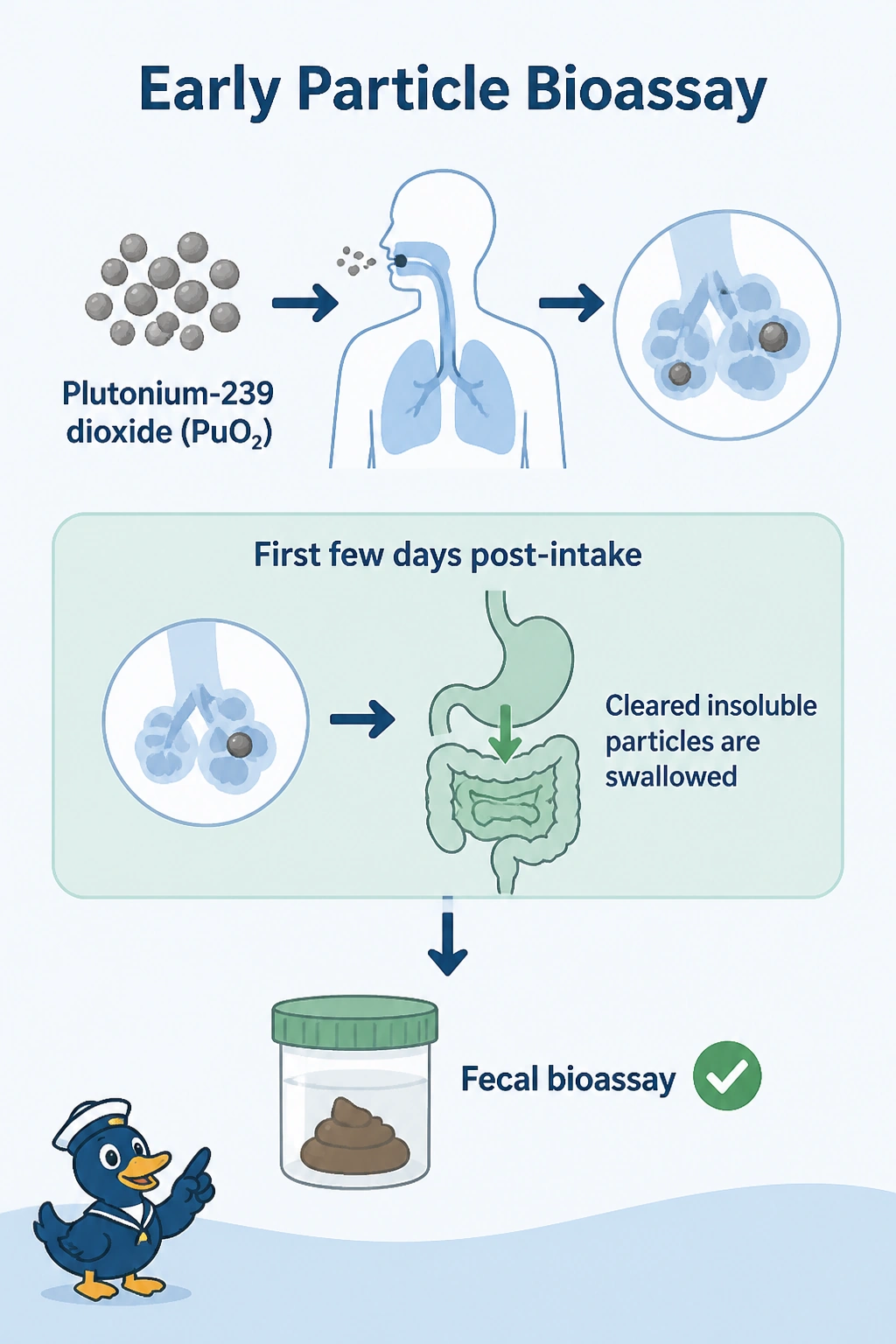
Short Explanation
Insoluble plutonium oxide behaves like fine grit in your lungs rather than dissolving into your bloodstream right away. Your airways sweep many particles up into your throat, where you swallow them, so early urine checks can miss what fecal bioassay catches.
Full Explanation
Inhaled insoluble actinide oxides such as Plutonium-239 dioxide are absorbed slowly from the lungs into systemic circulation. Fecal bioassay is therefore the most sensitive early assessment during the first few days: the mucociliary escalator moves deposited particles from the upper respiratory tract into the throat to be swallowed and excreted through the gastrointestinal tract. Whole-body gamma counting is unsuitable because Pu-239 is predominantly an alpha emitter; its very low-abundance, low-energy L X-rays are heavily attenuated by body tissue, rather than providing the high-energy photons this method would require. Urine bioassay alone is not appropriate because insoluble Class Y/Type S plutonium dioxide transfers very slowly to blood and produces minimal early urinary excretion, rather than dissolving rapidly in blood. Thyroid neck counting is also unsuitable: radioiodine, not plutonium, concentrates in the thyroid; plutonium deposits primarily in the lungs, liver, and bone. One caveat is that early fecal excretion reflects clearance from the upper airways, not deep-lung systemic retention, so it does not by itself establish the final dose. As a practical check after a confirmed alpha airborne event, promptly initiate fecal sample collection and interpret the results in the context of the intake and subsequent follow-up.
Prefer to study offline? Printable PDF study book + test engine ($7.50, unofficial). These questions stay free here.