
When passing through soft tissue or air, why do alpha particles travel in nearly straight, dense tracks while beta particles follow erratic, zig-zag paths?
Select an answer to reveal the explanation.
Short Explanation
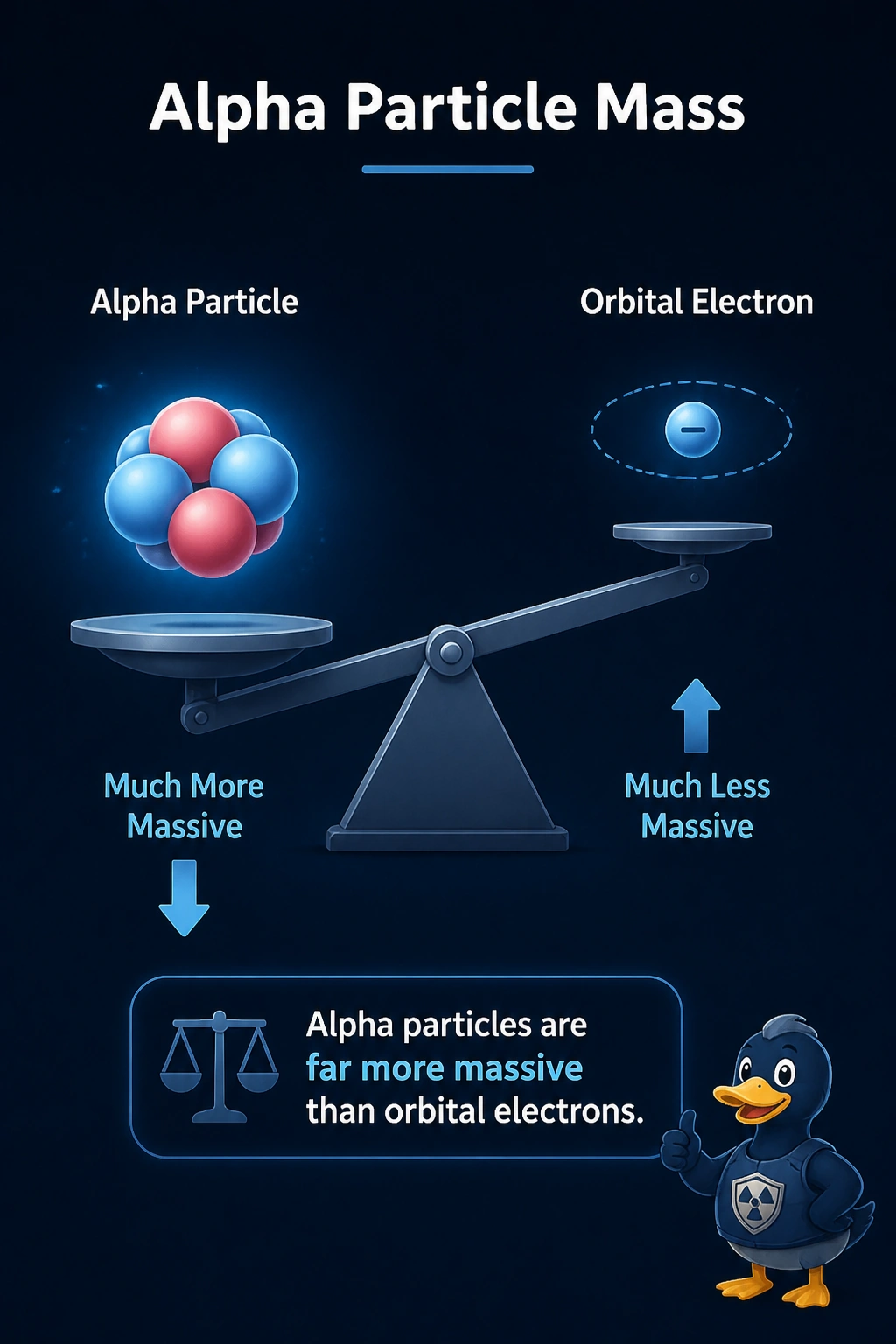
Picture a bowling ball plowing through ping-pong balls versus one ping-pong ball bouncing off another, and you immediately see why alpha tracks stay straight. Because alpha particles outweigh orbital electrons by thousands of times, they barely deflect on impact; the trap is thinking alphas ignore electrons.
Full Explanation
An alpha particle has more than 7,000 times the mass of an atomic electron, so each Coulomb collision transfers only a tiny fraction of its energy and causes negligible deflection, which is why Alpha particles are far more massive than orbital electrons. Choosing Alpha particles carry less kinetic energy than typical beta particles is false because alpha particles typically carry 4 to 9 MeV, which is higher than most beta emissions. Selecting Alpha particles interact only with atomic nuclei rather than electrons is incorrect because alpha energy loss occurs overwhelmingly through Coulomb interactions with orbital electrons. Picking Beta particles undergo nuclear fission inside low-Z tissue atoms describes a nuclear reaction that beta particles cannot induce in soft tissue. As a caveat, because light beta particles scatter through large angles easily, backscatter from high-Z surfaces can significantly increase beta dose rates near a shield. When measuring beta fields or calibrating beta detectors, always verify source backing material and window thickness to account for backscatter and self-absorption.
Prefer to study offline? Printable PDF study book + test engine ($7.50, unofficial). These questions stay free here.