
When a gamma photon undergoes Compton scattering with an orbital electron, at what photon scattering angle does the recoil electron receive the maximum possible kinetic energy?
Select an answer to reveal the explanation.
Short Explanation
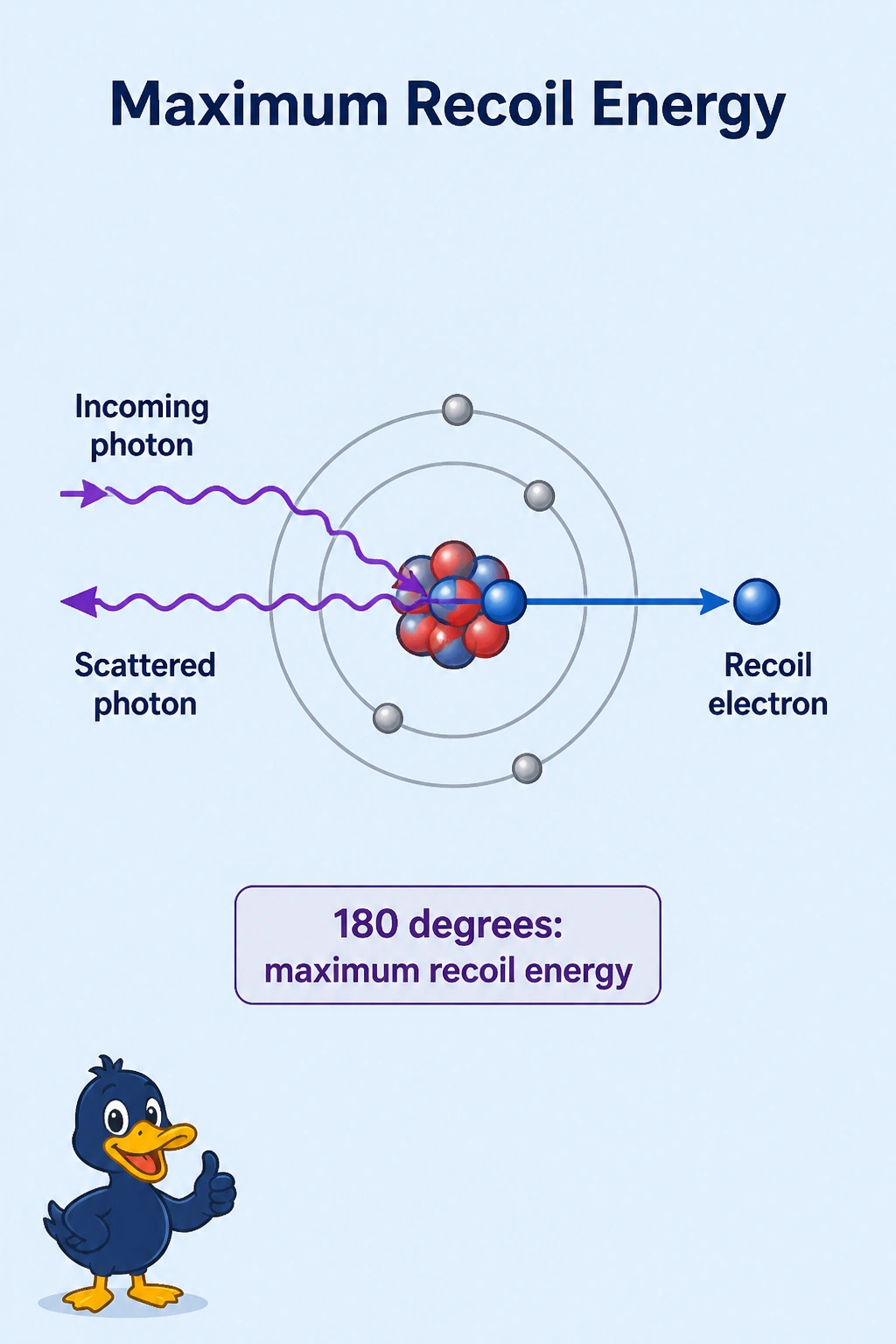
Picture a head-on billiard-ball bounce: when the photon reverses direction in a 180-degree backscatter, you get the biggest energy transfer to the recoil electron. As you analyze Compton spectra, remember that neither a straight-through pass nor a 45-degree or 90-degree scatter gives the electron as much kinetic energy.
Full Explanation
Conservation of energy and momentum in Compton scattering means the scattered photon retains the least energy when its deflection angle is greatest. At 180 degrees, the photon backscatters directly opposite its initial path, so the recoil electron receives the maximum kinetic energy, known as the Compton edge. At 0 degrees, the photon passes straight through without deflecting; with zero deflection, no momentum or energy is transferred to the electron. At 45 degrees, the photon and electron do not necessarily share the incident energy equally: energy sharing depends on the incident photon energy, and this angle does not maximize electron recoil. At 90 degrees, the scattered photon exits perpendicular to the beam and transfers significant energy, but it still carries away more energy than it does after a full 180-degree reversal. A caveat for your exam: even at 180 degrees, the photon does not transfer 100 percent of its energy in a Compton collision, because some scattered photon energy always remains. In practice, when calibrating gamma spectrometers, check the Compton edge energy below each photopeak to confirm proper detector gain and linearity.
Prefer to study offline? Printable PDF study book + test engine ($7.50, unofficial). These questions stay free here.