
During field gamma radiography with an Iridium-192 camera, the radiographer observes that the survey meter remains pegged off-scale after cranking the source back, indicating the source failed to retract into the shielded projector. What is the immediate priority action?
Select an answer to reveal the explanation.
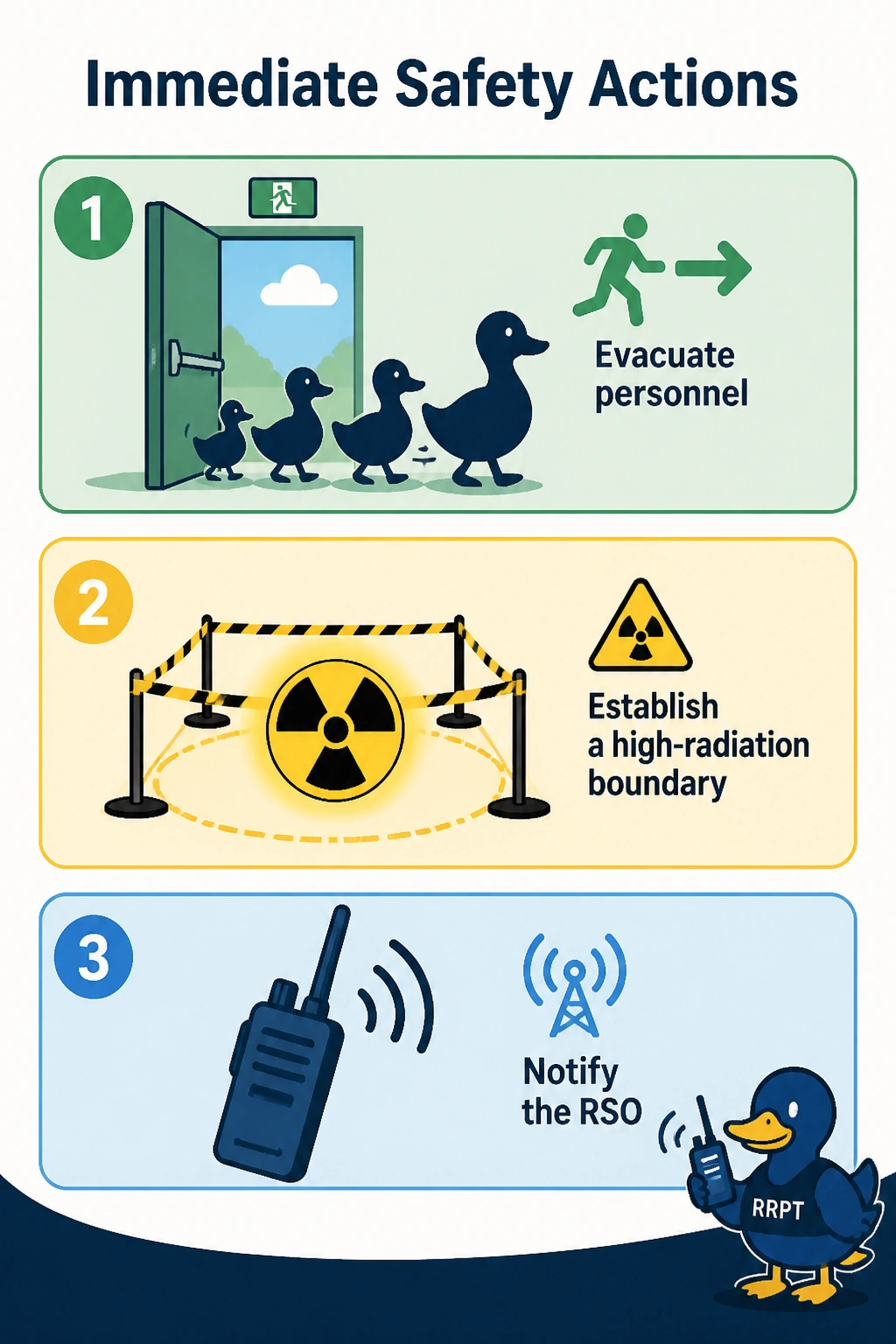
Short Explanation
You’re right to make everyone’s safety the first priority: an unshielded radiography source can deliver a severe extremity or whole-body dose in seconds, so evacuate personnel and secure the perimeter. Never approach the guide tube to inspect the cable before the area is controlled and the RSO is notified for emergency recovery support.
Full Explanation
When an Iridium-192 source fails to return to its shielded camera, dose rates near the guide tube can reach hundreds of rem per hour. Under 10 CFR 34 emergency procedures, your immediate priority is to evacuate personnel, establish a high-radiation boundary, and notify the RSO so trained recovery personnel can plan an ALARA-controlled retrieval. Approaching the guide tube to inspect the drive cable connection exposes you to an unshielded beam and can cause acute radiation injury or burns within seconds. Removing the source tube and carrying it to a shielded storage vault puts a bare, high-activity source close to your hands and torso, without specialized long-handled tools or shielding. Turning off the survey meter and checking it with a battery test wastes critical time and assumes instrument failure when an off-scale reading is the expected response to a hung source; treat a high reading as real until proven otherwise with a second meter from a safe distance. As a caveat, never leave the restricted boundary unattended while waiting for the RSO to arrive. For an operational check, verify the perimeter dose rate is below regulatory boundary limits using a second calibrated survey instrument from a safe distance.
Prefer to study offline? Printable PDF study book + test engine ($7.50, unofficial). These questions stay free here.