
A gamma source produces an unshielded exposure rate of 1,000 mR/hr at an operator's console. If one tenth-value layer (TVL) of concrete for this photon energy is 18 cm, what minimum thickness of concrete is needed to reduce the exposure rate to 10 mR/hr?
Select an answer to reveal the explanation.
Short Explanation
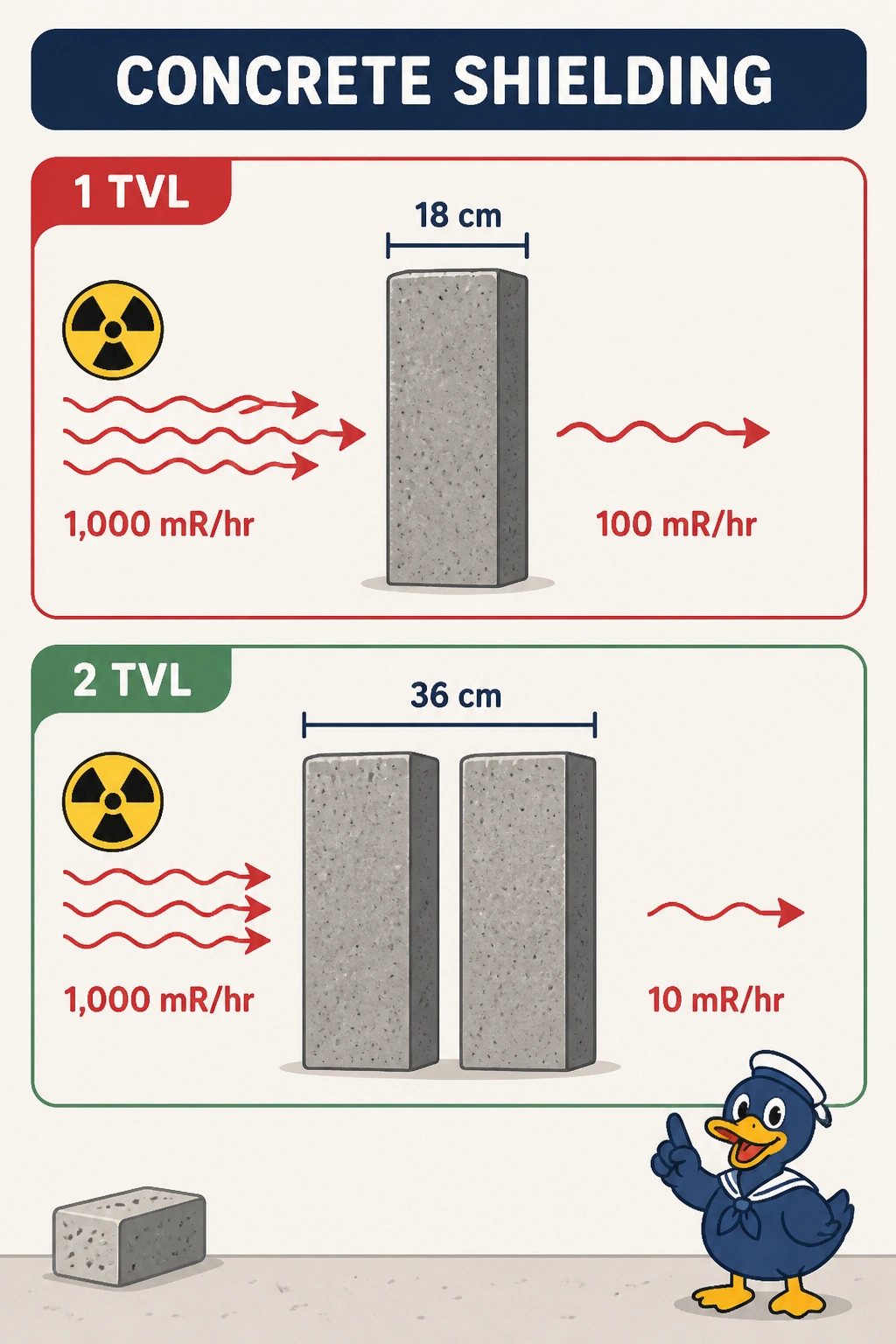
A tenth-value layer works like knocking a zero off the end of your exposure rate each time you add a slab. Going from 1,000 mR/hr down to 10 mR/hr drops two powers of ten, so you need two TVLs—36 cm of concrete. Watch out for the trap of multiplying by 100 or stopping after just one TVL, which leaves you at 100 mR/hr.
Full Explanation
36 cm of concrete is required because each tenth-value layer (TVL) reduces the photon exposure rate by a factor of 10 under narrow-beam exponential attenuation. Dropping from 1,000 mR/hr to 10 mR/hr requires a total reduction factor of 100, which equals 10 squared, or exactly 2 TVLs; multiplying 2 TVLs by 18 cm per TVL yields 36 cm. 18 cm of concrete provides only 1 TVL, reducing the exposure rate by a factor of 10 to 100 mR/hr, which is ten times higher than the 10 mR/hr target. 54 cm of concrete equals 3 TVLs, which over-shields the console down to 1.0 mR/hr rather than representing the minimum thickness needed for 10 mR/hr. 180 cm of concrete corresponds to 10 TVLs and results from mistakenly multiplying the 18 cm TVL by 10 instead of recognizing that attenuation is exponential rather than linear. As a caveat, broad-beam geometry and scattered photons in a thick wall cause buildup, so real-world shielding designs often require slightly more thickness than narrow-beam TVL calculations predict. As an operational check, survey the occupied side of the concrete barrier with a calibrated ion chamber at full source strength to confirm the actual dose rate is at or below 10 mR/hr.
Prefer to study offline? Printable PDF study book + test engine ($7.50, unofficial). These questions stay free here.