
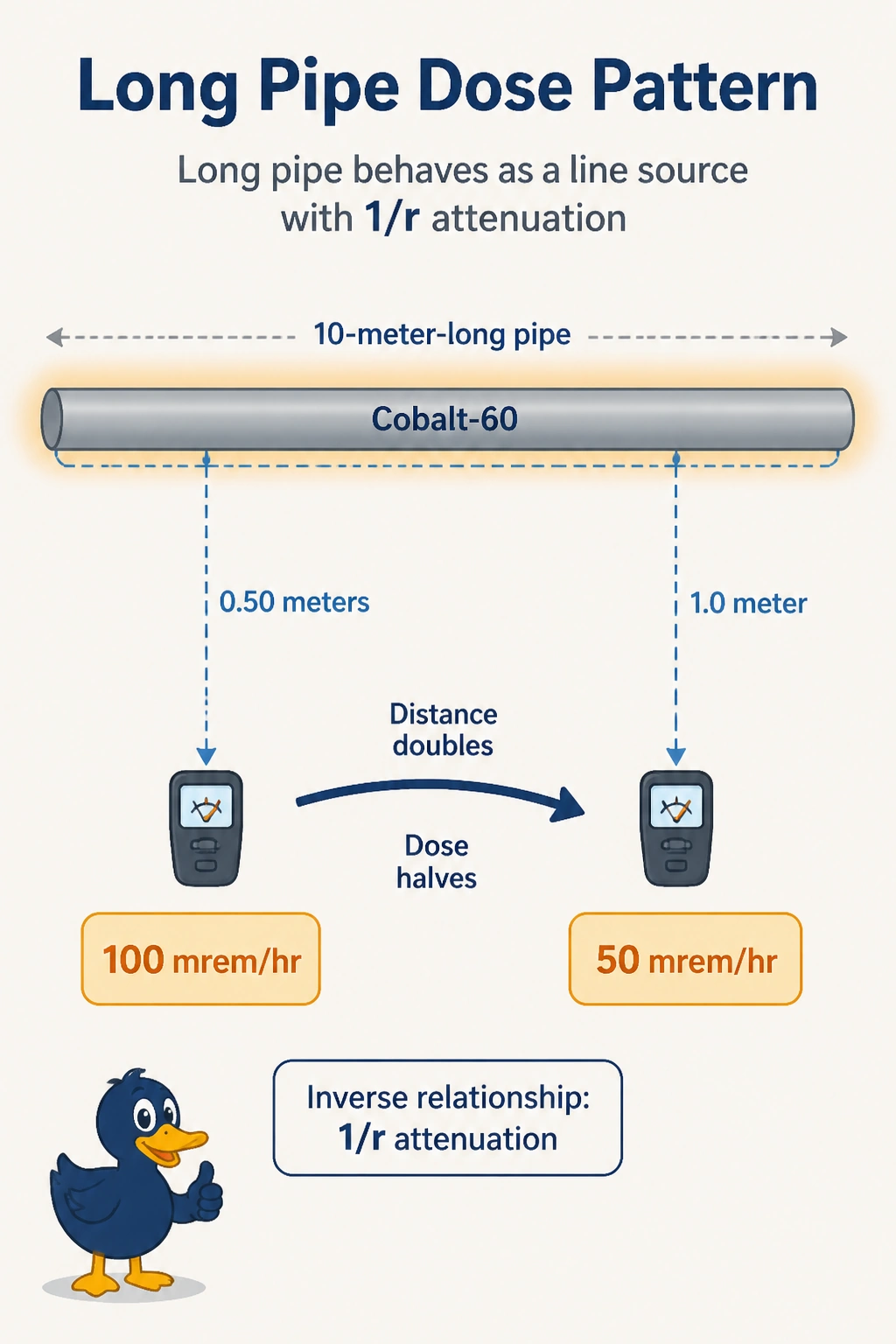
A technician measures a gamma dose rate of 100 mrem/hr at 0.50 meters from a 10-meter-long straight pipe uniformly filled with Cobalt-60-contaminated resin. Moving back to 1.0 meter, the technician measures 50 mrem/hr instead of 25 mrem/hr. What explains this result?
Select an answer to reveal the explanation.
Short Explanation
The inverse square law only works when a source looks like a tiny dot from where you stand. When you are only a meter away from a 10-meter pipe, the pipe stretches across your field of view like a glowing tube, so the dose rate drops off with simple distance rather than distance squared.
Full Explanation
Geometric attenuation depends on the source dimensions relative to the measurement distance. When a worker stands 0.50 to 1.0 meter from a 10-meter-long uniform pipe, the distance is much smaller than the source length, so The long pipe behaves as a line source with 1/r attenuation rather than a point source with 1/r squared falloff; doubling the distance from 0.50 m to 1.0 m therefore halves the dose rate from 100 mrem/hr to 50 mrem/hr. Claiming that Air attenuation doubles the photon buildup factor between 0.5 and 1.0 meters is incorrect because 0.5 meters of air produces negligible attenuation or buildup for 1.17 and 1.33 MeV Cobalt-60 gamma rays. Stating that Scattered photons from the floor double the primary beam intensity at 1 meter overstates floor scatter, which adds a modest fraction rather than doubling the direct field. Suggesting that Secular equilibrium increases the pipe activity during the second survey fails because Cobalt-60 decays to stable Nickel-60 with no radioactive progeny growing in. As a caveat, once the survey distance becomes several times greater than the 10-meter pipe length, the geometry transitions back toward point-source 1/r squared behavior. As an operational check, never extrapolate stay times at close range to long process pipes using point-source inverse square calculations without field verification.
Prefer to study offline? Printable PDF study book + test engine ($7.50, unofficial). These questions stay free here.