
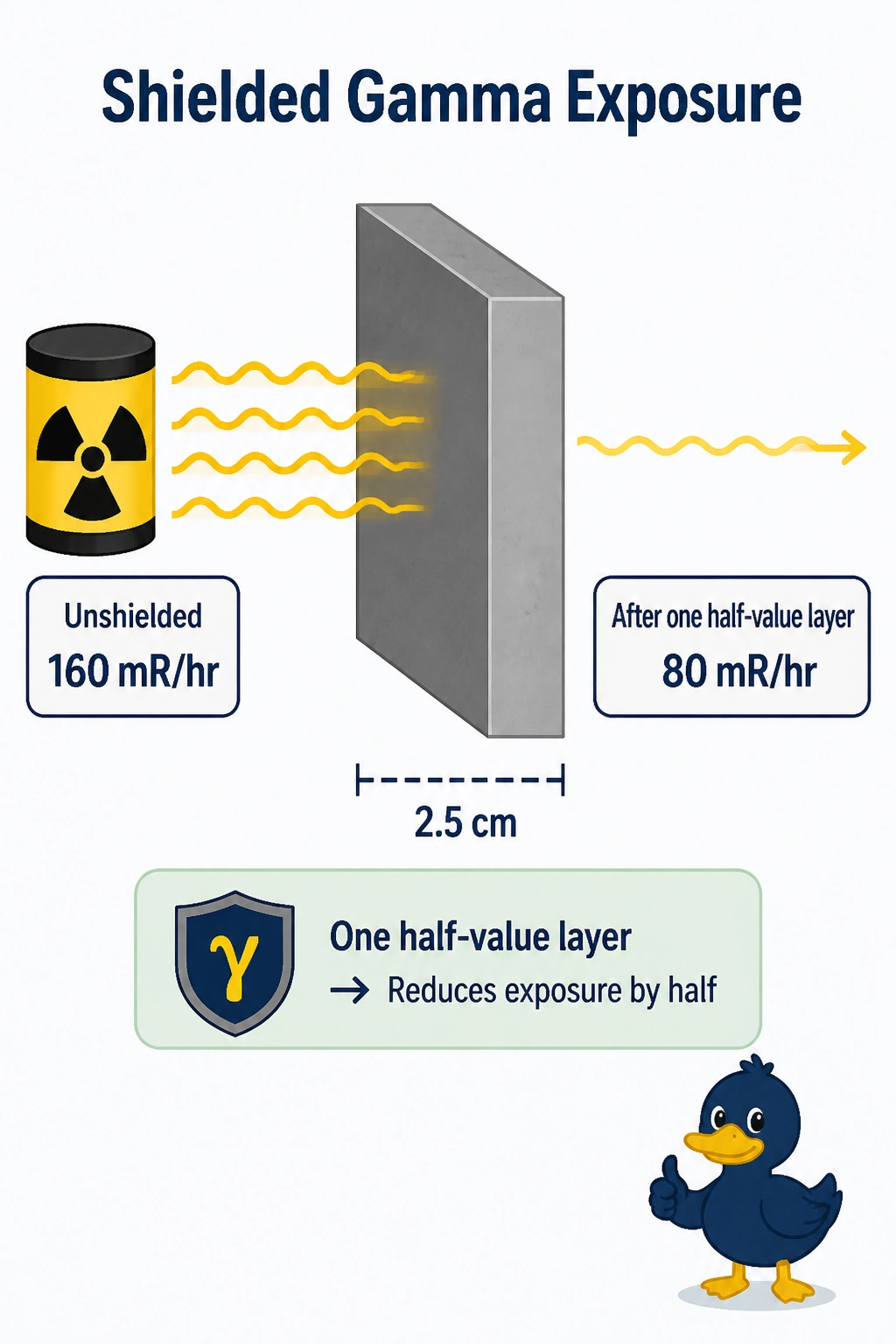
A narrow gamma beam produces an unshielded exposure rate of 160 mR/hr. A technician places a 2.5 cm thick shield made of a material with a density of 2.0 g/cm³ and a mass attenuation coefficient of 0.1386 cm²/g in the beam. Using ln(2) equals 0.693, what is the transmitted exposure rate?
Select an answer to reveal the explanation.
Short Explanation
Mass attenuation coefficients always need density to turn grams per square centimeter into real centimeters of shielding. Once you multiply 0.1386 cm²/g by 2.0 g/cm³ and 2.5 cm, the exponent equals 0.693—exactly one half-value layer, cutting 160 mR/hr in half to 80 mR/hr. The trap is forgetting to multiply by density, which leaves you with 113 mR/hr.
Full Explanation
To compute narrow-beam gamma attenuation from a mass attenuation coefficient (mu/rho), first convert it to a linear attenuation coefficient (mu) by multiplying by material density (rho): 0.1386 cm²/g times 2.0 g/cm³ equals 0.2772 cm^-1. Multiplying by the 2.5 cm plate thickness yields a dimensionless exponent of 0.693, which is ln(2) and represents one half-value layer. Applying exponential attenuation (160 mR/hr times e^-0.693) gives 80 mR/hr after one half-value layer. 113 mR/hr based on linear thickness alone is wrong because omitting the 2.0 g/cm³ density factor underestimates attenuation by using an exponent of 0.3465 instead of 0.693. 40 mR/hr after two half-value layers would require 5.0 cm of this shield (an exponent of 1.386), twice the actual thickness installed. 20 mR/hr after three half-value layers would require 7.5 cm of material, three times the available plate thickness. As an important shielding caveat, this exponential formula assumes narrow-beam geometry and neglects Compton-scattered photons; broad-beam fields require a buildup factor. In the field, always take a post-installation survey behind temporary shields to verify the actual transmitted exposure rate.
Prefer to study offline? Printable PDF study book + test engine ($7.50, unofficial). These questions stay free here.